
Olive exports to the U.S. do not pass through the same gate as olive oil, even when both come from the same
producer. Olive oil is one of the foods for which FDA asks for the fewest additional documents;
table olives, however, are fermented in brine and may be classified as acidified or low-acid
foods. This difference can add a second registration layer, FCE and
SID, on top of facility registration.
The pattern we see in the field is consistent: the producer has completed FDA facility registration,
submitted the Prior Notice, and the product is still held at the port. The reason
is usually not a single one; the process filing is missing, the label is not in English and
the product name does not follow U.S. rules. The three tend to appear together, because all three
stem from the same gap in preparation.
Below, we first explain the two thresholds that determine which FDA category your olives fall into,
then walk through the FCE and SID steps, followed by labeling and customs, in that
order. Whether registration is mandatory for fermented olives also becomes clear
following this sequence.
Why do olives follow a different path than olive oil?
For olive oil, FDA requirements are met with facility registration, a US Agent and a
Prior Notice for each shipment. Table olives may require one more registration on top of these three,
depending on the product's pH and production method: FCE
(Food Canning Establishment) facility registration and an SID
(Submission Identifier) process filing for each product. Both come from FDA's canned and
acidified food regulations.
| Step | Olive oil | Table olives |
|---|---|---|
| FDA facility registration and US Agent | Required | Required |
| Prior Notice, for each shipment | Required | Required |
| FCE registration and SID filing | Not required | Depends on the product's pH and method |
| Label | Nutrition Facts, product name | Nutrition Facts, product name, drained weight, additive declaration |
| Customs tariff | Heading 1509 | 2005.70, 0711.20 or 2001.90, depending on packaging and method |
The third row of the table is the backbone of this article. In our olive oil article we noted that FCE
and SID are not required for that product; for olives, the answer is not "no"
but "it depends on the product." This uncertainty is the main reason shipments are sent
without registration.
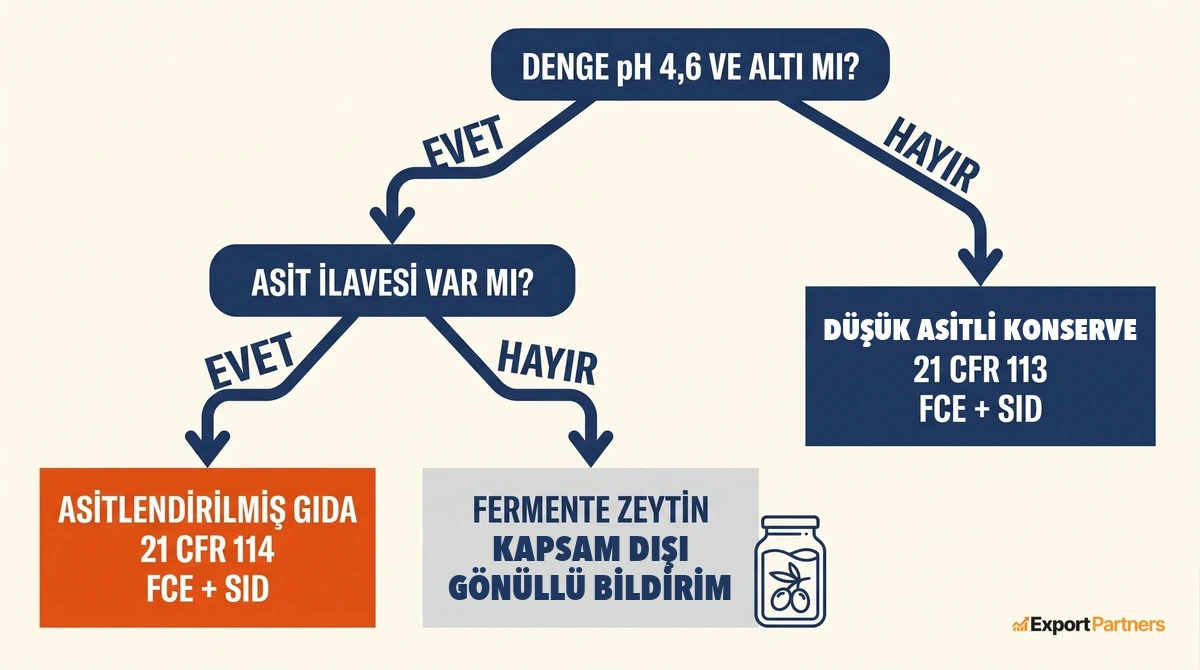
Which category is your product in: pH 4.6 and water activity 0.85
FDA's classification is based on two measurements. If the equilibrium
pH of the finished product is above 4.6 and its water activity is above 0.85, the product
is considered a low-acid canned food (21 CFR 113). If the pH is 4.6 or below
and that value is reached by adding acid, the product is an acidified food
(21 CFR 114). In both cases, FCE registration and an SID filing
are required.
There is a third case, and it is the most important one for olive producers:
according to FDA's own decision flow, a product whose pH drops to 4.6 or below
through fermentation, with no added acid, falls under neither
113 nor 114. For these products a process filing
is not mandatory but can be submitted voluntarily. Products stored and
sold under refrigeration also fall outside both scopes.
| Olive type | Typical case | FDA scope |
|---|---|---|
| Naturally fermented black olives in brine | If pH drops below 4.6 through fermentation, with no added acid | Out of scope, voluntary filing possible |
| Green olives, fermented, in acid-adjusted brine | If pH is adjusted with acid after fermentation | Acidified food, 21 CFR 114 |
| California-style black olives, oxidized | pH above 4.6, heat-treated in jars or cans | Low-acid canned food, 21 CFR 113 |
| Olive paste, stuffed olives, mixed appetizers | Contains low-acid ingredients | 114 or 113, depending on the formulation |
| Olives sold in the cold chain | Stored, distributed and sold under refrigeration | Outside both scopes |
The table is a guide; it does not make the decision. The decision rests on the product's measured equilibrium pH
value and its process records. Two olives from the same facility
can fall under different scopes; stuffed green olives and natural black olives are not filed under the same SID. We covered the
scope for meze, pickles and canned products separately
in our guide to exporting
canned food to the U.S.
How do FCE registration and SID filing work for olives?
FCE is the registration number assigned to the facility; SID is the identifier of the process filing made separately for each
product, container size and process combination produced at that facility. Registration is done with Form FDA 2541; process filings for acidified
products are submitted on Form 2541e, and for thermally processed low-acid
products on Form 2541d. FDA does not charge a fee for these filings.
The deadlines are set in the regulation: registration within 10 days
after production begins; the process filing within 60 days after registration and before the product
is shipped. For a manufacturer abroad, the practical meaning
is this: FCE and SID should be completed before the first shipment; it is not something to catch up on after the vessel
has sailed.
Where does the SID count come from
If a manufacturer's website lists 300, 370, 660 and 720 cc glass jars and
it produces two olive varieties, eight combinations appear at first glance. Because container
size affects the thermal process, each size is filed separately; minor recipe differences within the same
process and the same container can be grouped
into a single filing. Giving a number before the product range is settled would be misleading, so
the list of varieties and containers comes first.
Which facility the registration is opened under is also often confused. FCE is tied to the
facility: even if the exporting company signs the contract, the registration is opened in the name and at the address of the facility that actually
processes and fills the olives. Within a group of companies,
if production sits in a separate legal entity, the registration
runs through that entity. We explained the general logic of FCE and SID, the exemptions and the legal deadlines
in detail in our FCE
and SID number guide; this article does not repeat that
explanation, it adds the olive-specific side.
Is registration required for naturally fermented olives?
Under the regulation, no; in practice, that does not mean “it works without documents.”
While a fermented product is treated as out of scope, FDA wants to see that the product is actually
fermented: the salting or brining time, how many weeks
fermentation took, and the pH measured at each stage. FDA's process
filing form includes the instruction “if the product appears fermented, attach the fermentation flow and
the pH at each step.”
So the real question is not “is there a registration” but “is it documented whether the pH dropped below 4.6 through acid
or through fermentation.” In products where acid is added to the brine to speed up
fermentation, the line can shift: a small pre-fermentation
addition for control purposes does not, under FDA's own definition, disqualify a fermented
product, while an addition made after fermentation to lower the pH may move the product into the acidified food category. Proving this distinction after the fact without process
records is difficult.
That is why our recommendation to fermented olive producers is to make a voluntary filing
or at least keep the process file ready
in the form FDA would request. The U.S. importer may also ask for the same documents for its own foreign supplier verification program
(FSVP); if they are ready, the order moves forward,
if not, a wait begins on the buyer's side.
A refusal pattern seen in the field: three reasons together
Recently, four shipments from a black olive producer we reviewed
were refused on the same day. The refusal records listed three reasons together
for every shipment: there was no process filing for acidified or low-acid food,
the label was not in English, and the product information did not comply with U.S. labeling
rules. The company had completed its FDA facility registration; what was missing was the layer that comes from the olive's
own category.
In the same period, we saw the same picture with similar codes at a second olive producer.
The pattern is product-specific: companies shipping olive oil do not run into this
issue, because that product has no process filing layer.
A refused shipment is either re-exported or destroyed, and both
costs fall on the exporter. We explained how the post-refusal process works
in our guide for exporters whose product
is held at customs despite having an FDA
registration.
Label: English is required, drained weight is stated separately
For packaged food sold in the U.S., mandatory label information
must be in English; a translated label applied next to the original-language label
is accepted only if it carries every mandatory element. For olives, two of the refusal
reasons come directly from the label, so this step
is resolved before printing.

There are four olive-specific points. First, the product name must
reflect the processing method: ripe (oxidized) black olives and natural black olives
are not sold under the same name. Second, for brined products, stating drained weight alongside
net quantity is expected by U.S. buyers, and
duty at customs may be calculated on drained weight. Third, in oxidized
black olives, additives such as ferrous gluconate used as a color stabilizer
must appear by name in the ingredient list. Fourth, the Nutrition Facts
panel is not translated from your home-country nutrition table; it is rebuilt according to U.S.
serving size and rounding rules.
We set out all six mandatory elements and common mistakes
in our article on U.S.
labeling rules. When preparing an olive label,
working from that list and adding the four points above leaves nothing
missing.
Facility Registration, US Agent and Prior Notice Work the Same for Olives
These three steps work exactly as they do for olive oil: the facility that processes and
packs the olives must be registered with the FDA, must have a U.S. Agent
and every shipment must be reported before arrival. For a shipment by sea,
Prior Notice is filed at least 8 hours before arrival, and a notice submitted
too early is not accepted as valid.
We covered the details and common mistakes step by step
in our olive oil exports
to the U.S. article; a manufacturer shipping both oil and olives
from the same facility needs only one facility registration,
while FCE and SID are added for the olive side only. For the registration process
itself, see our
FDA
registration and certification service page.
Customs: The Tariff Heading Depends on Packaging and Method
Olives do not sit under a single heading in the U.S. tariff schedule. Prepared or
preserved olives fall under 2005.70; olives preserved with vinegar or
acetic acid fall under 2001.90; olives provisionally preserved in brine
and not suitable for immediate consumption are classified under 0711.20.
Subheadings are further split by green or black, pitted or stuffed,
and container size.
Two features of these headings need attention. In most subheadings, duty
is calculated per kilogram on drained weight, so the drained weight on the label
should match the customs declaration. Some subheadings are also
tied to quota notes, and a different rate may apply once the quota is filled.
We do not quote the rate here; it changes from period to period and additional
measures may apply depending on the country of origin, so it is better to have your customs broker
confirm it before shipment. For classification and cost questions, our
U.S.
and Canada customs service page is the better fit.
Process Summary and Common Mistakes
| Step | When | Common mistake |
|---|---|---|
| Equilibrium pH and water activity testing | When defining the product range | Calling it "fermented, no registration needed" without testing |
| FDA facility registration and US Agent | Before the first shipment | Opening the registration under the exporting company instead of the processing facility |
| FCE registration | Within 10 days after starting production | Applying the olive oil template to olives |
| SID filing | Within 60 days after registration and before shipment | Combining container sizes in a single filing |
| Label design | Before printing | A partial translation sticker placed over the original-language label |
| Prior Notice | Every shipment | Submitting the notice too early or too late |
| Tariff and drained weight confirmation | Before shipment | Label and customs declaration showing different weights |
Frequently asked questions
What Is an SID for Olives, and How Many Are Needed?
An SID is the identification number of a process filing submitted to the FDA. A separate filing is made for each product, container
size and process combination, so
a facility producing two olive varieties in three container sizes may need up to six filings.
The exact number becomes clear once the product and container list is finalized.
Is FCE Registration Required for Fermented Olives?
A product whose pH drops to 4.6 or below through fermentation, without added acid,
falls outside both regulations in the FDA's decision flow, and registration
is not required. However, fermentation records and pH measurements should be available
when requested; a voluntary filing is also possible. If pH is adjusted with acid
after fermentation, the product may be considered an acidified food
and registration is required.
What Does the High-Acid vs. Low-Acid Food Distinction Mean for Olives?
The threshold is the equilibrium pH of the finished product: above 4.6 is low-acid,
4.6 and below is considered acid. Low-acid olives (such as ripe black olives)
are sterilized by heat treatment and filed under 21 CFR 113;
products brought below 4.6 by adding acid are filed under 21 CFR 114 with a pasteurization
process. Two products from the same facility may fall
on different sides.
Is the FCE Registration Opened Under the Exporting Company or the Manufacturing Facility?
Under the facility. FCE is a registration tied to the address of the facility that actually processes and packs the olives;
even if another company within the group signs the contract,
the registration is opened under the legal entity of the manufacturing facility. The FDA facility
registration and U.S. Agent details should also be consistent with the same facility.
Are FCE and SID Certificates?
No. The FDA does not issue certificates; once registration is complete, the facility is assigned an FCE
number and each process filing is assigned an SID number. When a buyer or
customs asks for a "document," what you show is these numbers and the registration printout from the FDA
system. The phrase "FDA approved olives" is not used
on labels or in marketing.
Conclusion
Exporting olives to the U.S. adds, on top of the three olive oil steps, a test that determines the product's
category and, where needed, an FCE and SID layer.
Registration may not be required for naturally fermented olives, but
fermentation and pH records are kept ready in every case; for acidified
or low-acid olives, the filing is completed before the first
shipment. The label is prepared in English with drained weight, and the tariff
heading is confirmed based on packaging.
If you want to clarify which category your product falls into, set up FCE and SID
filings or have your label reviewed before printing,
we can look at your situation through our
FDA
registration and certification service.
We made the same comparison for honey: since honey does not fall under low-acid canned or acidified foods, the FCE and SID step does not apply there at all. Details are in our honey exports to the U.S. article.

