
The most common sticking point when a product enters the U.S. is not production but the text on the
packaging. The facility may be registered, a US Agent appointed and Prior Notice
submitted; a single missing field on the label can still stand in the way of
all of it. U.S. labeling rules are a separate regulatory area and
do not map one-to-one onto the labeling rules in your home country.
This article explains which fields are mandatory on food, supplement and cosmetic
labels, why the language rule is not negotiable, and why the review is done before
printing. Figures and section numbers are taken from the FDA's own
regulations, and every source is cited in the text.
What U.S. labeling rules cover
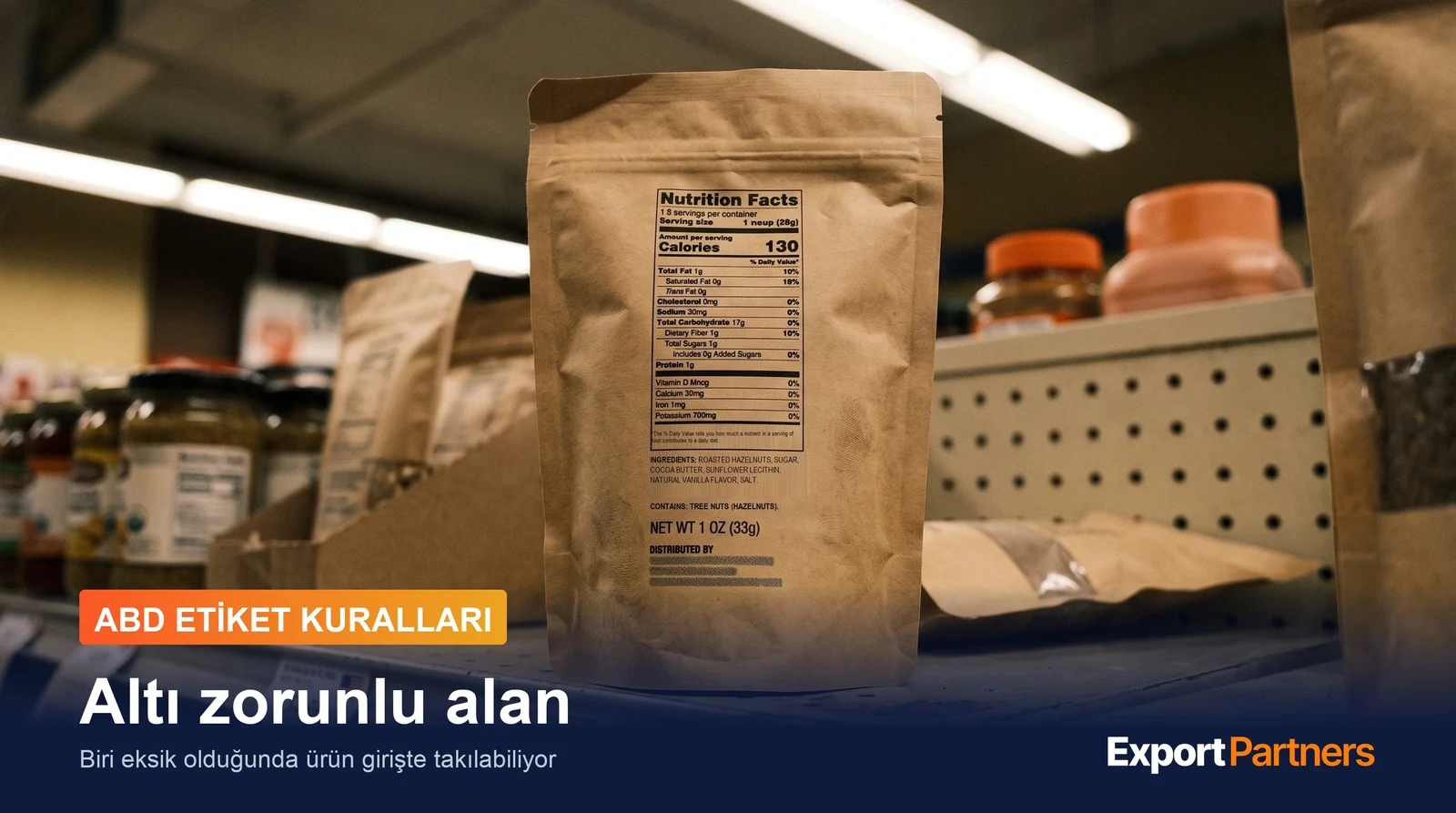
FDA food labeling rules are collected under 21 CFR Part 101. The rule
does not look at where a product comes from: the label of packaged food entering the U.S. market,
whether printed in Ohio or overseas, is subject to the same sections.
The most common misunderstanding here: facility registration and label compliance
are two separate things. Registration makes the manufacturer visible in the FDA system;
it does not say the label is correct. A product from a fully registered company can
still be refused because of its label. The details of this distinction are in
our article on the three
different FDA registration situations.
Six mandatory fields
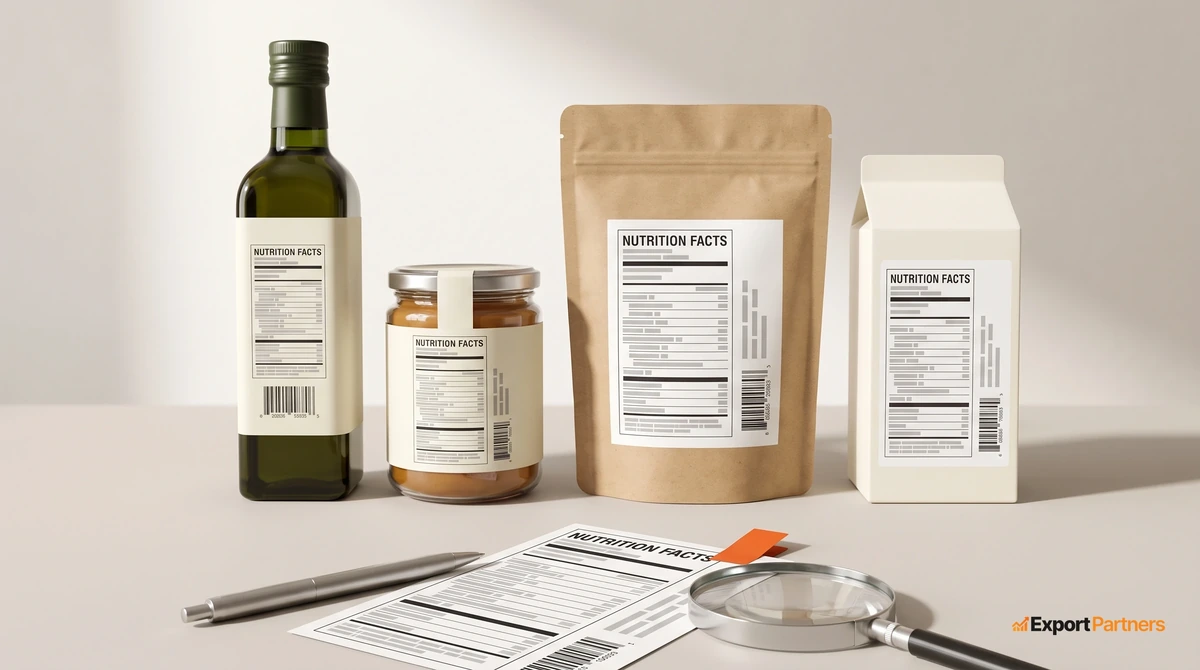
A packaged food label is checked for these six fields. The order reflects how the label is laid out,
not their importance.
| Field | What it means | Regulation |
|---|---|---|
| Product name (statement of identity) | What the product is, on the front panel | 21 CFR 101.3 |
| Net quantity | On the front panel, in U.S. and metric units together | 21 CFR 101.7 |
| Ingredient list | In descending order by weight | 21 CFR 101.4 |
| Allergen declaration | The nine major allergens | FALCPA, FASTER Act |
| Nutrition Facts | The U.S. nutrition facts panel | 21 CFR 101.9 |
| Company name and address | Manufacturer, packer or distributor | 21 CFR 101.5 |
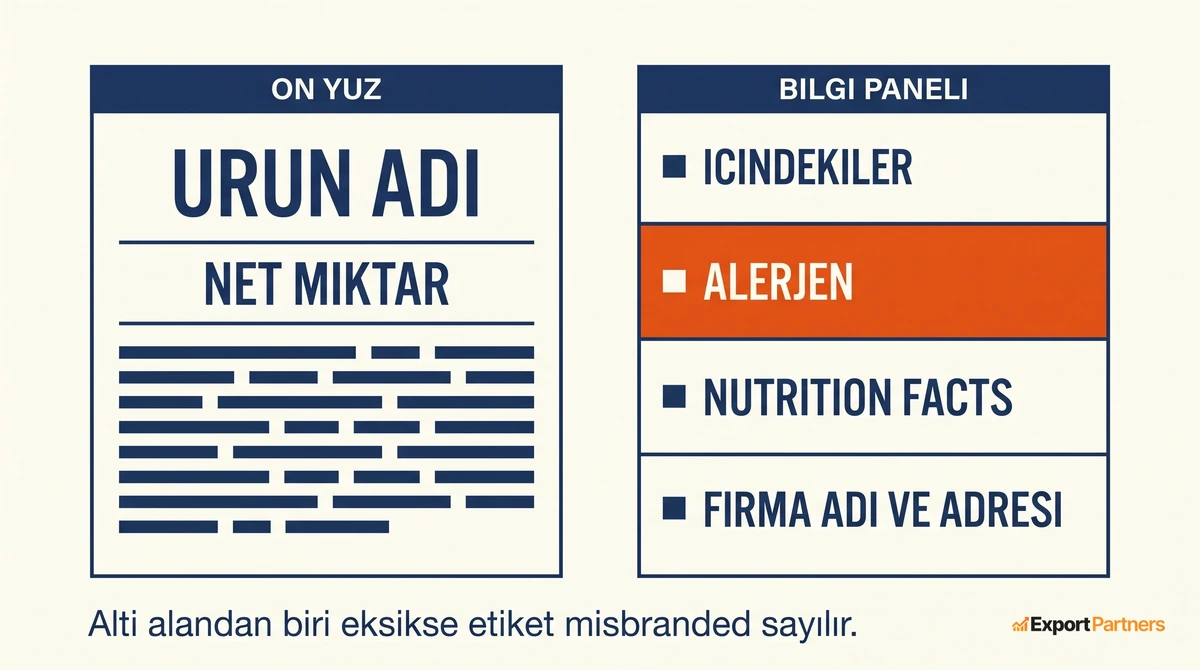
If one of the six is missing, the product is considered “misbranded” in regulatory terms. This
is a technical definition, not a quality judgment: it means the label does not
carry the information the law requires.
Principal display panel vs. information panel
The product name and net quantity go on the principal display panel, the side visible on the shelf.
Ingredients, allergens, Nutrition Facts and company details go on the information panel,
usually immediately to the right of the front panel (21 CFR 101.2). Spreading these fields across the back or bottom
surface can create noncompliance even if each one is written correctly.
The language rule is not negotiable
All statements required by law must appear in English on the label
(21 CFR 101.15(c)). Most manufacturers know this much. The lesser-known
part: if the label also uses a language other than English, the required
statements must appear in that language as well.
So if the front of the package carries a slogan or product description in another language,
the label is treated as bilingual and the required fields are expected in that language too.
This is the situation we see most often with manufacturers who apply an English sticker to existing
packaging instead of printing separate export packaging.
Ingredient names in the ingredient list
Ingredients are listed in descending order by weight, and each ingredient appears under its
common name in the U.S. (21 CFR 101.4). A literal translation of an ingredient name used in your home market
may not be the established name of that ingredient in the U.S. For compound
ingredients, listing sub-ingredients in parentheses is covered by the same section;
a single catch-all “spice blend” line is often not
enough.
Type size is a rule too
Mandatory information must be printed in letters at least 1/16 inch high
(21 CFR 101.2(c)). On small packages, designers tend to shrink these lines
to make them fit; when the size falls short, the information is not considered present on the label.
Sesame became the ninth major allergen
The U.S. had eight major allergens: milk, eggs, fish, crustacean
shellfish, tree nuts, peanuts, wheat and soybeans. With the FASTER Act,
sesame became the ninth, and since January 1, 2023 it must be declared
on packaged foods and dietary supplements.
Sesame is very common in food exports through tahini, sesame breads, seed blends and bakery
products. If a label template prepared before 2023 is still in use, this line
is quite likely missing. The declaration can be made in two ways:
listing sesame by name in the ingredient list, or stating it separately
below the list with a “Contains” statement.
Supplements and cosmetics follow different rules
Dietary supplements use a Supplement Facts
panel instead of Nutrition Facts (21 CFR 101.36), and the ingredient lines follow
a different layout. A supplement label built on a food template may be noncompliant
even when the information is correct, because it carries the wrong panel. We covered
the details for collagen and protein powder
separately in our collagen
and protein powder article.
For cosmetics, the framework changed with MoCRA. On the label side, the most visible requirement
is U.S. contact information for reporting adverse events
on the label. Building a cosmetic label with food logic can cause
problems at this point, where the two sets of regulations run separately.
Country of origin marking is a customs matter, not an FDA one
The two topics most often confused in a label file are the information FDA requires
and the country of origin marking customs requires. They come from different regulations
and are checked separately.
Country of origin marking falls under CBP: under 19 U.S.C. 1304 and 19 CFR Part 134,
an imported product or its container must show the English name of the
country of origin in a place where the ultimate purchaser in the U.S. can see it.
The marking must be legible, indelible and permanent; a sticker applied to the package afterward
that peels off easily may not meet this requirement.
In practice, this means a statement in your own language alone is not
enough; an English equivalent such as “Made in [country]” or “Product of [country]” is
expected. Even if every FDA field is complete, a shipment may be held
by customs if the origin marking is missing. We covered the customs side in full
in our U.S.
food export cost article.
What happens if the label is wrong
A label nonconformity is usually identified after the product reaches the border.
The shipment is held at entry, the company is notified of the deficiency and given
time to correct it. Correction is often possible, but relabeling costs at a U.S.
warehouse and the time the shipment sits waiting come into play.
FDA has a separate import alert for label-related refusals
(Import Alert 99-39). We explained step by step how the process works, which documents
are requested and how the correction is made in our
product
held at customs article.
The five errors we see most often
Recurring patterns show up in the files we review. Without naming companies,
in order:
- Translating the home-market label. The fields your domestic regulations require
and the fields the U.S. requires are not the same set. Translation does not
fill in a missing field. - Copying nutrition values directly. Serving size definitions
and reference values differ in the U.S.; writing the figures from a domestic table into the Nutrition
Facts template does not make the panel correct. - A missing sesame line. This usually comes from pre-2023
templates. - Leaving the address field blank. When it is not stated whether the manufacturer, packer
or distributor is listed, the field is considered incomplete. - Reviewing after printing. This is the most expensive error.
Review comes before printing
When label review is done before the packaging goes to the printer, it is a design
revision; done after printing, it becomes a matter of inventory, stickers and relabeling.
A supplement manufacturer we worked with had reviewed its label on its own
and was confident about the text, not the packaging.
This is the usual pattern: the text is right, the layout and panel are wrong.
As the number of products grows, review runs by product group, because the same
error repeats across products made from the same template. A layout error fixed on one
product applies to every SKU that shares that template.
Label review usually runs in the same package as facility registration and US Agent
appointment, because all three are steps that should be completed before the
first shipment. For the full process, see our
FDA registration
and certification service page.
Frequently asked questions
Which products do U.S. labeling rules cover?
Packaged food, dietary supplements, cosmetics and pet food are subject to separate regulations.
Food falls under 21 CFR Part 101, supplements under the Supplement Facts provisions in the same part,
and cosmetics under the MoCRA framework. Labeling obligations differ for bulk products and
intermediate goods; in that case, it depends on how the product will be sold.
Can the label keep its original language?
It can, but the label is then treated as bilingual, and every mandatory statement
must also appear in the second language. Preparing a single-language U.S. label
is usually the lower-risk option.
Where should the sesame declaration go?
There are two options: list sesame by name in the ingredient list, or state it
separately with a “Contains” statement directly below the list. Either one
is sufficient; both are not required.
When should the label review take place?
After the packaging design is finished and before the print order. A correction
made in this window stays in the design file. A correction made after printing
affects existing stock, so it can be costly.
Can we translate the Nutrition Facts panel from our existing nutrition table?
Translation alone is usually not enough. Serving size definitions, reference values and rounding
rules are defined separately in the U.S.; the panel is recalculated
according to these rules.
Will a product detained over its label be sent back?
In most cases the product does not need to be returned; a period is given for correction
and relabeling can be done in the U.S. The time and cost
depend on the product and warehouse conditions, so we recommend confirming with your customs broker
as well.
Conclusion
U.S. labeling rules are a separate topic from facility registration and can
stop a shipment on their own. When the six mandatory elements, the language requirement and the sesame
declaration are checked, most files move forward without issues. The critical
point is timing: a review done before printing is a design correction,
one done after printing becomes a logistics task.
If you would like your label checked before shipping to the U.S., you can contact
our FDA registration
and certification team.

