
For manufacturers who export tomato and pepper paste to the U.S. or are preparing to, the process starts with registrations before it starts with the product itself. For products sold in sealed containers, such as pepper paste, sun-dried tomatoes, pickles, canned beans, pomegranate molasses and fruit beverage bases, the FDA expects the facility and the production process to be registered before shipment; when this step is skipped, the product may be held at customs.
In this article we outline why this group of products sold in sealed containers can be held at U.S. customs, which registrations need to be completed in which order, and what to watch for on the label. The aim is to give you a checklist; the technical details vary with each product's recipe and production method.
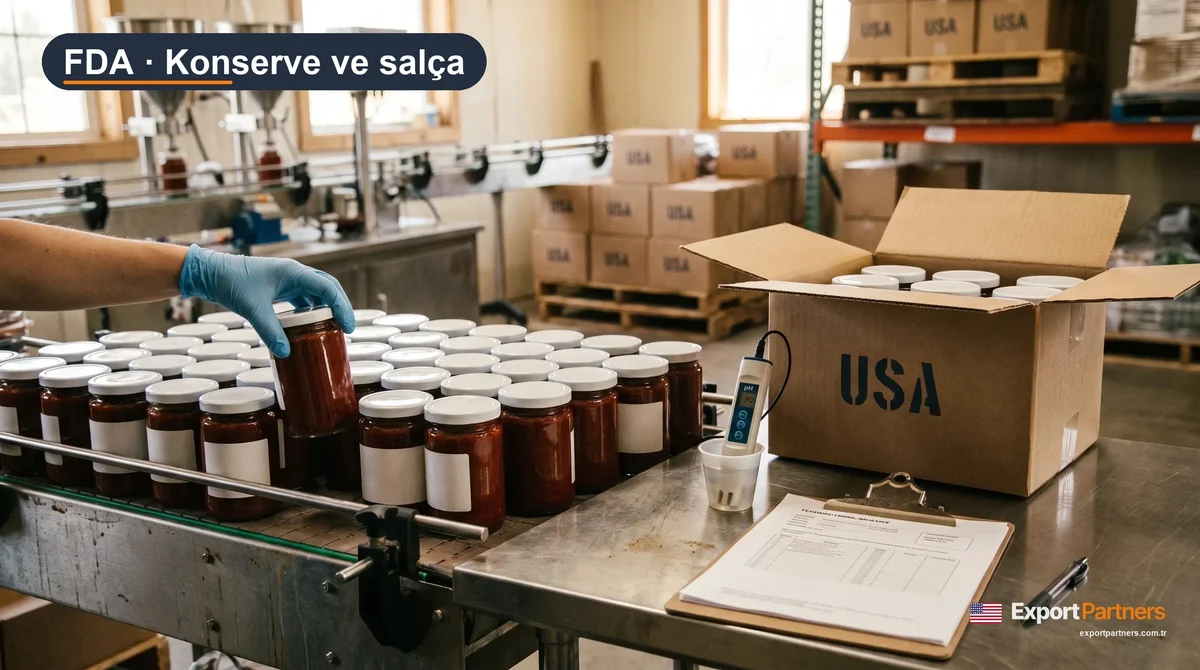
Why does the FDA refuse paste and canned products?
The two most common grounds for refusal in this group are that the scheduled process has not been filed with the FDA and that the manufacturing facility is not registered as a food canning establishment. For foods packed in sealed containers that either have a pH above 4.6 or are preserved by acidification, the FDA wants to see, before shipment, the process information showing that the product is microbiologically safe. If that information is missing, the product can be refused without any laboratory result being considered.
In practice this means the following: if the refusal record does not say "residue" or "hygiene", the problem is usually on the documentation side rather than in production, and it can often be resolved without touching the production line.
Which products fall within this scope?
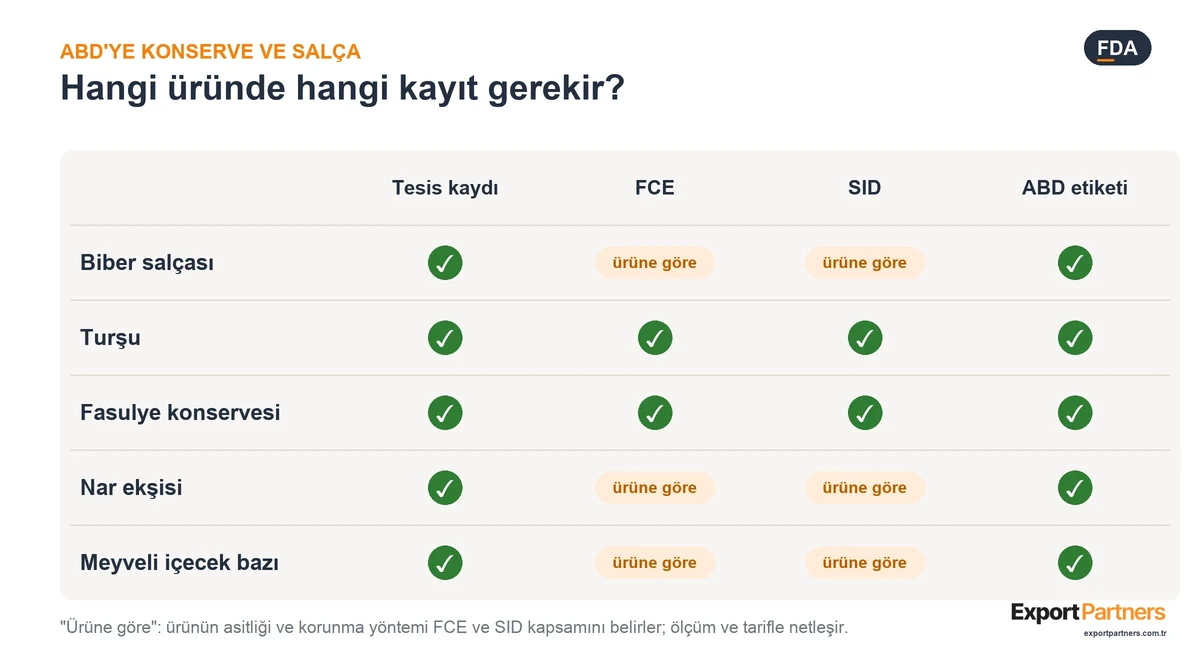
What determines the scope is not the name of the product but its acidity and how it is preserved. Within the same product group, one manufacturer may fall outside the scope while another manufacturer using a different recipe falls within it.
| Product | Typical category | What the FDA requires |
|---|---|---|
| Pepper paste, hot pepper paste | Depending on acidity and recipe, may be an acidified or a low-acid food | Food canning establishment registration (FCE) and a process filing per product (SID) |
| Pickles, acidified vegetables | Acidified food | FCE and a SID for each product and container size |
| Canned beans, chickpeas and vegetables | Low-acid canned food | FCE, SID and thermal process information |
| Pomegranate molasses, fruit purees | Depends on acidity and production method | FCE and SID if in scope; otherwise facility registration only |
| Fruit beverage bases | Depends on acidity, filling and packaging method | FCE and SID if in scope; a HACCP plan if the product contains fruit juice |
The table is meant as a guide. Which category a product definitely falls into is determined by its pH value, water activity and processing method. We explain the scope and filing steps in detail in our guide to exporting canned food to the U.S..
Tomato paste and pepper paste
Because of its natural acidity, tomato paste can often fall outside this scope, but for products such as pepper paste and hot pepper paste the answer depends on the recipe. Products preserved with an added acidulant, or whose pH stays above the limit, may require a process filing. Sun-dried tomatoes, in turn, may be assessed differently depending on the drying method and on whether they are sold in oil or in a jar. For paste products, the first step is to clarify the product's pH measurement and its recipe.
Pickles and acidified vegetables
Pickles preserved by adding vinegar or acid fall under the FDA's definition of acidified foods. For these products, the facility is expected to obtain an FCE number and to file a separate process filing for each product and each container size. The 500 gram and 1 kilogram jars of the same pickle may be treated as two separate filings; for manufacturers with a wide product range, the number of filings can therefore grow quickly.
Canned beans and vegetables
Canned beans, chickpeas and similar canned vegetables are considered low-acid foods, and in this group the information showing that the thermal process is adequate matters even more. The process filing must be based on data prepared by a qualified process authority who defines the process. For these products, missing documentation is one of the most common reasons a first shipment is held at customs.
Pomegranate molasses and fruit-based products
Although pomegranate molasses and fruit purees are generally acidic products, the FDA's assessment can vary depending on the concentration and filling method. If the product is in scope, FCE and SID are required; if it is out of scope, a standard food facility registration and a correct label may be sufficient. For this product, the decision should rest on an assessment supported by laboratory measurement.
Fruit beverage bases
For beverage bases containing fruit flavor or fruit juice, two separate rules can come into play: a process filing if the product is in a sealed container and its acidity is above the threshold, and a juice-specific HACCP plan if it contains fruit juice. The same product should be checked separately on both the label side and the process side.
How does the process work at customs?
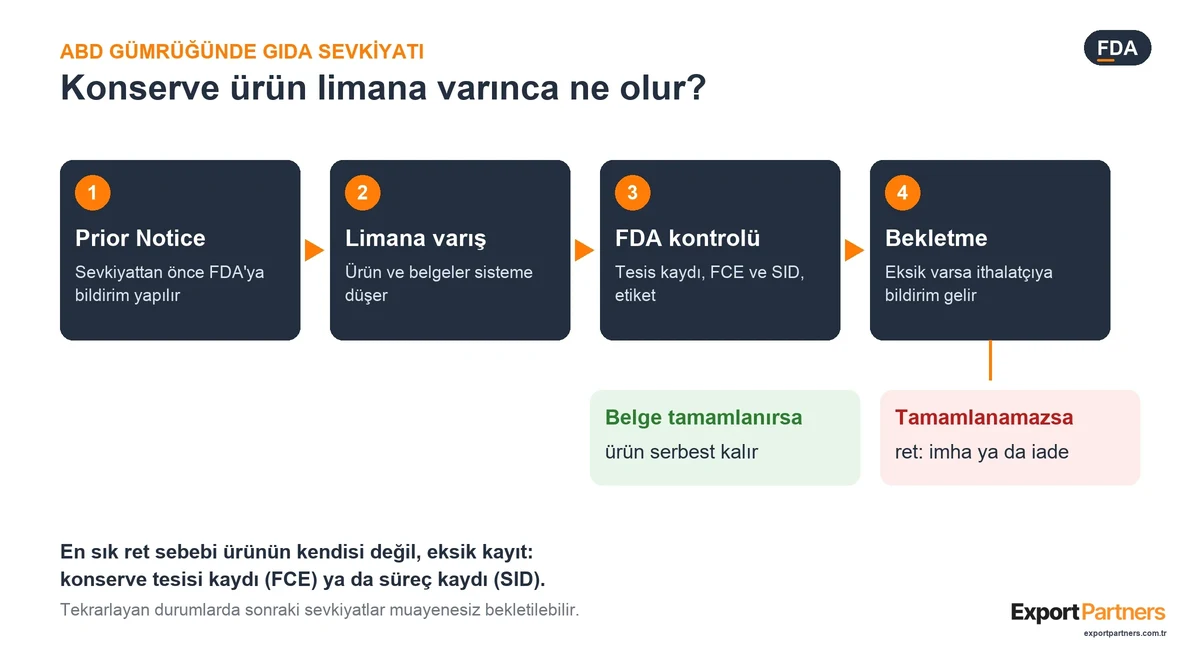
A Prior Notice is filed for every food shipment going to the U.S. When the product arrives at the port, the FDA checks the facility registration, the process filing and the label through its system. If it sees a missing item, it holds the product and notifies the importer. If the missing document is completed at this stage, the product can be released; if it cannot be completed, a refusal decision is issued and the product is either destroyed or returned. In repeated cases, subsequent shipments from the same manufacturer can be held without a physical examination. We explained the post-refusal process in our import refusal guide.
What should you watch for on the label?
In this product group, the second issue seen as often as missing documents is the label. The English product name, net quantity, ingredient list, allergen statement, nutrition facts panel and manufacturer or distributor information must be in the U.S. format. Placing an incomplete English sticker over the original-language label is often not enough. We compiled the label rules in our article on U.S. label rules.
Pre-shipment checklist
- Is the production facility's FDA food facility registration active, and has a US Agent been assigned?
- Does the product fall under acidified or low-acid food? Has it been measured?
- If in scope, has an FCE number been obtained, and has a SID been submitted for each product and container size?
- Is the label in U.S. format and in English?
- Are the importer, customs registration and customs bond ready, and will the Prior Notice be filed on time?
Frequently asked questions
Is exporting tomato paste banned?
No. Some countries require tomato paste and canned tomato exports to be registered with a domestic authority, but this is a registration procedure rather than a ban or restriction. Since such procedures change over time, it is worth confirming the current practice with the export authority or exporters' association in your country before shipping. The FDA rules on the U.S. side are independent of this.
What is a SID?
A SID is the process filing that shows how a canned or acidified food product is processed. It is submitted separately for each product and each container size and includes pH, thermal process and filling information. The filing is linked to the FCE number in the FDA's system.
Is an FCE registration the same as an FDA facility registration?
No. FDA facility registration is mandatory for every facility that ships food to the U.S. FCE is an additional registration obtained by facilities that produce canned, acidified or low-acid foods. For these products, both are required.
How many products need a SID?
A separate SID is required for each product variety and each container size. Two different jar sizes of the same product may count as two separate filings. That is why clarifying the list of products and packaging that will go to the U.S. in the first shipment lets you plan the number of filings and the timeline correctly from the start.
What is the most common mistake when exporting tomato paste to the U.S.?
Assuming that FDA facility registration is enough. Even if the facility is registered, a shipment can be held at customs without FCE and SID if the product falls under acidified or low-acid food. The second common mistake is a label that does not comply with the U.S. format.
Conclusion
For tomato paste, pickles, canned beans, pomegranate molasses and fruit beverage bases, most FDA refusals stem not from product quality but from missing filings. Measuring whether the product is in scope, completing the FCE and SID before shipment if it is, and bringing the label into U.S. format removes most of this risk. At Export Partners, we handle FDA facility registration, FCE and SID filing, label review and customs preparation in a single plan; to assess the scope for your product together, you can reach us through our FDA registration and certification page.

