
This article brings together, in one place, the rules that took effect over the last three months and the rules that take effect in the coming weeks. Each one directly affects a company selling to the U.S. or Germany, and each was verified against the agency's own publication. Drafts still in the comment stage are listed under a separate heading, since they do not create any work to be done today.
The order is by date. Under each item there are two lines: who it affects and what needs to be done.

Quick timeline first
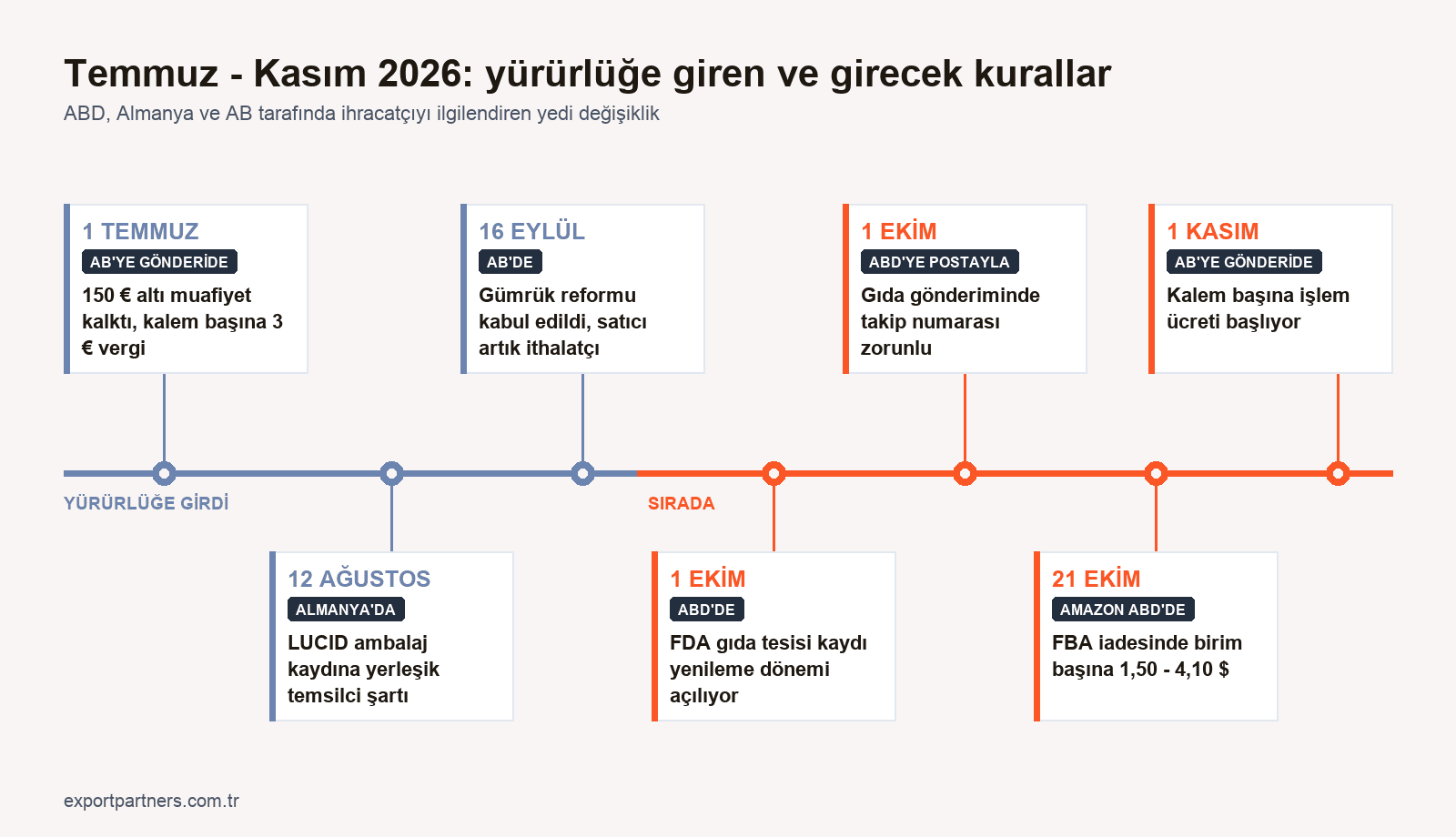
| Date | Status | What changed | Who it affects |
|---|---|---|---|
| July 1, 2026 | In effect | EU customs exemption for shipments under EUR 150 ended; a flat duty of EUR 3 per item began | Sellers shipping directly to the EU |
| July 3, 2026 | In effect | ||
| August 12, 2026 | In effect | Sellers not established in Germany need an authorized representative for LUCID packaging registration | Anyone shipping packaged products to Germany |
| September 16, 2026 | Adopted | EU Customs Code reform adopted; sellers and platforms are treated as importers | Anyone making distance sales into the EU |
| October 1, 2026 | Coming up | Carrier tracking number required in FDA prior notice for mail shipments | Anyone sending samples and small lots to the U.S. by mail |
| October 1, 2026 | Coming up | FDA food facility registration renewal period opens and closes December 31 | Every facility shipping food to the U.S. |
| October 1, 2026 | Coming up | EORI applications in Germany move to the Zoll-Portal | Sellers obtaining a new EORI |
| October 21, 2026 | Coming up | Amazon FBA returns programs change name and scope | Everyone selling through FBA |
| November 1, 2026 | Coming up | Collection of a per-item handling fee begins in the EU | Sellers shipping to consumers from outside the EU |
The U.S. side
FDA registration renewal period opens October 1
FDA food facility registrations are renewed in even-numbered years, and 2026 is one of them. The window is October 1 to December 31, 2026. A registration not renewed within that window is considered expired on December 31, and food from that facility may be held at the port of entry until the registration is completed.
There is no FDA fee for renewal. Two points can make the process harder, and both depend on a response from outside: your U.S. Agent replying to the FDA's verification e-mail, and the address linked to your D-U-N-S number matching the facility address on the registration. Both are often noticed only in the last week of the window, when the U.S. side is on holiday.
One more figure applies in the same period: the FDA's reinspection fees for FY2027 are $354 per hour for domestic work and $414 per hour when foreign travel is required (Federal Register, July 30, 2026). This is not a routine cost; it only arises when following up on a previously identified noncompliance.
What to do: have your registration number and PIN (if you have one) ready, confirm which e-mail address your U.S. Agent uses, and compare your D-U-N-S address with the address on the registration. Details are in our article on FDA registration renewal.
Prior notice for food sent by mail changes October 1
The FDA's prior notice rule has been updated: starting October 1, 2026, prior notice for food products sent to the U.S. by international mail must also include the name of the carrier service and the tracking number. If this information is missing, the shipment may be held by the FDA.

The rule is not new. It was published a year ago, and what has changed is that its effective date has arrived. Its scope is also narrow: it covers only shipments sent by international mail, such as samples, small lots and e-commerce parcels. Commercial cargo shipped by container or air freight falls outside this provision, and prior notice for those shipments continues as it does today.
What to do: companies sending samples to the U.S. should obtain the tracking number before handing over the shipment; prior notice should not be filed until the number is in hand.
Amazon FBA returns programs change on October 21
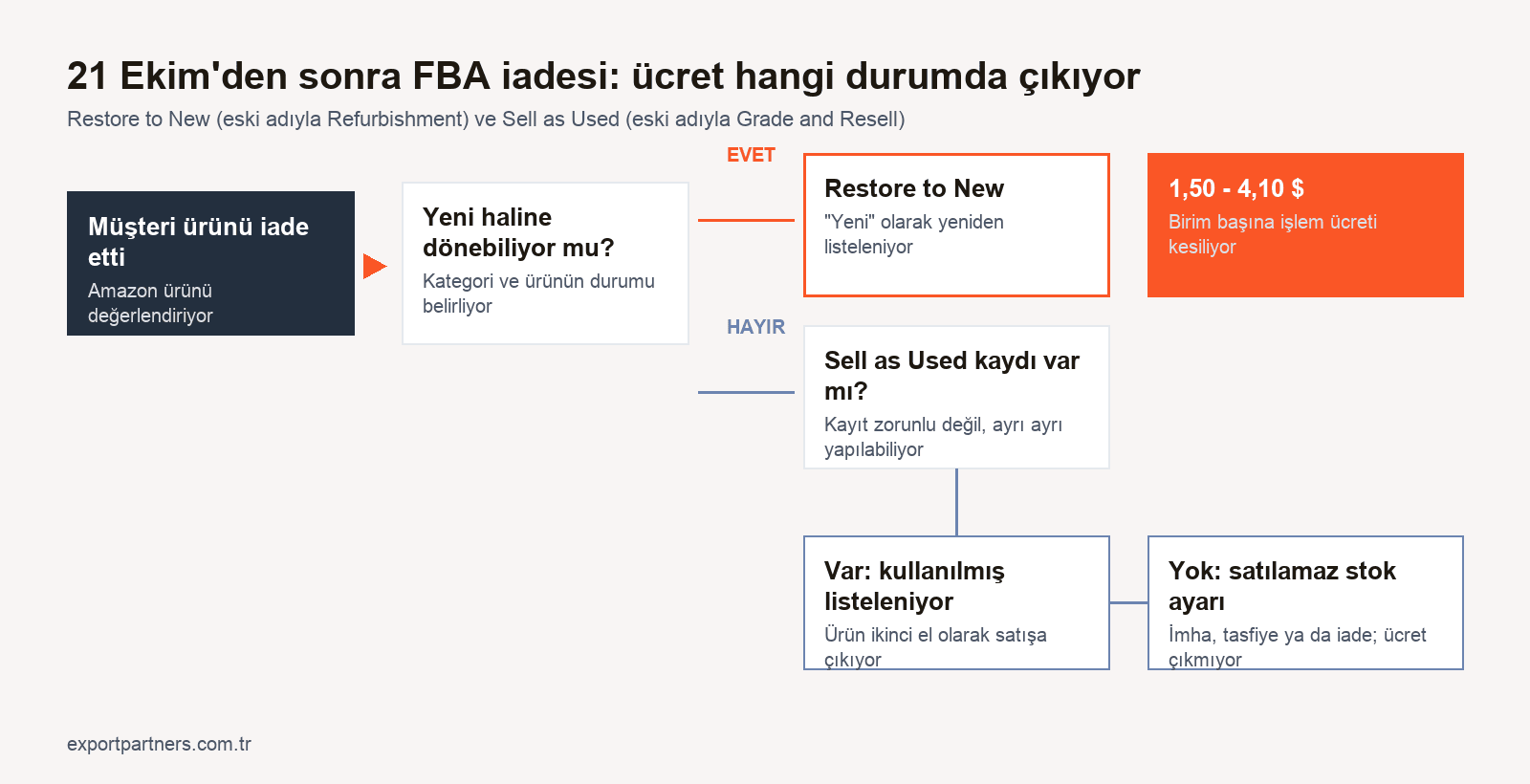
Amazon sent a notice to sellers this week. Starting October 21, 2026, two programs change their names and scope: Refurbishment becomes Restore to New, and Grade and Resell becomes Sell as Used. Restore to New is opening to more product categories.
Here is how it works: for an enrolled seller, Amazon evaluates the returned item. If it can be restored to new condition, it is relisted as "new" and a processing fee of $1.50 to $4.10 per unit applies. An item that cannot be restored to new is listed as "used" if the seller is enrolled in Sell as Used; if not, the item is handled according to the account's unfulfillable inventory settings, and in that case no fee applies.
Enrollment is optional, and sellers can join either program separately or both together. On the cash side, this means that in a category with a high return rate, the fee should be weighed against the recovered sales value; if the return rate is low, the impact stays small. We explain step by step where money sits in FBA in our FBA cash flow article.
What to do: check your value recovery settings under Seller Central > Amazon fulfillment inventory settings, measure your return rate by category once, and decide on enrollment after that.
Cosmetics and requests for an FDA certificate: the FDA does not issue one
On September 9, the FDA issued a public notice to cosmetics manufacturers and sales platforms: for facility registration and product listing under MoCRA, the FDA does not issue any certificate, confirmation letter or "registration not required" letter, and a registration number does not mean approval. The notice followed some sales platforms asking sellers for an "FDA registration certificate" and a rise in requests reaching the FDA.
What to do: if a platform asks you for a certificate, the only things you can provide are the registration number and a confirmation from the party that completed the registration. The full cosmetics picture is in our MoCRA and FDA compliance guide.
Two active ingredients removed from the sunscreen monograph
The FDA published a final administrative order amending the over-the-counter sunscreen monograph: aminobenzoic acid (PABA) and trolamine salicylate are no longer considered "generally recognized as safe and effective" as sunscreen active ingredients. If a manufacturer shipping SPF products to the U.S. uses either of these ingredients, the product may be considered noncompliant in the U.S.
What to do: if you ship SPF products, review your formula list once. Many sunscreen products on the market already do not use these two ingredients.
Germany and the EU
Authorized representative requirement in LUCID, in effect since August 12
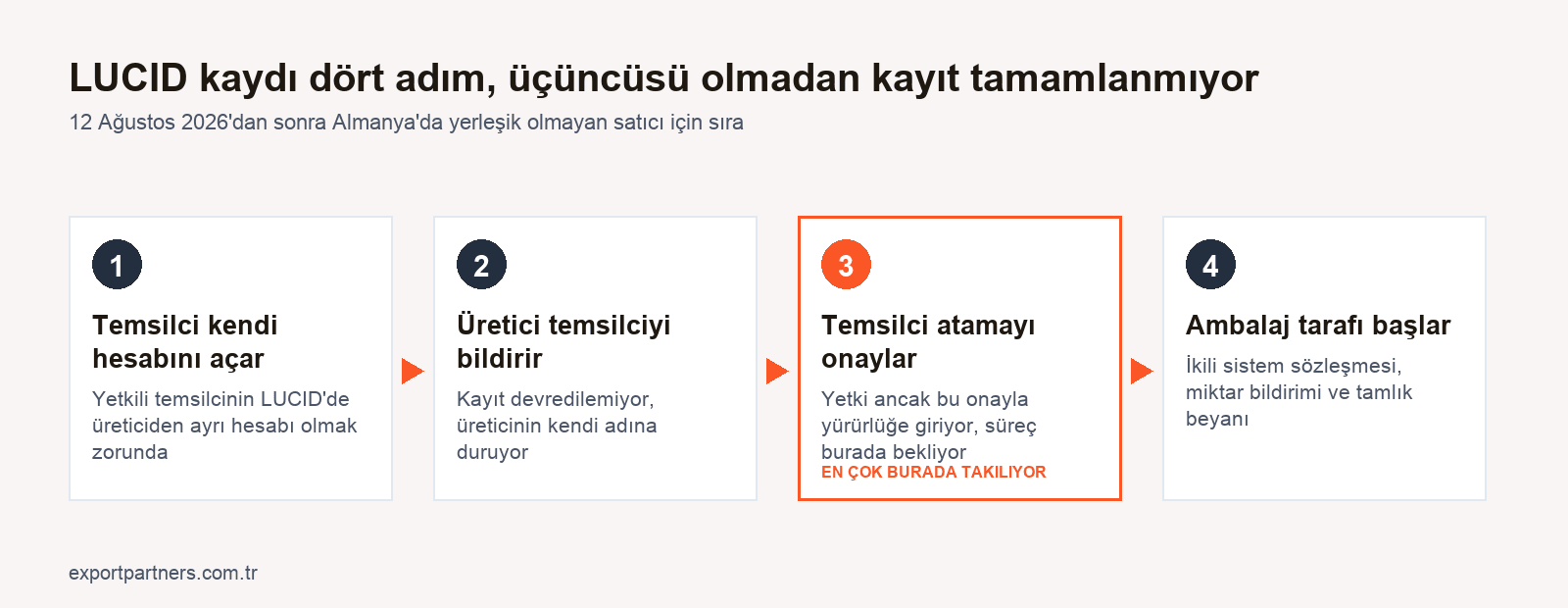
The EU Packaging and Packaging Waste Regulation (PPWR) and Germany's implementing law, the VerpackDG, took effect on August 12, 2026, replacing the 2019 VerpackG. The obligations for registration, participation in a dual system and volume reporting remain the same; what has changed is who fulfills them. Every business without a branch in Germany that ships directly to German consumers must now appoint an authorized representative (Bevollmächtigter) established in Germany. This was previously optional, and there is no exemption.
The most common sticking point in practice is that registration involves four steps: the representative opens its own separate account in LUCID, the manufacturer completes its own registration and names the representative, the representative confirms the appointment (the authorization takes effect only at that point), and then the dual system contract and packaging volume reporting become the representative's obligation. While the third step is pending, the registration may look complete to the seller, yet the product is not yet eligible to be placed on the market and the listing may remain inactive.
What to do: check whether the "Authorized Representative" field in your LUCID account shows as confirmed, then verify that the dual system contract and volume reporting are complete. The full Germany picture, including VAT and GPSR, is in our guide to selling on Amazon Germany.
Duty on shipments under 150 euros and the preferential origin exception
As of July 1, 2026, the EU removed the customs duty exemption for shipments valued under 150 euros. In its place, a flat duty of 3 euros per item applies on a temporary basis until July 1, 2028.
The Commission's guidance includes an exception: goods covered by a preferential trade agreement or a customs union are excluded from the flat duty if VAT was not collected through IOSS and the shipment was declared with a standard (H1) declaration. It is worth checking whether your country has such an arrangement with the EU and which proof of origin it requires.
What to do: ask your carrier in writing which declaration type your shipments are filed under. The same product may be shipped with or without duty depending on the declaration type.
Customs Code reform adopted, handling fee starts November 1
On September 16, 2026, the European Parliament adopted the Union Customs Code reform. Three points matter for sellers.
First, the handling fee: a new fee is coming for every item shipped directly to consumers from outside the EU. According to the European Commission's guidance of October 7, 2026, it is 2 € per item, to be reviewed every two years, and member states will start collecting it from November 1, 2026 at the latest. This does not replace the flat 3 euro duty per item; it is a separate charge.
Second, responsibility: sellers outside the EU who make distance sales to customers in the EU, and the platforms that facilitate those sales, are treated as the importer. Responsibility for product compliance and documentation moves directly to the seller, and obligations such as the GPSR responsible person and packaging registration become more visible under this definition.
Third, penalties and structure: for companies that repeatedly fail to comply, fines of 1 to 6 percent of the value of goods imported into the EU in the previous 12 months are foreseen. An EU Customs Authority based in Lille is being established, and the data hub that will replace 111 national systems becomes optional in 2031 and mandatory in 2034. Member states will put the full set of rules into practice within 12 months.
What to do: in the short term, the date to watch is November 1, 2026; the fee has been announced as 2 € and can be built into pricing. The rest is spread over 2027 and beyond.
EORI applications through the Zoll-Portal after October 1
In Germany, EORI number applications are made through the Zoll-Portal as of October 1, 2026; the paper form (0870) is reserved for exceptional cases. A company applying for a new EORI needs to open a portal account; existing numbers are not affected.
Not yet a rule, but worth watching
U.S. Customs and Border Protection (CBP) published an advance notice on September 2 asking which data it could request to gain closer visibility into import supply chains. One topic directly concerns foreign exporters: CBP is considering whether the export declaration a foreign exporter files with its own country's customs authority should also be shared with the U.S. side.
Nothing changes today. This is not a rule but the comment-gathering stage before a rule is written; comments are accepted until December 1, 2026, and it is not yet clear when or whether it will become a rule. It is worth tracking, but customers should not be told that a new document is required.
Frequently asked questions
Can I renew my FDA registration before October 1?
No. The renewal window opens on October 1; a renewal submitted before that date is not processed by the system. The easiest approach is to prepare in advance (registration number, PIN, U.S. Agent confirmation, D-U-N-S address) and submit on October 1.
What happens if my registration is not renewed on time?
The registration is considered expired on December 31. You can register again, but you receive a new number, and products shipped in the meantime may be held at the port of entry. Renewing is both faster and lower risk than registering again.
What happens if I do not enroll in the FBA returns programs?
Nothing; enrollment is not mandatory. If you are not enrolled in Sell as Used, returned items are handled according to your existing unfulfillable inventory settings (disposal, liquidation or return to you), and no processing fee applies.
Can an authorized representative complete the LUCID registration on my behalf?
The registration itself cannot be transferred; it stays in the producer's own name. The representative is declared in the registration and confirms the appointment through LUCID. After confirmation, the dual system contract, quantity reports and declaration of completeness become the representative's obligations.
How much will the EU handling fee be?
In the guidance it updated on October 7, 2026, the European Commission announced the fee as 2 € per item; the amount will be reviewed every two years, and member states begin collecting it on November 1, 2026.
Conclusion
The busy autumn is not caused by a single regulation but by two markets tightening at the same time. On the U.S. side, the focus is registration discipline: the renewal window, the new field in prior notice and the fee for returns programs. On the German and EU side, responsibility is shifting to the seller: the authorized representative for packaging registration, importer status under the customs reform and a new per-item fee.
Of the nine items on the calendar, four are in effect and five are coming; three of those take effect on October 1. If all three apply to one company, the order looks like this: first the FDA renewal (its window closes), then the LUCID representative confirmation (it can take a listing offline), and last the returns program decision (an optimization, not a loss of money).
The services we provide on the U.S. and German side correspond to these items: FDA facility registration, U.S. Agent and registration renewal, label and content compliance, importer customs registration, customs registration and customs bond; on the German side, LUCID packaging registration, authorized representative and GPSR responsible person setup; and in the Amazon U.S., Germany and UK marketplaces, account setup, listing and sales management.
If you are not sure where you stand in one of these processes, write to us through our contact form, and we can work out together which items concern you and what the next step is.
Last updated: September 25, 2026

