
Many manufacturers who ship pickles, brined olives, hot pepper sauce or roasted vegetables to the U.S. get stuck at the same point: because the product's pH is below 4.6, they assume it falls outside the scope. In fact, the opposite is true. FCE and SID numbers are required not because the product's pH is low, but because that pH was reached by adding acid.
What matters is not the pH of the finished product, but how that pH was reached. A naturally acidic product is outside the scope; a low-acid product made acidic by adding acid is fully inside it. This article covers the scope question, the difference between the two registrations and the regulatory timelines of the process. Section numbers and timelines are taken from the FDA's own regulations.
FCE and SID: two separate filings, neither is an approval
The two are often confused, and both work separately from FDA facility registration.
- The FCE (Food Canning Establishment) number is assigned to the facility. It records in the FDA system that a manufacturing facility produces acidified or low-acid canned foods.
- The SID (Submission Identifier), on the other hand, is assigned to the product. It shows that the thermal processing and acidification process of each product has been filed with the FDA.
Neither is an approval document. In this process the FDA does not approve the product; it accepts the filing. The phrase "FDA approved product" has no basis on this side.
There is a third registration, and this is where confusion is most common: Food Facility Registration. The FCE does not replace facility registration; on the contrary, before an electronic FCE registration can be opened, the facility must first be listed in food facility registration and must have identified itself as a manufacturer of acidified or low-acid foods. We covered facility registration in our article on what you need to know about FDA registration.
What is an acidified food, and why pH 4.6 alone is not enough
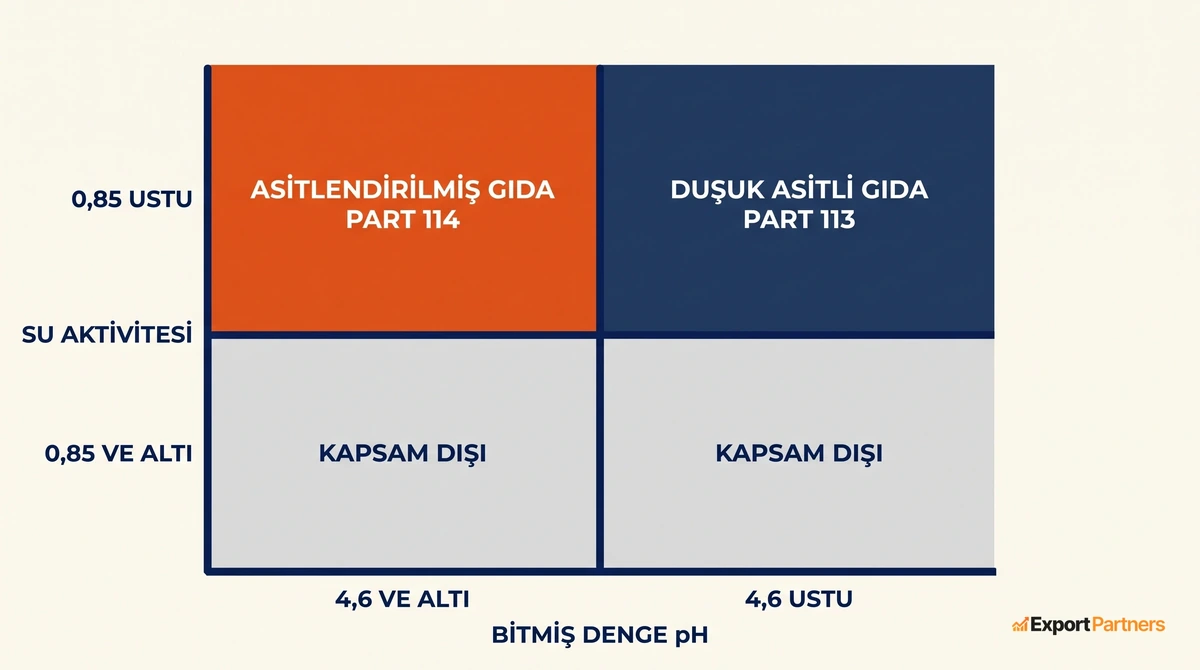
The definition is in 21 CFR 114.3(b): an acidified food is a low-acid food to which acid or acid foods are added, with a water activity greater than 0.85 and a finished equilibrium pH of 4.6 or below. Both conditions apply together.
The subtle point is this: being below pH 4.6 does not take a product out of scope; it is actually one of the conditions for being in scope. What takes a product out of scope is a pH that is naturally low. Lemon juice is naturally acidic, so it falls outside Part 114. Cucumber is a low-acid vegetable; when it becomes a pickle through added vinegar, its pH drops below 4.6, and that is exactly why the product falls within scope.
Water activity is the second threshold and the one most often overlooked. In products with a water activity of 0.85 or below, the conditions for microbial growth are removed, so the product stays outside the scope. In other words, neither pH alone nor water activity alone gives the answer; both are considered together.
Which products fall outside the scope
21 CFR 114.3(b) also lists the exemptions. Products outside the scope:
- Carbonated beverages
- Jams, jellies and preserves
- Acid foods with a natural pH of 4.6 or below
- Food dressings and condiment sauces that contain small amounts of low-acid food and whose finished equilibrium pH does not differ significantly from that of the predominant acid
- Foods that are stored, distributed and sold under refrigeration
The last item is very useful in practice: the same formulation may fall within scope when sold as shelf-stable, but stay outside the scope when sold through the cold chain. The dressing and condiment exemption, on the other hand, is read narrowly; saying "it contains some low-acid ingredients" does not create an exemption on its own. The requirement is that the finished product's pH does not differ significantly from that of the predominant acid.
The definition of a low-acid food is in the same place, 114.3(d): foods with a finished equilibrium pH greater than 4.6 and a water activity greater than 0.85. There is a separate note for tomatoes; tomatoes and tomato products with a pH below 4.7 are not considered low-acid.
Typical scope examples for exported products
These are the product groups that come up again and again in the files we review. None of them is an automatic classification; each one is evaluated on its own formulation, pH and water activity.
- Pickles and brined vegetables. Vinegar or acid is added to a low-acid vegetable, which is the classic definition of an acidified food.
- Brined olives. The answer depends on the brining and acidification method; olives acidified through natural fermentation and olives with added acid are evaluated separately.
- Hot pepper sauces and condiment sauces. The sauce exemption is read narrowly; the question is whether the pH of the finished product differs meaningfully from the pH of the predominant acid.
- Roasted vegetables and meze-style spreads. If sold shelf-stable, they may fall within scope; if sold refrigerated, they may fall outside it.
- Certain tomato paste and jam formulations. Jams and marmalades are on the exemption list, but if a formulation moves outside that definition, the picture changes. For tomato products, the 4.7 threshold also comes into play.
The classification decision is based on a laboratory result and a process authority evaluation, not on the name of the product group.
Part 113 vs. Part 114
The two regulations cover two separate product groups, and falling outside one does not mean falling outside the other.
| Product type | pH | Water activity | Which scope |
|---|---|---|---|
| Naturally acidic food | 4.6 or below, natural | Above 0.85 | Outside both |
| Food acidified by adding acid | 4.6 or below, through acidification | Above 0.85 | Part 114 |
| Low-acid canned food | Above 4.6 | Above 0.85 | Part 113 |
| Low water activity product | Does not matter | 0.85 or below | Outside both |
| Product sold refrigerated | 4.6 or below | Above 0.85 | Outside both |
The most common wrong conclusion we see in practice is: “my product is not covered by Part 113, so no registration is needed.” Part 113 covers low-acid canned foods, while Part 114 covers acidified foods. Being exempt from one does not mean being exempt from the other.
How to get an FCE number: the ten-day window
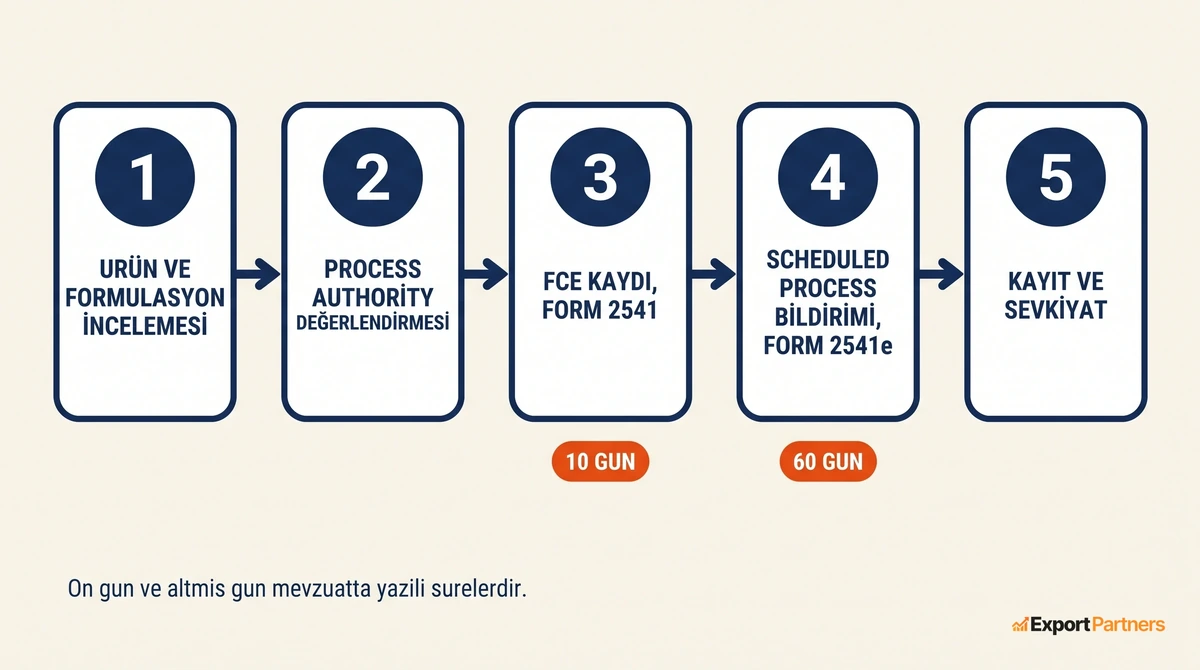
The requirement is set out in 21 CFR 108.25(c)(1). A facility that begins manufacturing acidified foods registers as a Food Canning Establishment using Form FDA 2541 no later than ten days after starting and receives its FCE number.
The forms can be submitted electronically through FDA Industry Systems, and a paper option is also available. The prerequisite for the electronic route is the distinction mentioned above: the facility's food facility registration must be active, and the facility must be identified as a manufacturer of acidified or low-acid foods.
How the SID is filed: sixty days, separately for each package size
21 CFR 108.25(c)(2): no later than sixty days after registration, and before packing a new product, scheduled process information for each acidified product is submitted to FDA using Form FDA 2541e.
The critical detail here: the filing is made separately for each product and each package size. A 250 ml jar and a 500 ml jar of the same sauce mean two separate filings, because package size changes the thermal process calculation. The product is not considered compliant until the filing is complete.
Process authority and Better Process Control School
The scheduled process, meaning the product's acidification and thermal processing recipe, is not something the company can set on its own. It is established by a qualified person with expert knowledge of acidification and processing, known as a process authority. In the U.S., university food science departments and private organizations provide this service.
21 CFR 114.10 adds a separate requirement: the person supervising the acidification and processing operations must have completed a school recognized by FDA. In practice this is Better Process Control School, which is also offered online.
This also shows where the costs arise. FDA charges no fee for FCE registration or SID filing. Costs come from the process authority review, laboratory analyses and training; the amount varies with the number of products and package sizes.
FCE and SID number process: steps and timelines
| Step | Who does it | Approximate time |
|---|---|---|
| Product and formulation review | Manufacturer and service provider | A few days |
| pH and water activity analysis | Laboratory | A few days |
| Process authority evaluation | Qualified organization | A few weeks |
| FCE registration, Form 2541 | Manufacturer | No later than 10 days after starting production |
| Scheduled process filing, Form 2541e | Manufacturer | No later than 60 days after registration |
| Registration and shipment | Manufacturer | After the filing is complete |
The ten-day and sixty-day periods are set in the regulations. The other items in the table are approximate; they vary with the complexity of the product, laboratory workload and the number of package sizes.
Common mistakes
- Having the registration opened in an intermediary's name. The FCE number is issued to the manufacturing facility, and the SID is filed for that facility's product and process. It is not opened in the service provider's name. This is the point most often confused in practice.
- Mistaking the facility registration for the FCE. They are two separate registrations; one does not replace the other.
- Assuming a single SID covers all package sizes. The filing is made separately for each product and package size.
- Deciding a product is out of scope based on pH alone. What matters is how the pH was achieved, along with the water activity.
- Planning a shipment before the filing is complete. With an incomplete filing, a shipment may be held at entry; the process and how to correct it are explained in our article on products held at customs. For the customs side as a whole, see our U.S. and Canada customs page.
Frequently asked questions
My product's pH is 3.6. Do I still need an FCE?
If the product's pH was brought down to 3.6 by adding acid and its water activity is above 0.85, then yes, the product is considered an acidified food. A low pH does not take a product out of scope; it is one of the conditions that puts it in scope.
I have an FDA facility registration. Is the FCE automatic?
No, they are two separate registrations. The facility registration does not replace the FCE. The link runs the other way: to open an electronic FCE registration, a facility registration must already exist and the manufacturer type must be marked correctly.
Does each product need its own SID?
Yes, and in fact each container size needs its own. Jars of the same product in different volumes require separate filings, because the container size changes the thermal process calculation.
Is the registration opened in our name or in the name of an intermediary?
In the name of the manufacturing facility. The FCE number is assigned to the facility, and the SID is filed for that facility's product. A registration opened in an intermediary's name means the facility does not have its own registration.
Can we manage the process from outside the U.S.?
Yes. Registration and filing can be completed electronically, and the process authority review can also be handled remotely. However, the analyses are performed at an accredited laboratory, and the documents need to be prepared in English.
Conclusion
The need for FCE and SID numbers comes from a product being acidified, not from it being naturally acidic. Scope is decided by two thresholds: is the finished equilibrium pH 4.6 or below, and is the water activity above 0.85? If both are met and the low pH was achieved by adding acid, the product falls under Part 114.
On the process side, there are two legal deadlines, both written into the regulations: FCE registration within ten days after production begins, and scheduled process filing within sixty days after registration. If you are not sure which side your product falls on, you can reach out to our team on the FDA registration and certification side.
Last updated: September 10, 2026

