
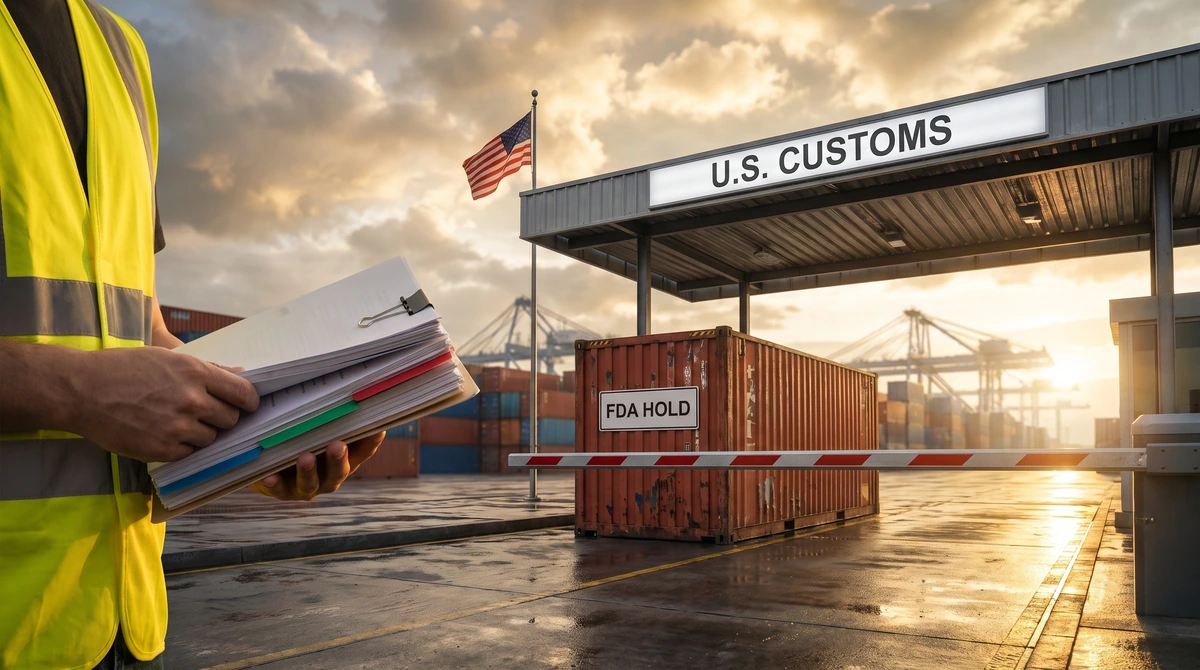
The most common frustration for manufacturers exporting to the United States is this: the FDA paperwork is done, FDA registration is complete, a US Agent has been appointed.. and yet the product is held at U.S. customs. On the FDA side this is called an FDA import refusal, and the cause is often not the registration itself but a detail in the declaration.
And not just once. Again and again.
“We have FDA approval, so why are we still being held?” This guide answers exactly that question.
Why Aren't an FDA Certificate and FDA Registration Enough on Their Own?
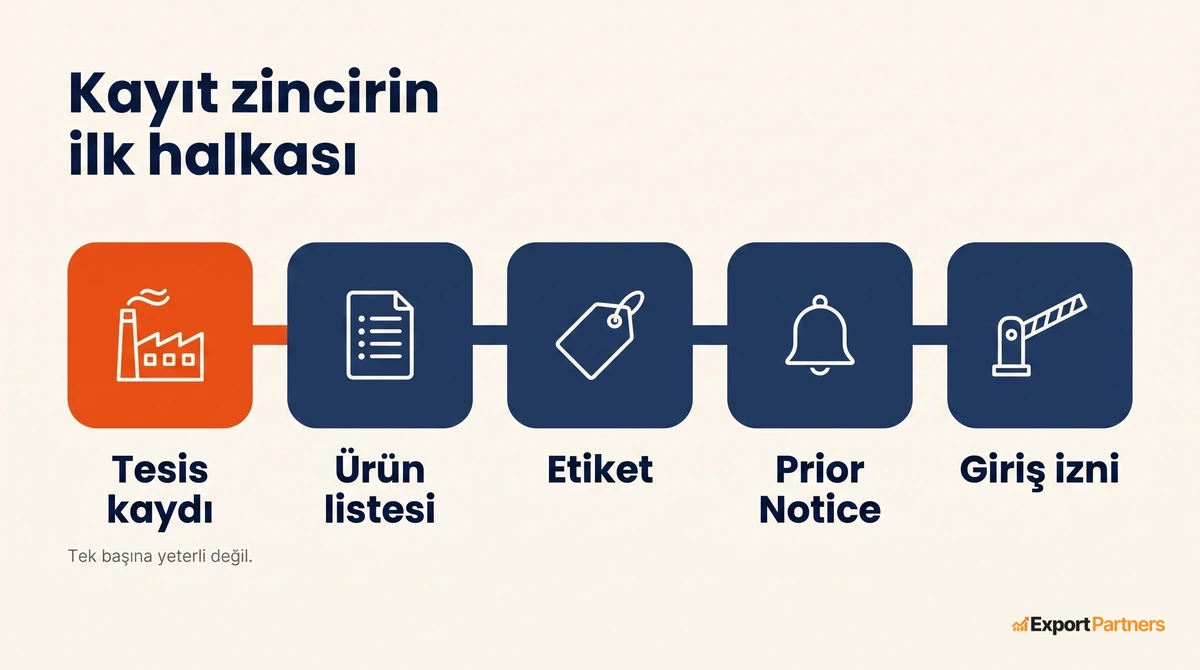
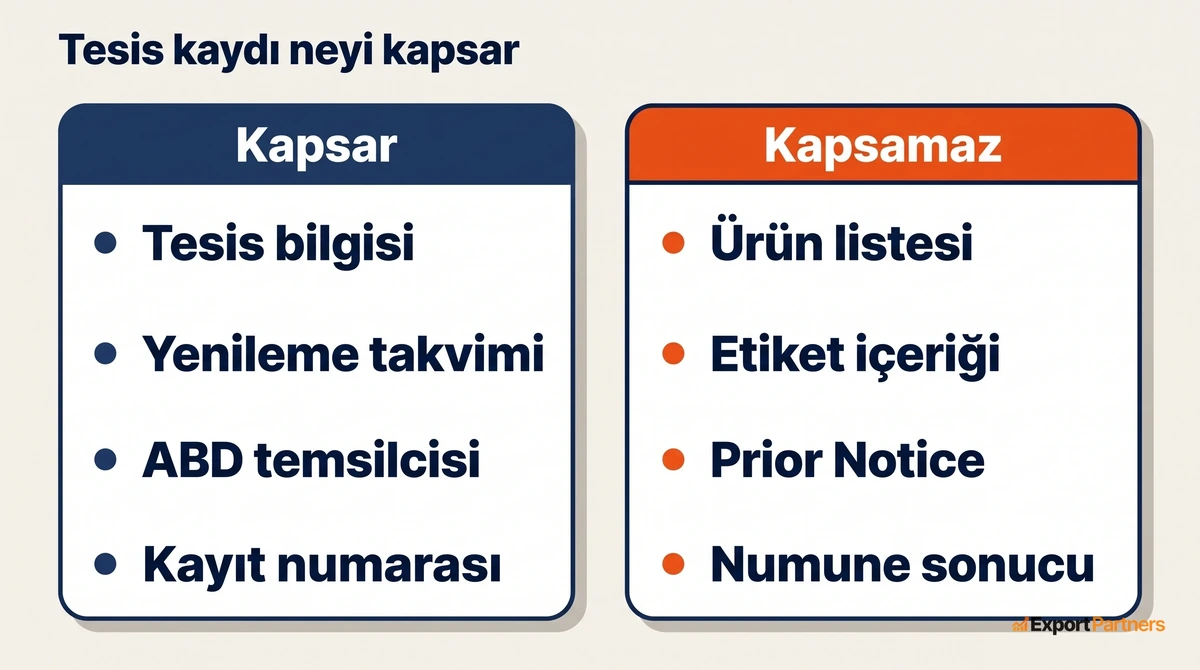
FDA registration means your facility has been notified to the FDA system.. it is not a quality seal or a guarantee of entry. What the market calls “FDA approval” is, for most product groups, actually this registration.
Registration is the key to the door. But to get through the door, the product itself must also meet U.S. rules: labeling, formulation, process filing, supplier verification.
An FDA registration does not say “you may enter”; it says “I know who you are.”
What Is an FDA Import Refusal, and Why Are Shipments to the U.S. Sent Back?
An import refusal is the FDA's decision to deny a shipment entry into the United States. Each refusal is entered into public records with a refusal code (refusal charge).
The critical point: a shipment is often refused not under one code but under several codes at once. The problem rarely stays on a single line.
Most common refusal reasons in food exports to the U.S.
- Labeling: Nutrition Facts format, English-language requirement, ingredient and allergen list
- Process filing (FCE/SID): the mandatory process filing was not submitted for products such as olives, pickles and tomato paste
- Facility registration: no FDA registration, or it is not current
- Additives/colorants: permitted in your country, but not on the U.S. list
Case: “We Have an FDA Registration, Yet Every Shipment Is Sent Back”
A fruit juice manufacturer we reviewed was a well-established company and was registered with the FDA. Even so, every product in its latest shipment had been held at customs.
The records were clear: every shipment was being refused under the same two codes.. the English-labeling requirement and the nutrition facts format. What's more, the same codes had been repeating for years, across different facilities.
This was not a one-off problem. The label template had never been adapted to the U.S. format. Each lot was rescued, and the next one hit the same wall.
If the same code appears a third time, the problem is not the shipment; it is the file.
How to Break the Import Refusal Cycle
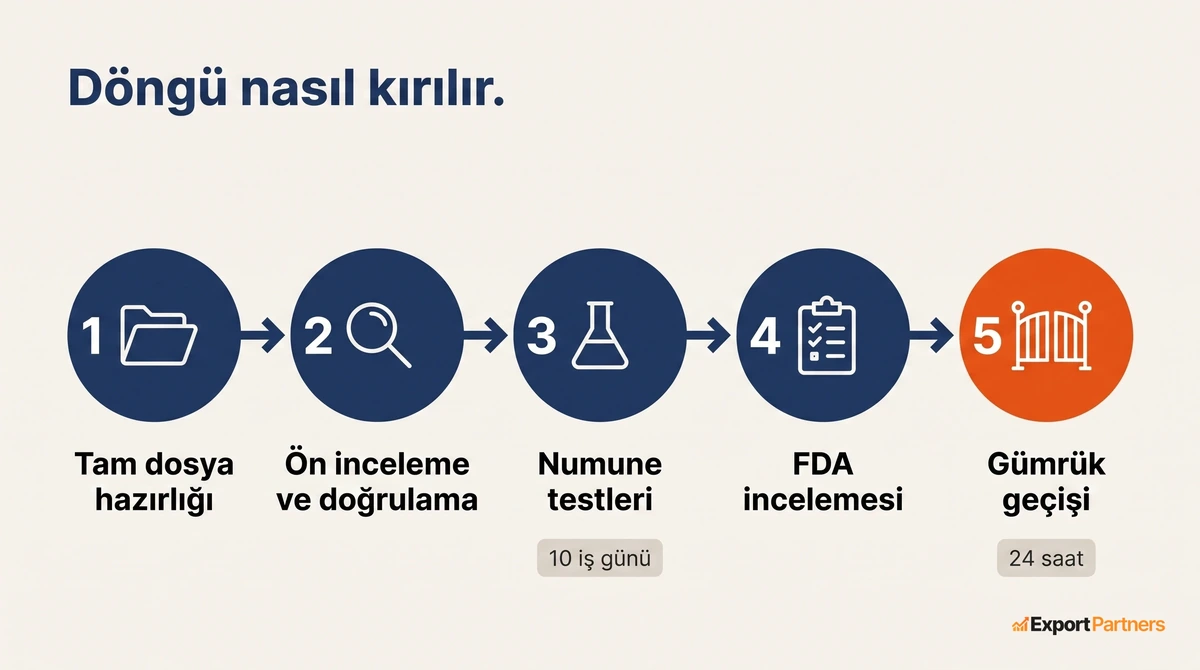
Instead of rescuing shipments one at a time, you need to find the root cause and build the file as a whole. Five steps:
- Decode the refusal code, determine exactly why you were refused
- Scan the context, labeling, process filing and additive status together
- Isolate the root cause, a one-time error or a structural gap
- Build the file, close the gaps as a single compliance file
- Re-enter, clear the way for the shipment and schedule the renewals
Why a Holistic Approach Makes the Difference
The most frustrating part of an import refusal is that fixing a single item is often not enough. You correct the label, and this time the shipment is refused for a different gap.
A provider that offers only certification services completes that single item; the rest is left to you. What sets Export Partners LLC apart is that we handle every link in the U.S. entry chain under one roof: FDA registration and compliance, U.S. customs and export operations, marketing, U.S. company formation, trademark registration and U.S. accounting.

So you are not left on your own once your product clears customs; from the sale on the shelf to brand protection, you move forward with the same team.
Why Are Imported Food Products Most Often Refused in the U.S.?
We reviewed the FDA’s own import refusal records: between January 13, 2025 and September 23, 2026, 305 shipment lines from 98 food exporters in a single country were refused at U.S. customs. Because one line can be refused for more than one reason, the total number of reasons exceeds the number of lines. The 20 most frequent reasons fall into five groups, and most of them are the kind that can be prevented before the product ships.
| Refusal reason group | What it means | Count (top 20 reasons) |
|---|---|---|
| Label | Nutrition facts panel not in U.S. format, net quantity or English labeling missing, no ingredient list or allergen statement | 257 |
| Color additive | A color additive not permitted in the U.S. was used, or the color additive used was not declared on the label | 148 |
| Residues and microbiology | Salmonella, pesticide residue, aflatoxin or another harmful substance was found | 109 |
| Manufacturing and hygiene conditions | The product appeared to have been manufactured or processed under insanitary conditions | 66 |
| FCE and SID | FCE registration or process filing (SID) missing for canned or acidified food | 30 |
The two most frequent groups in the table, labeling and color additives, are based on documentation rather than laboratory results. In other words, if the label and the formulation are reviewed against U.S. rules in advance, a large share of these refusals can be avoided. On the residue and microbiology side, independent testing arranged before shipment can reduce the risk.
Why do FCE and SID matter for canned foods and pickles?
For low-acid canned foods and acidified foods (pickles, roasted vegetables, some sauces), FDA facility registration alone is not sufficient; the facility also needs an FCE number and a process filing (SID) for each product. If these two records are missing, the product can be refused at customs even when the label is correct. We covered the details in our guide on exporting canned food to the U.S..
The USDA side for animal products
For meat, poultry and some products containing animal ingredients, jurisdiction may lie with USDA rather than FDA; these products do not appear in the FDA’s refusal data, but entering the U.S. is difficult unless USDA’s permit and certificate requirements are met. For the permit process, see our article on how to obtain a USDA VS Permit.
If your product was refused or you are on an import alert
A refusal record and FDA’s import alert list can affect a company’s subsequent shipments as well: products from a company on an import alert may be detained without physical examination. Removal from the list is requested by petitioning FDA with documented corrective action. We can review your refusal reason together and clarify what needs to be corrected on the labeling, formulation and registration side; you can reach us through our information request form.
Frequently Asked Questions
If I have an FDA certificate, why is my product held at customs?
An FDA certificate/registration is only a notification of the facility. Labeling, formulation and process filings are separate requirements; if one of them is missing, the shipment can be refused. We explained how a shipment is affected when the registration expires or is suspended in our guide to FDA registration cancellation and re-registration.
Are FDA approval and FDA registration the same thing?
For food and cosmetics, FDA does not “approve” individual products; facility registration and listings are filed instead. The phrase “FDA approved” is technically incorrect in these categories and cannot be used on the label.
I received an import refusal. Does that mean my product is unsafe?
No. A significant share of the reasons are administrative items such as labeling and registration. Public records show the code under which your shipment was refused.
Why do I keep getting refusals for the same product?
A repeated refusal points to an unresolved root cause. For example, if the label template has never been adapted to the U.S. format, every shipment comes back for the same reason.
Conclusion
Success in exporting food to the U.S. depends not on an FDA certificate but on the compliance file as a whole. Once set up correctly, that file clears the way for all subsequent shipments.
If your product keeps getting held at U.S. customs, we are with you from root cause analysis to re-entry through our FDA registration and certification and FDA labeling and customs service processes.
Related guides:
Exporting Canned Food to the U.S.: FDA, FCE and SID Guide
Exporting Fruit Juice to the U.S.: FDA Registration and Labeling Guide
Last updated: October 11, 2026

