
Exporting olive oil to the U.S. passes through a narrower corridor than it
appears on paper. Product quality alone is not enough; on the U.S. side
the facility needs to be registered, every shipment needs advance notice and the label
needs to follow the American format. If one of these three layers is missing,
the problem usually shows up at the port, not during production.
The good news: olive oil is one of the food categories that requires the fewest
additional documents. Some registrations that are mandatory for canned and acidified
products are not required for olive oil. Below, we separate step by step which
steps are actually needed and which ones are often described
unnecessarily.
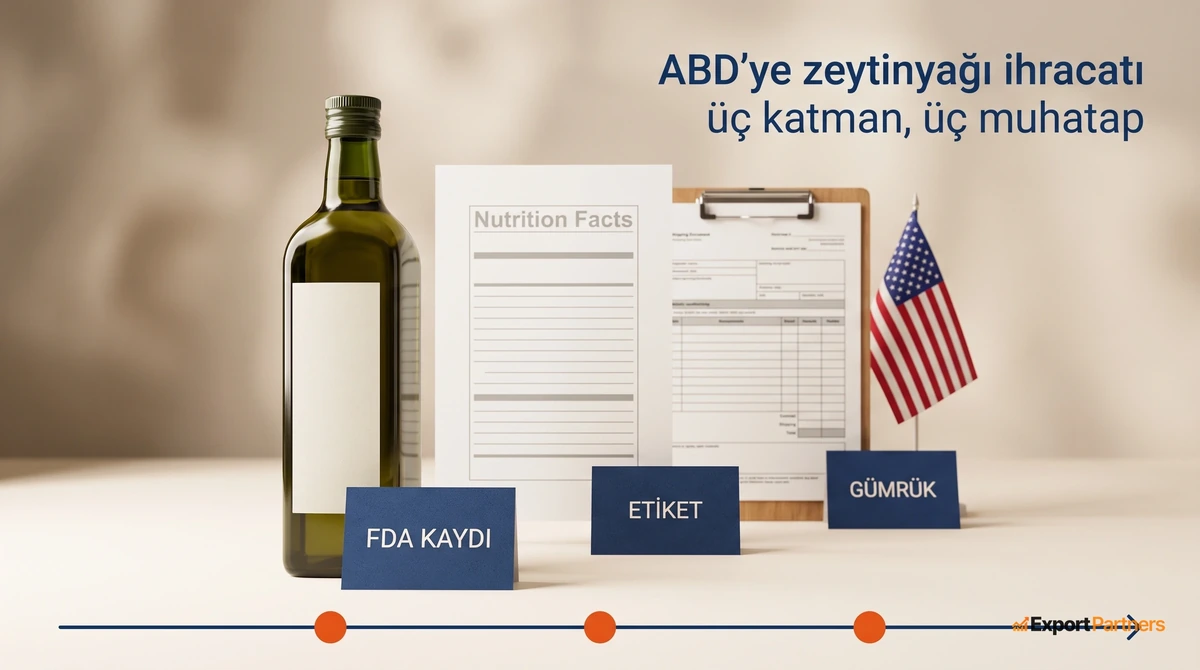
The process has three layers
Shipping food to the U.S. involves three separate authorities, and each works
independently of the others. Completing one does not automatically
satisfy the others.
| Layer | Authority | What olive oil requires |
|---|---|---|
| Food safety | FDA | Facility registration, US Agent, Prior Notice for every shipment |
| Labeling and quality | FDA and USDA | Nutrition Facts panel, product name, optional quality grade |
| Customs | CBP | Tariff classification, the importer's declaration and FSVP responsibility |
Order matters. Without FDA registration, Prior Notice cannot be filed, and without Prior
Notice the shipment is not accepted for entry into the U.S. If the label is not
resolved before production, printing costs may end up being paid twice.
FDA facility registration: where olive oil fits
Facilities that ship food for human consumption to the U.S. must be registered
with the FDA. A facility that produces or bottles olive oil also falls
under this requirement. The registration belongs to the facility, not the product: if you ship
different olive oil varieties from the same facility, you do not need a separate
registration for each.
Two points of the registration are often overlooked. First, the registration is renewed
every two years, and if the renewal window is missed the registration may become
inactive. Second, the registrant needs to have a representative
in the U.S. For details of the registration process and common mistakes,
see our FDA
registration and certification service page.
Who the US Agent is and what they do
The US Agent is the party with a physical address in the U.S. who handles
communication between the FDA and the company. Their role is not to prepare documents, but to be reachable
when the FDA has a question or a shipment is held.
If the agent's details in the registration are not current, FDA notices may not
reach the right place and the process can quietly drag on.
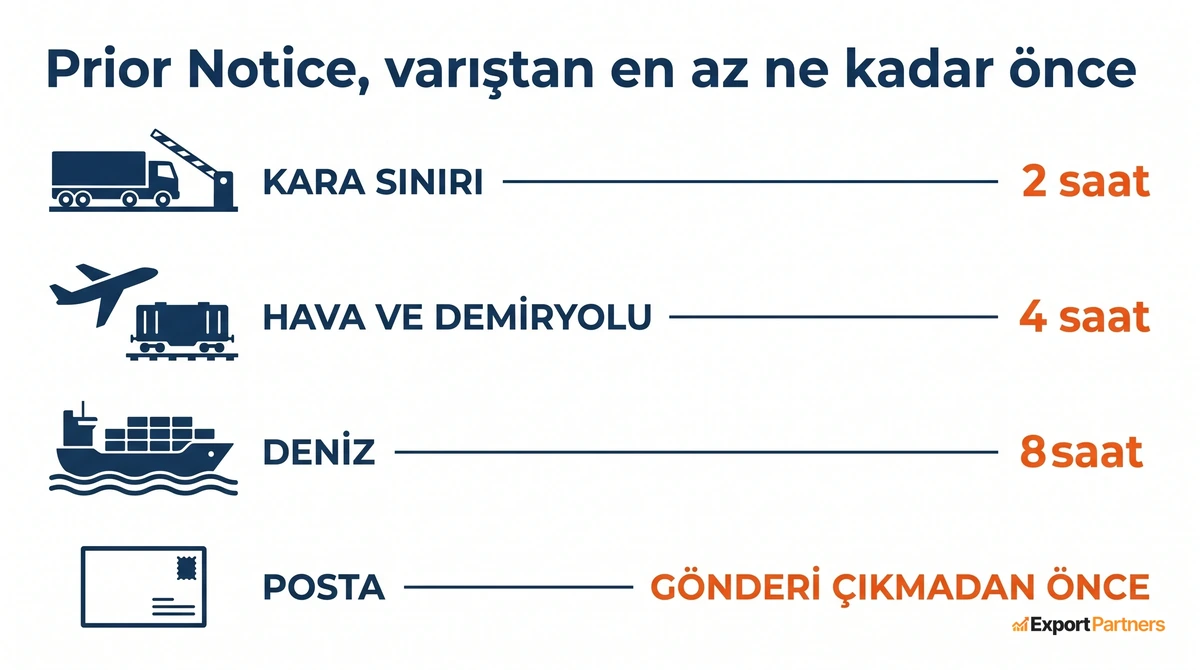
Prior Notice: a separate notice for each shipment
Facility registration is done once, while Prior Notice is filed again for every
shipment. The notice is submitted to the FDA electronically before the cargo arrives
in the U.S., and the minimum lead times before arrival vary
by mode of transport.
| Mode of transport | Minimum time before arrival |
|---|---|
| Land border | 2 hours |
| Air and rail | 4 hours |
| Sea | 8 hours |
| International mail | Before the shipment departs |
Filing too early is not accepted either: notices submitted through the FDA's own
system more than 15 days before arrival, and notices submitted through the customs
system more than 30 days before arrival, are not considered valid.
For an olive oil lot shipped to the U.S. by sea,
the practical takeaway is this: it is safer to file the notice not at loading,
but once the arrival date is confirmed.
FCE and SID numbers are not required for olive oil
This is one of the most common misunderstandings we see in the field. FCE
(Food Canning Establishment) and SID (Submission Identifier) numbers exist
for acidified and low-acid canned foods. Extra virgin
olive oil does not fall under these definitions.
If a company shipping olive oil is asked for an FCE number, it is worth asking about the source of
the request: either the product actually falls into a different category
(such as olive paste, brined products or sauces), or the request may come from the wrong
template. We covered the requirements on the canned food side separately
in our guide to the cost of
exporting food to the U.S.
Label: Nutrition Facts and product name
Packaged food sold in the U.S. must carry a label in the American
format. A nutrition table used in other markets is not accepted
as is; the Nutrition Facts panel uses its own layout, its own serving size logic
and its own rounding rules.
Two points are specific to olive oil. First, the product name needs to be
consistent with the contents: if the term “extra virgin” is used, the product is
expected to meet that definition. Second, country of origin and net quantity
are stated according to U.S. rules. When preparing the label, the most practical
approach is to have the design checked against the U.S. format before it goes to
print.
USDA quality grades are voluntary, but buyers may ask for them
The grade standards USDA publishes for olive oil are not mandatory
but voluntary. In other words, a USDA grade is not required for export. However,
U.S. buyers may reference these grades in their contracts, so
it helps to know what they mean.
| Grade | Free fatty acidity (oleic acid) |
|---|---|
| U.S. Extra Virgin Olive Oil | No more than 0.8 grams per 100 grams |
| U.S. Virgin Olive Oil | No more than 2.0 grams per 100 grams |
| U.S. Olive Oil | No more than 1.0 grams per 100 grams |
| U.S. Refined Olive Oil | No more than 0.3 grams per 100 grams |
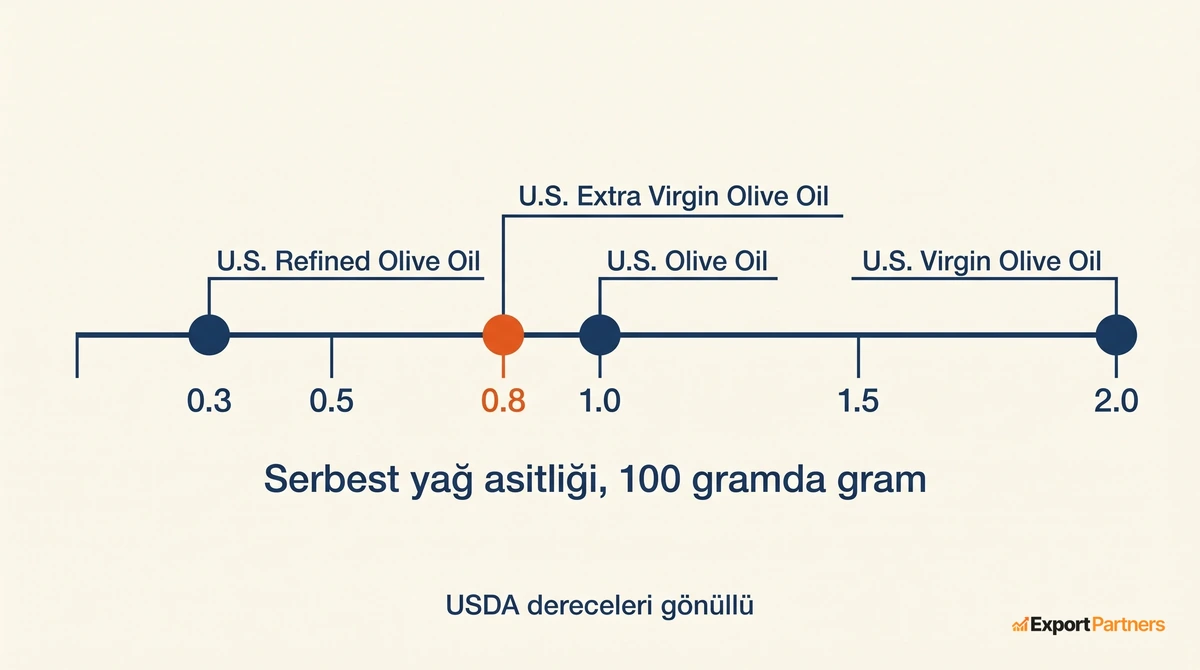
One point in the table stands out: the “extra virgin” limit is not set by
acidity alone; flavor and aroma evaluation is also part of the definition.
A product can test below the limit in the lab and still show defects
in sensory evaluation.
Customs: classification and the importer's responsibility
In the U.S. tariff schedule, olive oil falls under heading 1509. This
heading covers olive oil obtained by mechanical means; oils extracted with solvents
fall under a different heading. The subheadings are split by whether the oil is virgin
and by packaging type, and the duty rate varies by
subheading.
We do not list the rate here. Tariff rates are updated from time to time, and
additional measures may apply depending on the country of origin; before shipment
it is better to have your customs broker confirm the current rate. The same
logic applies to additional duty measures.
The FSVP obligation lies with the importer, not the exporter
The importer in the U.S. is required to verify that its supplier produces to a standard equivalent
to U.S. food safety standards. This is called FSVP (Foreign
Supplier Verification Program), and the responsibility belongs to the U.S. buyer.
For the exporter, this means the buyer may ask you for production records, a hazard
analysis or an audit report. When these documents are ready, the process on the buyer
side moves faster; when they are not, the order may be delayed.
Process Summary and Common Mistakes
| Step | When | Common mistake |
|---|---|---|
| FDA facility registration | Before the first shipment | Missing the renewal window |
| US Agent designation | Together with registration | Not updating contact information |
| Label design | Before printing | Using a home-market nutrition table as is |
| Prior Notice | Every shipment | Submitting the notice too early |
| Tariff confirmation | Before shipment | Calculating costs at an outdated rate |
What happens if a problem arises after a shipment reaches the U.S., and how
it proceeds, is a separate topic; we covered it
in our guide for those whose products are held at customs
despite having FDA
registration. If you are curious how GMP works for vegetable oils,
our
vegetable
oil export guide goes into more detail.
Frequently asked questions
How do you get an FDA certificate, and is it required for olive oil?
The FDA does not issue a “certificate”; it registers the facility. The facility that produces
or bottles the olive oil must be registered in the FDA system and have a
representative in the U.S. Once registration is complete, you receive a
confirmation number, not a certificate.
Is there such a thing as “FDA-approved olive oil”?
There is no FDA approval category for food products. The FDA registers food
facilities and monitors the market; it does not approve products one by one.
Using the term “FDA approved” on a label or in marketing may be considered misleading.
Does olive oil require FCE and SID numbers?
No. FCE and SID numbers are required for acidified and low-acid canned
foods. Extra virgin olive oil is not within this scope. If the product
turns into a brined, paste or sauce form, the situation may change.
Is a GMP certificate required?
FDA registration does not require a GMP certificate, but production is expected to follow
good manufacturing practices. A U.S. buyer
may ask for a certificate or audit report for its own FSVP process; that would be
the buyer's request, not the FDA's.
Who pays the customs duty?
On entry into the U.S., the duty is paid by the importer of record. The delivery terms
can change this: under DDP agreements, the cost may be passed on to the
exporter. When preparing a price quote, it helps to clarify in writing which
costs the delivery terms cover.
Conclusion
What exporting olive oil to the U.S. requires is not a long list of documents
but the right sequence. Facility registration and the US Agent are set up once, Prior
Notice is repeated with every shipment, the label is settled before production,
and the tariff rate is confirmed before shipment. One advantage of olive oil
is that the additional registrations required for canned foods do not apply to this product.
If you would like to set up the process from the start or review your existing registration,
we can assess your situation through our
FDA
registration and certification service.
For classification and cost questions on the customs side, our
U.S.
and Canada customs service page is a better fit.

