
The cost of exporting food to the U.S. is more than freight and customs duty. The items that tend to surprise a budget are one-time compliance costs and small fees that repeat with every shipment. One-time costs land on the first shipment, so that lot looks more expensive than it really is, while recurring fees look small one by one and often never get added up.
In this guide we split the cost into three parts: one-time setup, per-shipment costs and per-unit shares. Then we walk through the U.S. customs and FDA process step by step, and at the end you will find the rules that changed in 2026.
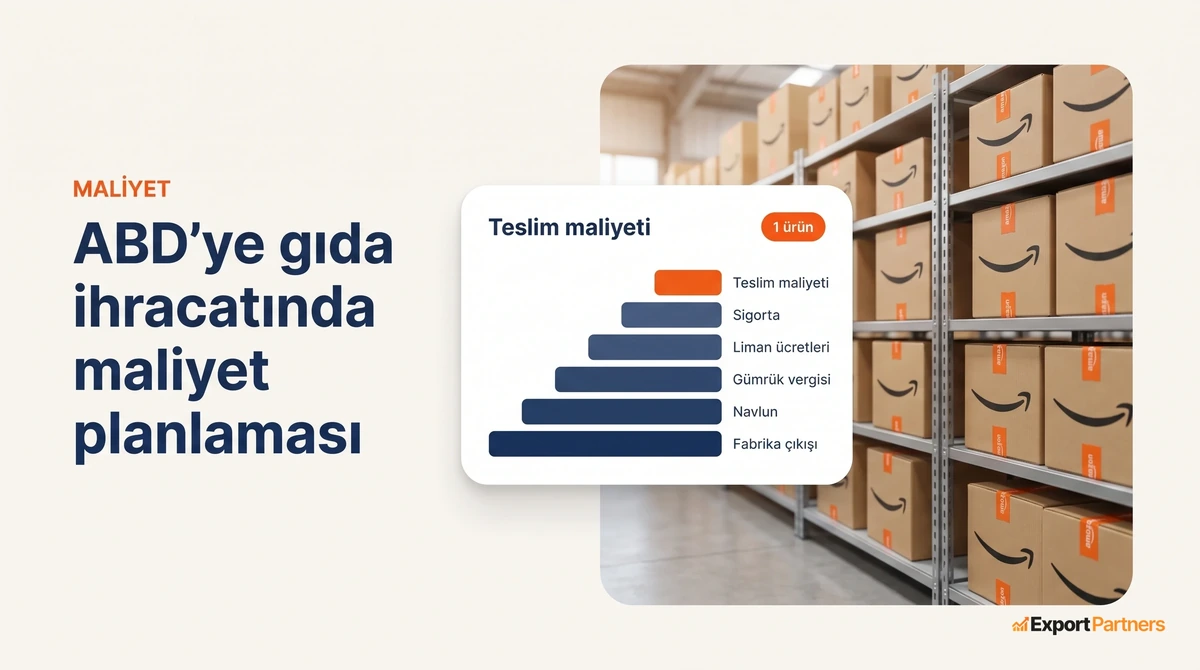
What makes up the cost of exporting food to the U.S.?
The cost of exporting food to the U.S. is the total of every expense incurred from the moment the product leaves the factory until it reaches the buyer's warehouse in the U.S. It falls into four groups: compliance and preparation, logistics, customs and U.S. distribution.
| Group | Includes | Frequency |
|---|---|---|
| Compliance and preparation | FDA facility registration, U.S. Agent, FSVP, label adaptation, laboratory analysis | One-time and annual |
| Logistics | Freight, insurance, inland transport, handling | Every shipment |
| Customs | Customs duty, Section 301 additional duty, MPF, HMF, customs broker, bond | Every shipment |
| Within the U.S. | Port drayage, bonded warehouse, storage, distribution | Every shipment |
What are the one-time setup costs?
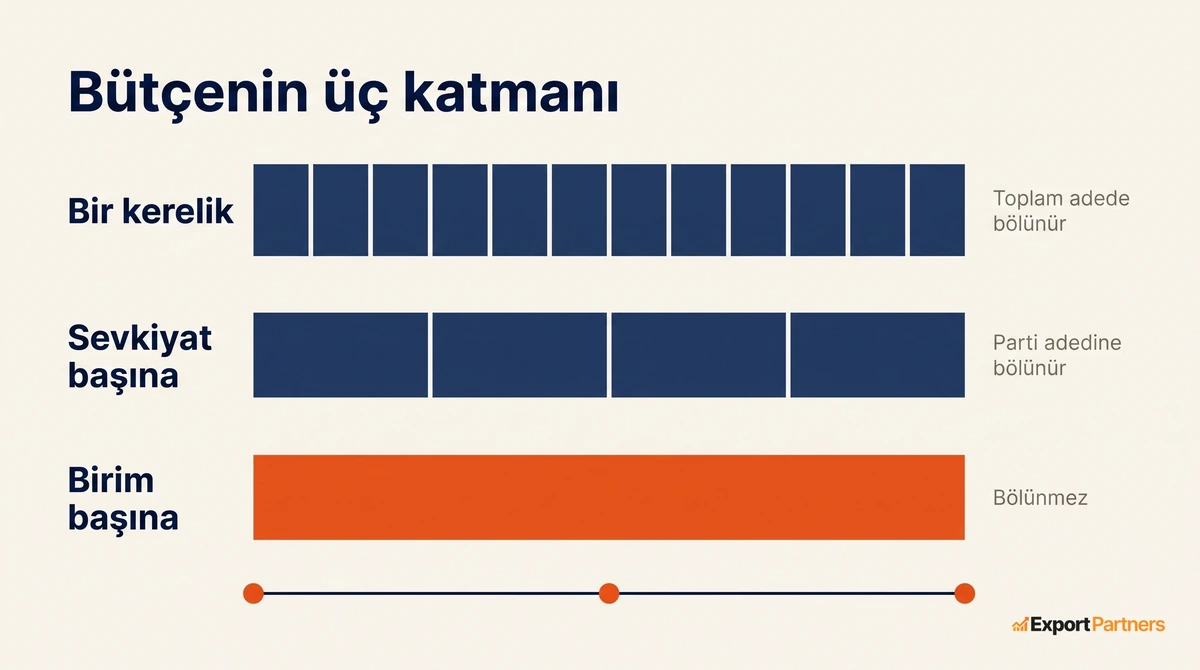
These items are paid before the first shipment and do not repeat on later lots. They should be kept separate in the budget and divided across total production volume; otherwise the first lot looks less profitable than it really is.
- FDA facility registration. The registration itself is free; the cost lies in completing it correctly and keeping it up to date. The FDA registers a facility, it does not approve it. Confusing the two in contracts and product communication can cause problems.
- U.S. Agent. Required for every foreign food facility. It is a commercial service, and the annual fee varies by provider.
- Label adaptation. Nutrition Facts layout, allergen declaration, net quantity, country of origin and the English-language requirement. Translating your existing label is usually not enough; the layout needs to be rebuilt to the U.S. format.
- Laboratory analysis and documentation. Depending on the product group: nutrient analysis, shelf-life study, and FCE and SID filing for acidified and low-acid canned foods.
- Continuous customs bond. Roughly $700 to $800 per year. A single-entry bond may look cheaper, but for more than three shipments a continuous bond is usually more economical.
For details on labeling and customs, see our FDA labeling and customs guide; for the additional permits required for products with animal-derived ingredients, see our article on exporting animal-based food to the U.S.
What are the per-shipment costs?
These items recur with every lot and feed directly into unit cost. The table below shows ranges as of mid-2026; since freight changes weekly, rates should be confirmed at the time of quotation.
| Item | 2026 range | Note |
|---|---|---|
| 40-foot container, ocean freight | $4,000 to $7,000 | Transit 25 to 35 days |
| 20-foot container, ocean freight | $2,500 to $4,500 | Transit 25 to 35 days |
| Less-than-container load (LCL) | $80 to $200 per cubic meter | Transit 30 to 40 days |
| Air cargo | $5 to $15 per kilogram | Transit 5 to 7 days |
| Port drayage | $300 to $800 per container | Port to warehouse |
| MPF, merchandise processing fee | About 0.35% of the value | Has a minimum and a maximum |
| HMF, harbor maintenance fee | 0.125% of the value | Ocean freight only |
On top of these, demurrage and chassis fees apply once free time is exceeded. Because they are not planned expenses, they usually do not make it into the budget. Setting aside a small percentage of the shipment budget for this item helps keep the plan intact at the first delay.
How is U.S. customs duty calculated in 2026?
Since July 24, 2026, a 12.5% Section 301 additional duty applies to goods originating in the economies covered by the investigation. The action was announced by USTR on the evening of July 23, 2026 and took effect the next day at 12:01 a.m. U.S. Eastern Time. The rate is added on top of the product's own MFN duty.
A common mistake: the 12.5% is not added on top of the 15% discussed earlier; it replaces it. The earlier layers have ended, so the effective change was from 10% to 12.5%.
| Layer | Status |
|---|---|
| IEEPA reciprocal tariff (15%) | Ended February 24, 2026 |
| Section 122 global surcharge (10%) | Ended July 24, 2026 |
| Section 301 (12.5%) | Started July 24, 2026 |
The action is not aimed at a single country. The same investigation covers 60 economies; 17 face 10% and 38 face 12.5%. The investigation concerns whether a country has, and enforces, a rule banning imports of goods made with forced labor; it is not a finding about the nature of any country's manufacturing. Explaining this distinction clearly to your U.S. buyer can head off an unnecessary discussion. The rate is not necessarily permanent either: if USTR determines that a country is actually enforcing the ban, a path to a reduction remains open.
The exemption list and your own HTS code
The duty does not apply to every product. The exempted HTS lines are listed in the annex to the notice published in the Federal Register on July 28, 2026. These lines are grouped under heading 9903.05.87 in the tariff schedule and can be tracked through the list published by CBP.
The logic of the list: raw materials that are not grown in the U.S. at all, or cannot be produced there in sufficient quantity, are exempt. Coconut, palm kernel oil, cocoa and tropical fruit derivatives appear on the list. Many typical food exports to the U.S., however, are not on it: hazelnuts, nuts and dried fruits such as dried figs and dried apricots, olive oil, sunflower oil, pasta, tomato paste, confectionery and pet food remain in scope. The 12.5% applies to these items.
How you check matters. The list works at the eight-digit code level, not at the four-digit heading level. Some subheadings under the same heading may be exempt while others remain in scope; that is why a product made from tropical fruit can be exempt while a standard product under the same heading is covered. The check should therefore be made with the full eight-digit code you will use in your entry. An approximate match is not enough.
The formula: CIF value multiplied by (MFN rate plus 12.5%). The duty base is CIF, not FOB, so freight and insurance are included. For steel, aluminum and copper items covered by Section 232, this additional duty does not stack.
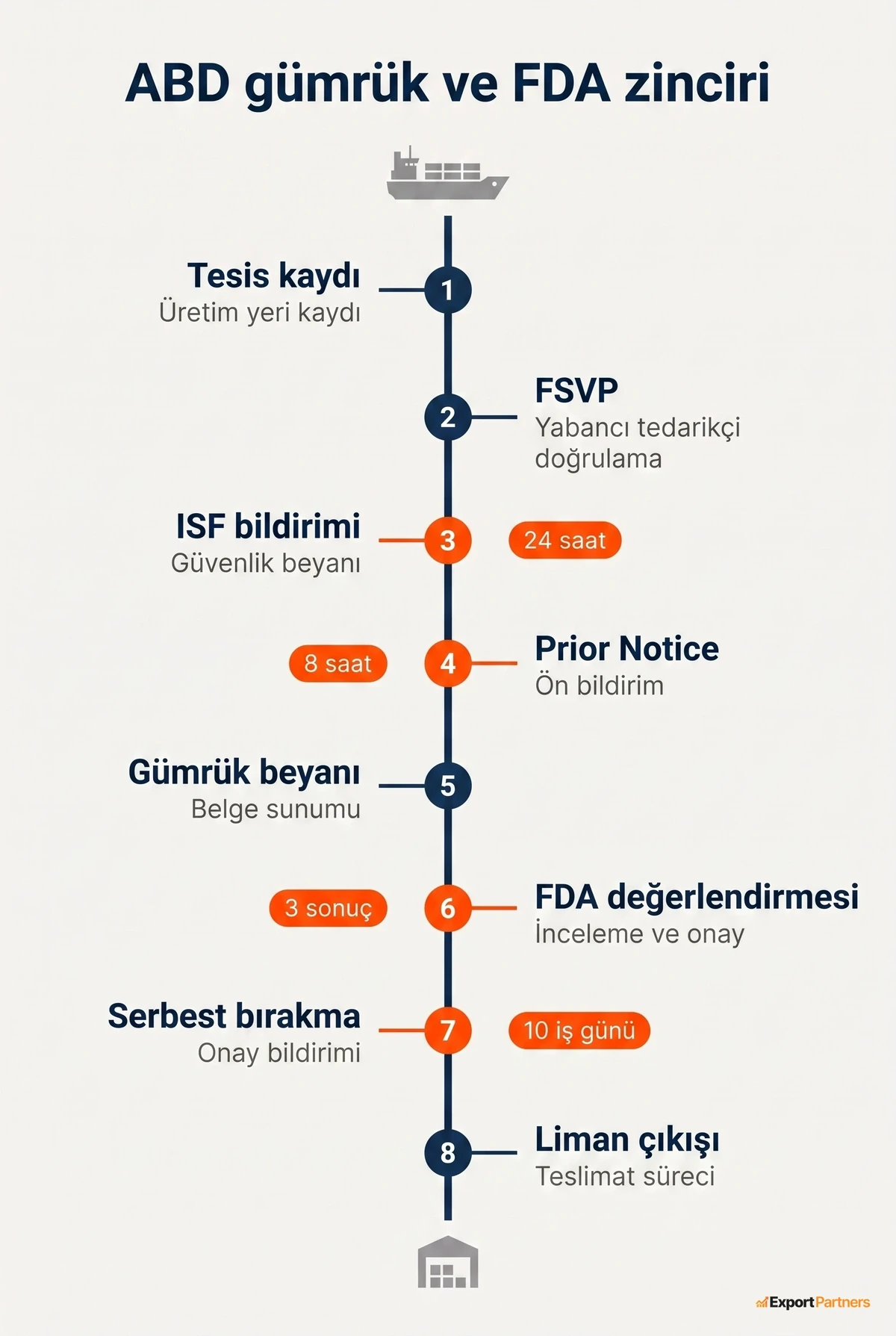
How does the U.S. customs and FDA process work from start to finish?
The sequence below is for a food shipment arriving by sea. Each step has a responsible party and a time window.
- Facility registration and agent. The manufacturing facility should be registered with the FDA and have a valid U.S. Agent.
- FSVP setup. The U.S. importer needs a written program that verifies the foreign supplier. The responsibility lies with the importer, but the manufacturer provides the documents.
- ISF filing. The Importer Security Filing is submitted at least 24 hours before the goods are loaded onto the vessel.
- Prior Notice. Advance notice is submitted to the FDA before arrival. The standard windows are 2 hours before arrival by land, 4 hours by air and rail, and 8 hours by water, and notice can be submitted no more than 30 days in advance (21 CFR 1.279).
- Customs entry and bond. The customs broker files the entry. The goods' HTS code, country of origin and CIF value are declared here.
- FDA review. The FDA issues one of three outcomes: May Proceed, a document or label review, or sample analysis. Label review is the most common hold and the easiest to prevent.
- CBP release and duty payment. After release, the entry summary is filed and duties are paid within ten business days.
- Port exit and distribution. The container is picked up and moved out of the port within the free time.
If you would like to handle the customs side together, take a look at our U.S. and Canada customs services. Detailed information on the FDA registration steps is available on our FDA registration and certification page.
Three rules that changed in 2026
The FDA facility registration renewal period opens October 1
FDA food facility registrations are renewed in even-numbered years. The 2026 renewal window runs from October 1 to December 31, 2026. A registration not renewed within this window is considered invalid. For shipments planned for October, renewing early tends to be the safer choice.
The Prior Notice rule was updated
With a final rule dated September 25, 2025, the FDA amended the Prior Notice regulation. For food arriving by international mail, the name of the postal service and the tracking number must now be reported. Specific time windows were also defined for resubmissions made after a refusal or hold.
FSMA 204 traceability rule postponed to 2028
For products on the Food Traceability List, the compliance date was moved from January 20, 2026 to July 20, 2028, a delay of thirty months. The content of the rule did not change; only the date was pushed back. If your product falls into a group on the list, you have gained extra time to set up your recordkeeping system.
How do you build the budget?
A simple three-column table covers most needs: one-time, per shipment and per unit. Setup items are divided by the total planned quantity, and shipment items by the quantity in that lot. This makes the unit cost difference between the first and third lot visible.
| Column | What goes in | How it is divided |
|---|---|---|
| One-time | FDA registration follow-up, label adaptation, lab testing, FSVP setup | By total planned quantity |
| Per shipment | Freight, insurance, customs broker, duty, MPF, HMF, drayage | By that lot's quantity |
| Per unit | Product cost, packaging, label printing | Direct |
Annually recurring items, such as the U.S. Agent and the bond, should be kept on a separate annual line rather than in the one-time column, and divided by that year's total quantity.
The three most common budgeting mistakes
- Loading setup costs onto the first lot. FDA registration, labeling and lab testing are not the expense of a single lot. If they are not divided by total quantity, the first lot looks unprofitable and a pricing decision may be based on the wrong numbers.
- Not setting aside a reserve for free time. Storage and chassis fees are rarely planned, but they do occur. Setting aside a small percentage of the shipment budget is usually enough.
- Calculating duty on FOB value. U.S. customs duty is assessed on the transaction value, and freight and insurance can affect the final landed cost. A calculation based only on FOB value may understate your total cost.
Frequently asked questions
Is FDA registration free?
Yes, the facility registration itself is free. The cost comes from completing the registration correctly, the U.S. Agent service and tracking the biennial renewal. FDA registers the facility; it does not approve the product.
What happens if my registration is not renewed on time?
The registration becomes invalid and shipments from that facility may be held at entry. Re-registration is possible, but the process takes time. For details, see our article on FDA registration cancellation and re-registration.
Who submits the Prior Notice?
The notice can be submitted by the importer, the customs broker or a party authorized on behalf of the exporter. What matters is the accuracy of the notice; missing or incorrect information can cause delays at entry.
Do dietary supplements go through the same process as conventional food?
The basic flow is the same, but labeling rules and claim limits differ. For supplements, ingredient statements and health claims are reviewed separately. Our article on selling collagen and protein powder offers a more detailed framework for this group.
Are there extra costs for products with animal-origin ingredients?
Yes. In addition to FDA, USDA and APHIS come into play, and import permits and certificates add time and cost. Our article on exporting pet food to the U.S. walks through the permit process step by step.
*The amounts in this guide are as of mid-2026 and are updated periodically. They should be checked against your own product's HTS code and category.*
Last updated: August 30, 2026
If you would like a step-by-step look at a single product, we have laid out the same process for olive oil in our guide to exporting olive oil to the U.S..
Cost items also vary by product. For honey, for example, antidumping duties applied to certain source countries enter the calculation; in our article on exporting honey to the U.S., we explain which countries are on the list.

