
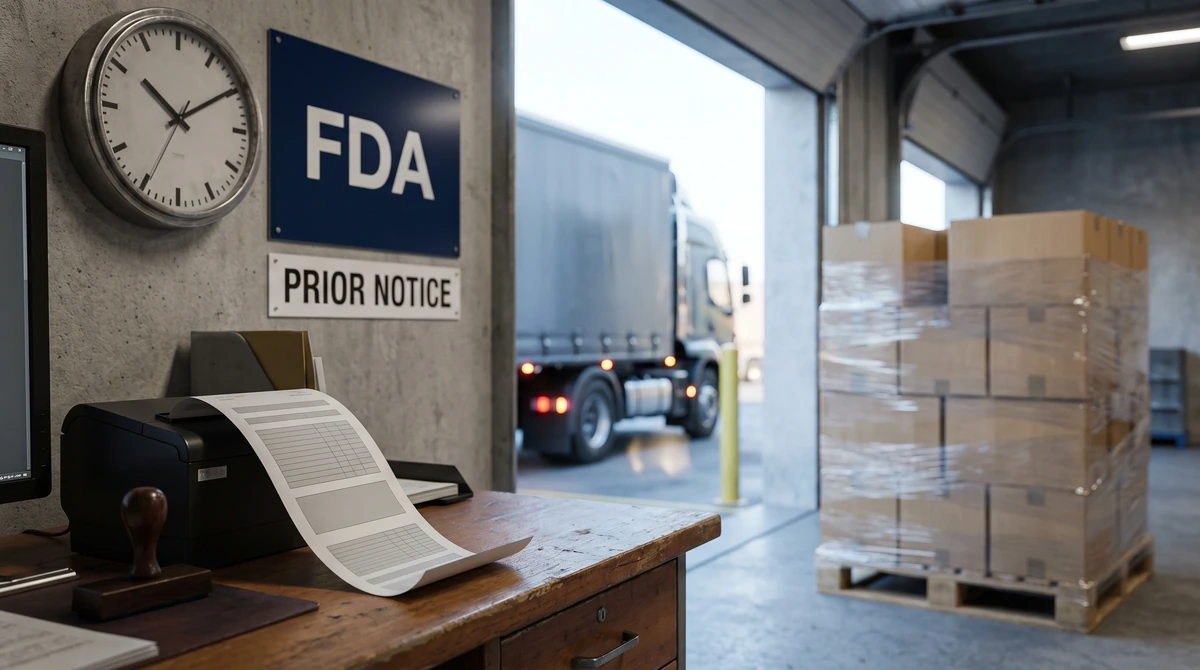
FDA Prior Notice is the advance notification submitted to the FDA for every food shipment arriving in the U.S., before the goods reach the port of entry. It is different from facility registration: registration is renewed every two years, while Prior Notice is filed separately for each shipment. Once the notice is confirmed, the FDA issues a PN Confirmation Number, and the notice timeline starts from that number.
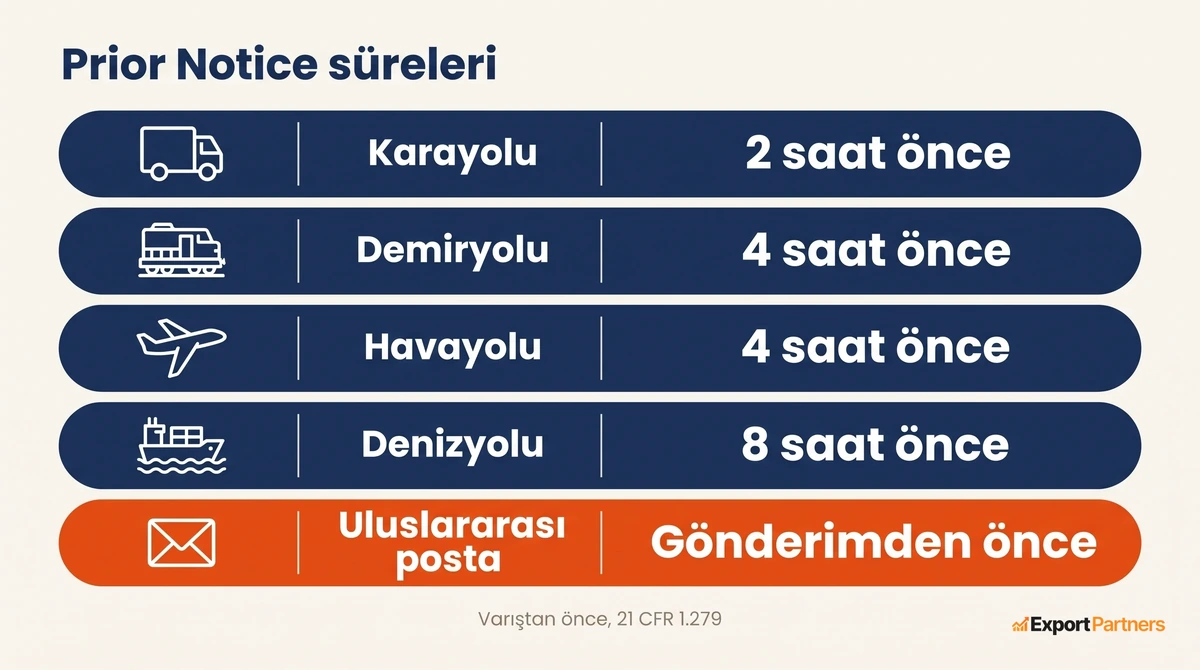
Deadlines vary by mode of transport and are defined in hours: 2 hours for land by road, 4 hours for rail and air, 8 hours for ocean. There is also an upper limit, so a notice submitted too early is not accepted either. International mail follows a different rule: the notice is submitted before the goods are sent.
Below we cover who submits the notice, the deadline table, the rules that changed at the end of 2025, and what happens when a notice is missing or incomplete.
What is FDA Prior Notice and who submits it?
Prior Notice is the advance notification to the FDA of food that is imported or offered for import into the U.S. Its purpose is to let the FDA plan inspection resources at the port of entry before the shipment arrives. The notice is usually submitted by the importer or by the customs broker working on its behalf; the manufacturer is not required to submit it directly.
There are two submission channels: the FDA's own interface, PNSI, and the customs-side ABI, ACE, ITDS channel. The channel used also determines how far in advance the notice can be submitted.
The manufacturer's role here is indirect but decisive. The notice asks for the facility registration number and manufacturer and shipper details. Since this information comes from the facility, an outdated registration number can leave the notice incomplete. We cover cases where registration status lapses in our article on FDA registration cancellation and re-registration.
What are the Prior Notice deadlines?
21 CFR 1.279 sets deadlines by mode of transport. The notice must be submitted at least this long before the goods arrive at the port of entry. How early a notice can be submitted is also limited, depending on the channel.
| Mode of transport | Latest submission | Basis |
|---|---|---|
| Land (road) | 2 hours before arrival | 21 CFR 1.279 |
| Rail | 4 hours before arrival | 21 CFR 1.279 |
| Air | 4 hours before arrival | 21 CFR 1.279 |
| Ocean | 8 hours before arrival | 21 CFR 1.279 |
| International mail | Before the goods are sent to the U.S. | 21 CFR 1.279 |
| Submission channel | Earliest submission |
|---|---|
| FDA PNSI | No more than 15 calendar days before expected arrival |
| ABI, ACE, ITDS | No more than 30 calendar days before expected arrival |
Many overseas exporters ship to the U.S. by ocean, so in practice the 8-hour deadline and the 30-day upper limit are what matter most. If the estimated arrival on the ocean bill of lading shifts, the notice may need to be managed in line with that change.
When is a notice considered submitted?
When the FDA accepts the notice for review, it sends a response message containing the PN Confirmation Number. The notice is considered submitted at the moment the FDA confirms it for review, and the timeline runs from that point. In other words, the confirmation time counts, not the moment you hit send.
How does the rule work for food sent by mail?
For food arriving by international mail, a different rule replaces the hour-based deadline: the notice is submitted before the goods are sent to the U.S. In addition, the PN Confirmation Number should appear on the customs declaration that travels with the package (CN22, CN23 or the U.S. equivalent).
This comes up often with samples and first shipments. Handing a sample to the courier and filing the notice afterward reverses the order the regulation requires.
A rule published in the Federal Register on September 25, 2025 (90 FR 46045) added one more field here. From October 1, 2026, notices for food arriving by international mail must include the carrier name and tracking number. This date is the same day the 2026 registration renewal window opens; details are in our FDA registration renewal guide.
This provision covers only food sent by international mail: samples, small lots and e-commerce parcels. Prior notice for commercial shipments moving by container or air cargo does not change; those continue under the hour-based deadlines above. The rule is not new either: it was published on September 25, 2025, with an effective date of October 1, 2026. For an exporter mailing samples, the practical result is this: the tracking number has to be in hand before the notice is submitted, so the shipping label is created before the notice.
What information does a Prior Notice submission require?
The notice carries a set of information that identifies the shipment. It includes the product description and quantity, manufacturer and shipper details, the facility registration number, the country the goods come from, the carrier, and the expected port and date of arrival. The submitter's own details are also recorded.
Most of these fields draw on documents from the manufacturer's side. When the details on the invoice, packing list and bill of lading do not match, a mismatch can also appear in the notice. That is why having the document set checked in one place before shipment keeps the notice from becoming a separate task.
If a shipment contains more than one product, a notice is filed for each line item. With mixed loads, the most common issue is a line item being missed. This can make only that item problematic rather than the whole load, but in practice it can mean the entire shipment waits.

What happens if the notice is incomplete?
Food imported or offered for import without adequate prior notice may be refused admission under section 801(m)(1) of the Act. If refused goods are not immediately exported under customs supervision, they are moved under an appropriate bond. The location where the goods will be held at the port is reported to FDA before they are moved there.
The notice can be submitted afterward, or FDA review can be requested. If neither happens and the goods are not exported, they are handled under the general order provisions of the customs regulations and, unless the parties agree otherwise, may only be sold for export or destroyed.
International mail works a little differently. If the notice is inadequate or the confirmation number is not properly attached, customs holds the package for 72 hours for FDA review and decision. If FDA refuses the goods under 801(m)(1) and a return address is available, the package may be returned to the sender marked as refused.
| Status | Duration | Source |
|---|---|---|
| Prior Notice submission after a refused or held shipment | 10 days | 90 FR 46045, effective October 27, 2025 |
| Submission of facility registration for a shipment held due to an unregistered facility | 30 calendar days | 90 FR 46045, effective October 27, 2025 |
| Customs hold period for a mailed package with inadequate notice | 72 hours | 21 CFR 1.283 |
These time limits are the core of the late-2025 update. Previously there was no defined deadline for post-refusal and post-hold submissions; now there is. Given what a waiting shipment costs, acting early tends to make more sense than using the full window.
What does it take to keep the notice accurate?
Most of the information in the notice comes from the manufacturer, so some errors start there too. When the four items below are a standard part of the information package sent to the customs broker, friction on the notice side tends to decrease.
| Item | Why it matters |
|---|---|
| Current facility registration number | It is required in the notice; if the registration was not renewed, the number may no longer be valid |
| Manufacturer and shipper details matching the documents | A difference between the entry and the notice can lead to additional questions |
| Accurate product description and quantity | The content of the notice should match the actual load |
| Reporting changes to the estimated arrival | Deadlines run from the arrival time |
The US Agent is not required to submit this notice, but questions FDA directs to the facility may come through the agent. The agent's role and the confirmation mechanism are covered in detail in our FDA US Agent guide. For the path followed once an examination starts at the port of entry, see our import refusal guide.

Frequently asked questions
Should the manufacturer submit the Prior Notice?
It is not required. The notice is usually submitted by the U.S. importer or their customs broker. The manufacturer's responsibility is to provide the facility and product information the notice requires, accurately and up to date.
Is Prior Notice the same as facility registration?
No. Facility registration is renewed every two years, while Prior Notice is filed separately for each shipment. The Prior Notice asks for the facility registration number, so the two are linked but are not the same process.
The notice was confirmed. Does that mean FDA approval?
No. The PN Confirmation Number shows that the notice has been received for review. FDA does not approve food facilities or shipments; the decision at the port of entry is a separate process.
If the arrival date changes, do I need to update the notice?
Because deadlines run from the arrival time, a change in the estimated arrival needs to be reflected in the notice. In practice the customs broker handles this, but passing the change to them in time is up to the shipper.
Is Prior Notice required when sending samples?
Food shipments other than those for personal use fall under the notice requirement. For food sent by international mail, the notice is submitted before the goods are sent and the confirmation number appears on the customs declaration. From October 1, 2026, the carrier's name and tracking number are also required.
Conclusion
FDA Prior Notice is filed for every shipment and has deadlines defined in hours: 2 hours by road, 4 by rail and air, and 8 by sea. For mail, the notice is submitted before the goods are sent and the confirmation number is added to the customs declaration.
The late-2025 rule set time limits for submissions on refused or held shipments, and from October 1, 2026 it makes the carrier tracking number mandatory for mail. Rules can change, so confirming on fda.gov before shipping is a sensible step.
To set up prior notice, registration and customs together, you can reach us through our FDA registration and certification service or our U.S. and Canada customs processes page.
Last updated: September 10, 2026

