
Exporting Animal-Based Food to the U.S.: The USDA Process Beyond the FDA
Manufacturers planning animal-based food exports to the U.S. should keep one important fact in mind: whether the product is dry pet food, wet pet food, premium organ-based treats or processed food containing meat, animal products follow a very different process from regular food. Completing FDA registration is often not enough; for the product to clear the U.S. border, a second agency is also involved: the USDA.
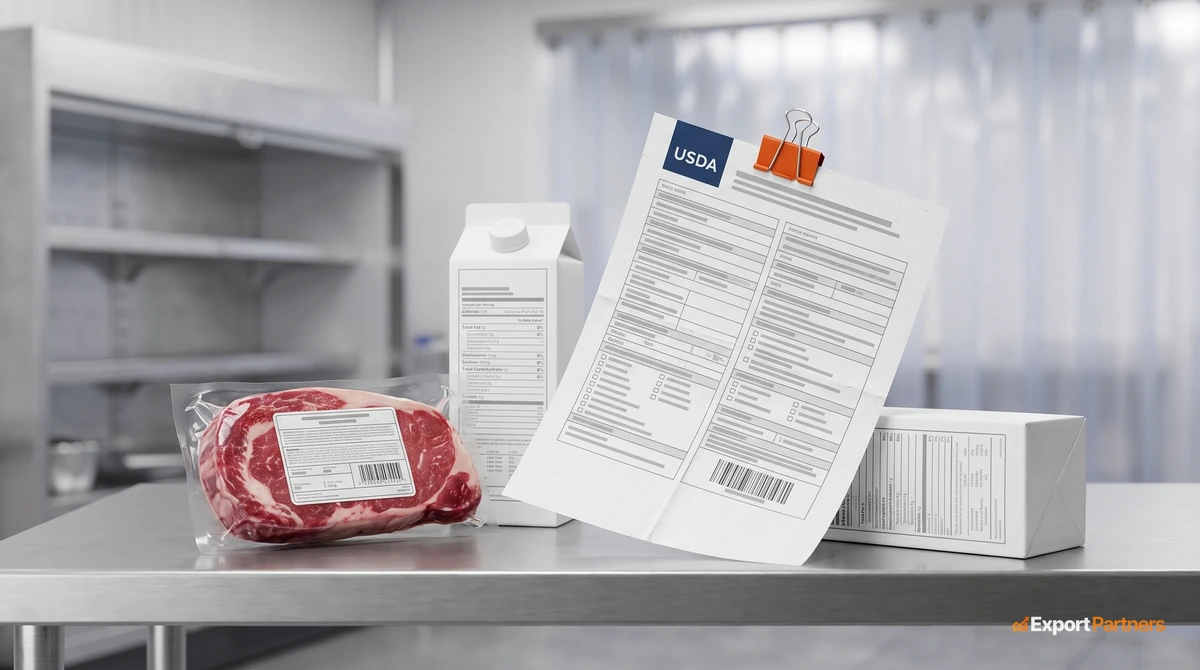
For manufacturers who start without knowing this distinction, the outcome is often the same: the container waits at the port, daily demurrage accrues, and in some cases the product is sent back. The rules themselves are clear, and when the process is set up correctly from the start, it can move forward smoothly. In this article, we explain the entry path for animal-based food into the U.S. within a framework that covers all product groups.
The U.S. Animal-Based Food Market: Why Is Demand So Strong?
The U.S. is one of the largest markets in the world for spending on food with animal-based ingredients. Three categories in particular open a real window of opportunity for foreign manufacturers:
Pet Food and Premium Treats
The U.S. pet products market is among the largest in the world and continues to grow. The fastest-growing segment is premium and functional treats: freeze-dried meat treats, single-protein and grain-free foods, and high value-added organ-based products. For our in-depth guide on pet food, see our article Pet food exports to the U.S.: an APHIS, FDA and Amazon guide.
Milk and Dairy Products
U.S. cheese imports exceed 2 billion dollars a year; sheep's milk cheeses and aged cheeses hold a strong position on the gourmet shelf. Imported dairy products can find real demand, especially under the Mediterranean cuisine umbrella and across ethnic grocery networks.
Processed Meat and Charcuterie
Traditional products such as cured sausages, air-dried beef and cooked preserved meats reach both diaspora communities and mainstream consumers who follow the "international foods" trend. However, this category is where USDA oversight is most intensive, so the process structure is especially critical here.
The demand side is ready. What makes the difference is whether the regulatory structure is set up correctly from the start.
Why USDA? What Does the FDA Not Cover?
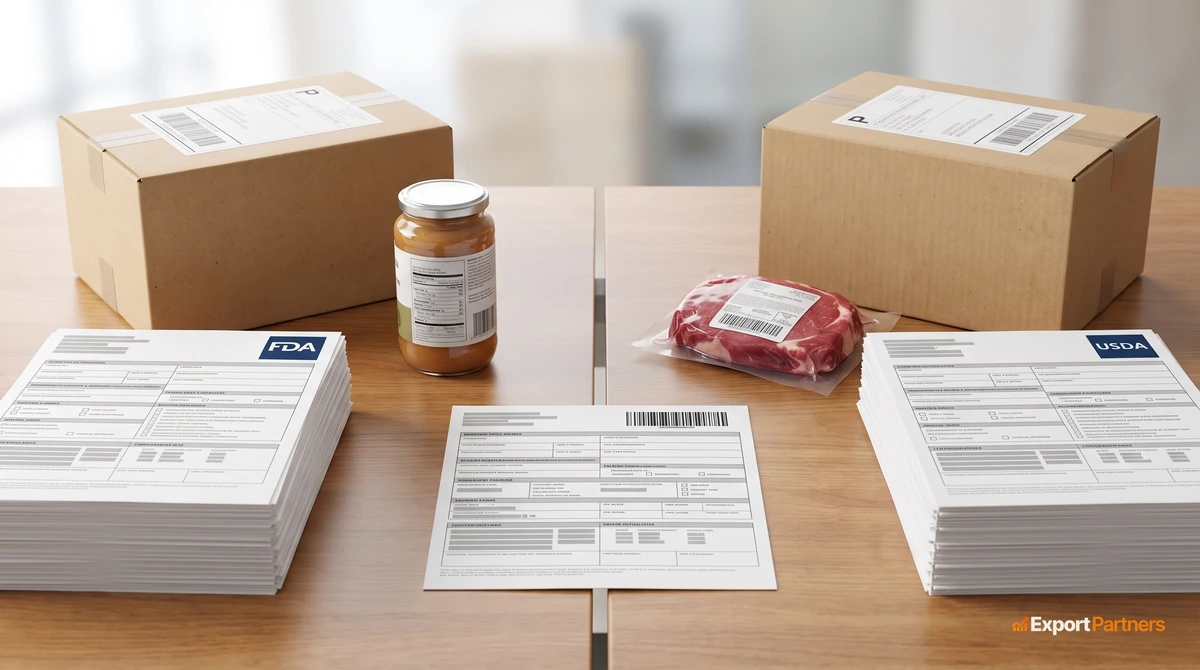
Let us correct a common misconception first: the FDA is responsible for food "in general," but not for all food. In the U.S., food oversight is shared between two agencies:
- FDA (Food and Drug Administration): Most conventional food, processed food, beverages, supplements, cosmetics and drugs.
- USDA (United States Department of Agriculture): Meat, poultry and egg products, along with many products containing animal-based ingredients. The USDA's food safety arm is FSIS (Food Safety and Inspection Service), and its animal health arm is APHIS (Animal and Plant Health Inspection Service).
The main reason the USDA is involved comes down to one word: biosecurity. To prevent foreign animal diseases such as foot-and-mouth disease (FMD), African swine fever (ASF) and avian influenza from entering the country with imported animal products, the U.S. applies very strict border controls. So the question is not only "is your product safe?" but also "is this product acceptable given the animal health status of the country it comes from?"
This approach also explains the point where manufacturers most often go wrong: a product can be fully compliant from the FDA's perspective, but if the animal disease status of the country of origin is not acceptable, the product may not be allowed into the U.S. The check is made not per product, but per combination of country, product and manufacturer.
What Is Required for Animal-Based Products?
Requirements vary by product group, but for animal-origin products a U.S. entry file typically includes the following layers:
1. Country of Origin Health Certificate
This is an official certificate issued by the competent veterinary authority in the country of origin. It confirms that the product is eligible for export from an animal health standpoint. It should be issued in English, in a format USDA accepts, with the correct references. In most cases a separate certificate is issued for each shipment.
2. USDA FSIS Documents
For meat and poultry products, production facilities subject to the FSIS process support each shipment with the relevant documents, including FSIS 9540-I. The basic rule is that USDA expects imported products under FSIS inspection to come from countries whose inspection systems are equivalent to U.S. standards. A country's equivalence status is assessed by product group, so for processed meat products this point should be clarified at the very start.
3. APHIS Permit and VS Permit
Offal-based products, dried organ treats, some dairy products and feed or pet food products may require an APHIS Veterinary Services (VS) permit. Requirements are checked by product and country of origin through APHIS's VS Permitting Assistant, and each product follows its own set of rules. For a detailed guide covering the application steps, the current APHIS eFile process and common mistakes manufacturers make, see our guide on how to obtain a USDA VS Permit.
4. FDA Requirements and Prior Notice
The USDA layer does not replace FDA. For many animal-origin products, including pet food, FDA facility registration, a US Agent designation and Prior Notice for every shipment still apply. The process is built as "FDA + USDA", not "FDA or USDA". For details, see our FDA Registration and Certification guide.
5. Customs and Importer Layer
On the shipping side, an animal-origin product is unlikely to clear customs smoothly without importer registration, a customs bond and the correct HTS classification. On the label side, the product name, net quantity, ingredients, allergens, manufacturer details and country of origin statement (for example, "Product of India") need to be in English and in U.S. format. For label review, our FDA Label and Customs Guide can help.
What Does the Wrong Sequence Cost?
When the documents are not in place before the product ships, the practical consequences often look like this:
- Demurrage and storage: Daily charges for a container held at customs can reach thousands of dollars within a few weeks.
- Sampling and testing costs: Additional samples or tests requested by FDA or USDA are charged to the importer.
- Re-export or destruction: Products refused entry may have to be shipped back or destroyed, which costs money and can affect your reputation.
- Import Alert (DWPE) risk: Repeated problems can lead FDA to place a firm on its "Detention Without Physical Examination" list, after which later shipments may be detained automatically.
- Buyer relationship: A problem with the first shipment to a U.S. distributor or retailer can be very hard to recover from.
What Does the Right Sequence Look Like in Practice?
In the animal-origin product projects we manage, the sequence we follow works roughly like this:
- 1. Product and origin eligibility check: Entry conditions for each product from your country of origin are checked through the APHIS VS Permitting Assistant. This is the go/no-go point for the project.
- 2. Core registrations: FDA facility registration + US Agent, and D-U-N-S if needed.
- 3. USDA layer: FSIS equivalence review and the APHIS VS Permit application, depending on the product range.
- 4. Health certificate setup: Setting up the certificate workflow in the country of origin, a process that repeats with every shipment.
- 5. Label and packaging compliance: Label review and revisions for each SKU to match U.S. format.
- 6. Shipping operations: Prior Notice, importer registration, customs bond, correct HTS classification and freight planning.
The Roadmap at a Glance
| Stage | What Is Done | Why It Matters |
| Category analysis | Product-level eligibility (APHIS VS) | The project's go/no-go point |
| FDA basics | Facility registration + US Agent + Prior Notice | FDA requirements still apply to animal-origin products |
| USDA FSIS | Equivalence review + document set | The main gateway for meat and poultry products |
| APHIS permit | VS Permit application and follow-up | Decisive for offal, organ and some dairy products |
| Label | Label in U.S. format for each SKU | Most revisions come up here |
| Shipping | Health certificate + bond + HTS | Operations repeated with every shipment |
Frequently Asked Questions (FAQ)
Is FDA registration enough for animal-origin products?
No. Depending on the product group, USDA FSIS and/or APHIS permits also apply, and a health certificate is required for every shipment. The FDA and USDA layers are set up together.
Is a health certificate required for every shipment?
Yes. The health certificate is issued by the authority in the country of origin for each shipment and should be in a format USDA accepts.
How long does an APHIS permit take?
It depends on the product and country of origin. Applying early with the right documentation can shorten the process noticeably. Beyond timing, the key question is whether the product is eligible for entry from that country of origin.
How does my country's foot-and-mouth disease status affect exports?
USDA assesses imported animal-origin products based on the animal disease status of the country of origin. That is why confirming the product and origin combination in the APHIS system comes first in the process.
Can my label be in my own language?
No. The entire label should be in English and include the mandatory elements required in U.S. format.
Getting the Documents Right Before the Product Ships
In animal-origin food exports, the real task is getting the documents right before the product ships. Projects that do not plan the FDA and USDA layers together often end up learning through delays and extra costs on the first shipment, while for manufacturers who follow the right sequence the process becomes far more predictable.
We manage FDA and USDA regulatory processes end to end for manufacturers exporting animal-origin products to the U.S. We also coordinate freight and U.S. customs procedures, U.S. tax and accounting, and trademark registration under one roof.
Related guides: How to obtain a USDA/VS permit · Exporting pet products to the U.S. · FDA registration and certification · Trademark registration in the U.S.
Other guides in this series
This guide is part of a series on FDA processes for exporting to the U.S. Related guides:
- APHIS, FDA and AAFCO steps for exporting pet food to the U.S.
- Exporting natural dog chews to the U.S.
- FDA registration, GMP and customs for vegetable oil exports
- For registration and certification support, see our FDA registration and certification service.
Last updated: October 7, 2026

