
To ship dried fruit and nuts to the U.S., FDA food facility registration is mandatory, free of charge and renewed every two years. Registration alone is not the whole picture, though. For raisins, figs and pistachios, the deciding factor is often whether the product appears on one of FDA's import alert lists. Shipments covered by these lists can be detained at U.S. customs without physical examination.
Below, you will find what registration does, the two import alert lists most relevant to dried fruit and nut exporters, the aflatoxin limit, labeling requirements and the tariff rate that changed in 2026.
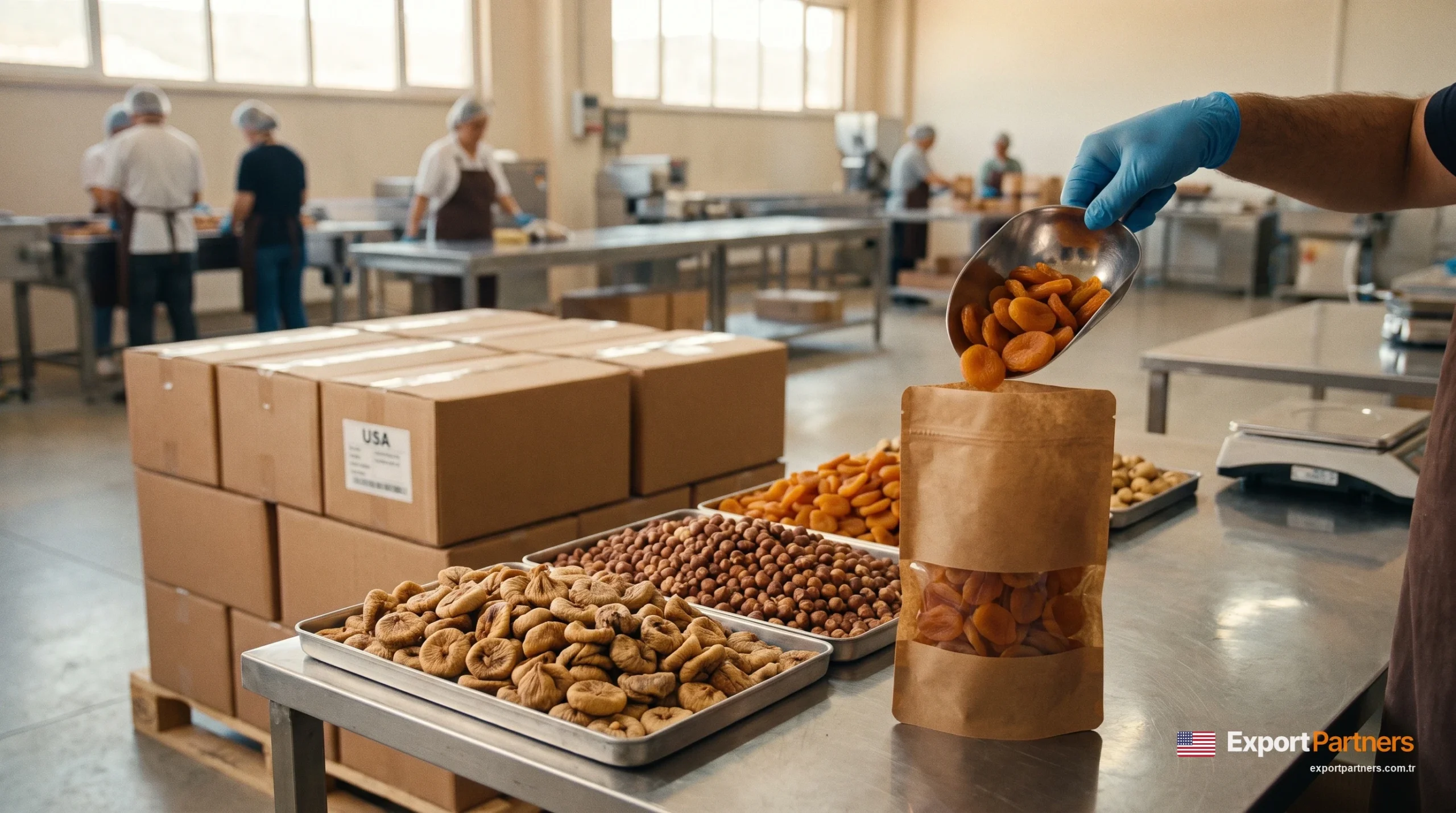
What does FDA registration do, and what does it not do?
FDA facility registration means notifying FDA of your production facility. Registration is free, and the facility receives an eleven-digit number.
A common misunderstanding: registration does not show that a product is produced safely or meets U.S. standards. FDA does not approve food; it only records that the facility exists. For this reason, using the phrase “FDA approved” on a food product is considered a misleading claim in the U.S. We cover the difference in detail in our article on FDA registration, approval and certificates.
For dried fruit and nut exporters, the registration stage has three parts:
- Facility registration. Completed through FDA Industry Systems, free of charge.
- U.S. Agent. Required for every foreign food facility; communication between FDA and the facility runs through this contact. Details are in our U.S. Agent article.
- Prior Notice for each shipment. Registration is a one-time step, while Prior Notice is filed separately for every shipment. They are two separate obligations.
The real issue: which import alert lists apply?
An import alert is a pre-emptive detention mechanism FDA applies to specific products and firms. It is known as DWPE, “detention without physical examination.” When a covered shipment arrives at a U.S. port, it can be detained without sampling, and the burden of showing the product is compliant falls on the exporter.
Dried fruit and nuts can appear on two separate lists, and their scope is different:
| List | Product | Reason | Scope |
|---|---|---|---|
| Import Alert 99-15 | Raisins (whole and paste) | Procymidone residue, a pesticide | Country-wide. Raisin shipments from the listed country are covered |
| Import Alert 23-14 | Pistachios (in-shell and kernels), figs, fig paste, peanuts | Mycotoxins, mainly aflatoxin | Firm-specific. Only firms named on the list are covered |
This distinction matters a great deal in practice. For raisins, the list applies country-wide, so a shipment can be covered even if your company has never had a problem. For pistachios and figs, the list applies by firm name; if your company is not listed, your shipment is not subject to this mechanism.
There is also a way off the list. FDA can place firms that document their compliance on an exemption list known as the “green list.” In raisins, a manufacturer obtained an exemption this way in 2018. The process requires analysis results and a history of consecutive compliant shipments, and it takes time, but it is not a closed door.
You can check your own status on the Import Alert 99-15 and Import Alert 23-14 pages. The lists are updated, so it is worth checking before each shipment.
How do you get off an import alert list?
Being placed on an import alert list is not permanent. The path to FDA's exemption list, the “green list,” works like this:
- Find and fix the cause. For aflatoxin, you need to identify where it forms in the harvest, drying and storage chain. For residues, the issue lies in pesticide application. Until the cause is fixed, the other steps have little value
- Build a history of consecutive compliant shipments. FDA generally looks for a set number of consecutive shipments found compliant through independent laboratory analysis
- Prepare the file. Corrective action report, analysis results, and changes to production and storage conditions
- Submit the request. The request is sent to FDA and reviewed
The process is not quick; it is measured in months. But the fact that a raisin producer obtained an exemption this way in 2018 shows it is not a closed door.
In the meantime, shipments do not stop entirely. A listed firm can still ship, but it needs to document compliance for every lot and plan for detention time. That means port fees and storage costs, so for most firms getting off the list makes more commercial sense.
What happens if a shipment is detained?
The detention notice goes to the importer in the U.S., not to the manufacturer. The importer has a set period to respond, and there are two options: show with documentation that the product complies, or send the product back or destroy it without bringing it into the U.S.
Showing compliance usually requires analysis at a laboratory in the U.S. that the FDA recognizes. Analysis done in your own country is not always accepted. That difference in cost and time is why preparation before shipment matters.
What is the aflatoxin limit?
The FDA action level for total aflatoxins in human food is 20 ppb (parts per billion). The same level applies to the whole nut group, including pistachios, peanuts and Brazil nuts. There is a separate and much lower level for aflatoxin M1 in milk, 0.5 ppb, but that falls outside this product group.
The key point: 20 ppb is not a "permitted contamination" limit. It is an action level set for unavoidable situations. The goal is not just to stay under the limit, but to keep levels as low as possible.
European Union limits are lower than U.S. limits for some products. A manufacturer already shipping to the EU has its testing setup in place, which also makes the U.S. side easier.
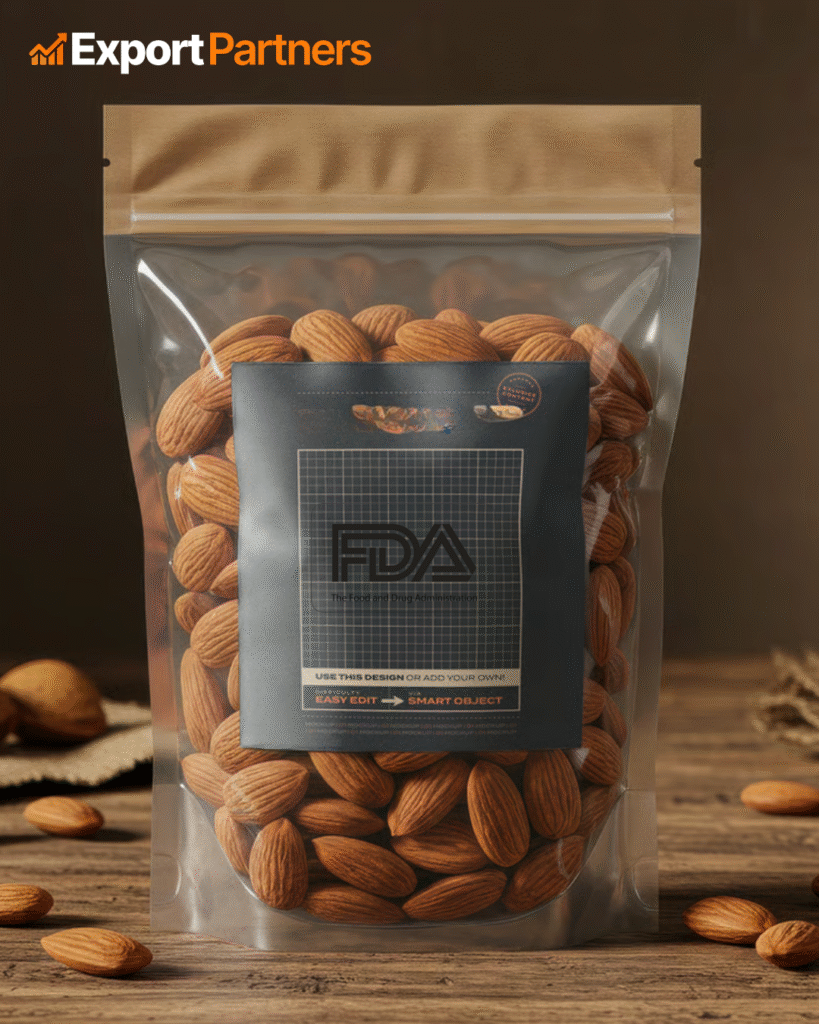
What does the label need to include?
Translating your existing label into English is not enough; the layout needs to be rebuilt in the U.S. format. For nuts and dried fruit, these are the elements reviewers look for:
- Nutrition Facts panel. In the U.S. format, with serving sizes based on U.S. reference amounts
- Allergen declaration. Tree nuts are a major allergen group in the U.S. Hazelnuts, almonds, walnuts and pistachios are named individually: "Contains: Hazelnuts"
- Ingredient list. In English, in descending order by weight
- Net quantity. In both metric and U.S. units
- Name and address of the manufacturer or importer
- Sulfur dioxide declaration. If used in dried apricots or other dried fruit, it must be declared above 10 ppm
Who is responsible for FSVP?
This is where most of the confusion comes from. The party required to maintain the FSVP file is the importer in the U.S., not the manufacturer abroad.
However, the importer asks the manufacturer for documents to complete that file: hazard analysis, preventive controls, test results and supplier verification records. So even though the responsibility sits with the importer, part of the work falls on the manufacturer. A manufacturer that keeps these documents ready becomes an easier supplier for the importer.
What changed with tariffs in 2026?

An additional duty that took effect on July 24, 2026 applies at 12.5% for some origin countries. This rate was not added on top of previously discussed rates; it replaced them.
The duty has an exemption list, but it covers raw materials not grown in the U.S., such as coconut, cocoa and palm kernel oil. Hazelnuts, dried figs, dried apricots and raisins are not on this list, so they remain in scope.
The exemption list works at the eight-digit tariff code level. A four-digit heading appearing on the list does not mean the product is exempt; the check needs to be done on the eight-digit code. For the full set of cost items, see our article on the cost of exporting food to the U.S.
When is registration renewal due?
FDA food facility registration is renewed in even-numbered years, between October 1 and December 31. The 2026 window opens on October 1, 2026 and closes on December 31, 2026. A registration that is not renewed is considered expired and is cancelled.
Renewal, like registration, is free of charge with the FDA. During this period, some intermediaries may send invoices titled "renewal fee"; before paying, it is worth having the registration number checked to confirm the renewal was actually completed.
What should you do, step by step?
- Check whether your product is on any import alert lists. This comes first because the result affects everything else
- Have aflatoxin and residue testing done at an accredited laboratory and keep the results
- Complete your FDA facility registration and appoint your U.S. Agent
- Rebuild your label in the U.S. format
- Discuss FSVP documents with your importer in advance
- Confirm the duty rate using your eight-digit tariff code
- Submit Prior Notice for every shipment
We handle the process end to end for dried fruit and nuts. If you would like to discuss your situation, contact us.

