
An FDA label and customs service brings together the two areas food manufacturers shipping to the U.S. need most. The United States has some of the strictest food import regulations in the world. For manufacturers planning frozen food exports, the process involves more than production and logistics; FDA (Food and Drug Administration) label compliance, Food Facility Registration and U.S. customs procedures are also critical.
An incorrectly prepared label, a missing FDA registration or an inaccurate customs entry can lead to products being detained at customs or even refused entry entirely. For this reason, manufacturers who want to export frozen food to the U.S. should fully meet both FDA and CBP (Customs and Border Protection) requirements.
What steps should manufacturers follow to ship frozen food to the U.S.?
Which fields are mandatory on the label is a separate topic. We cover the six mandatory fields and the mistakes we see most often in practice in U.S. Labeling Rules: Six Mandatory Fields. This guide explains where the label sits in the export and customs process, and which step depends on which.
Why Label Compliance Matters in FDA Label and Customs Service
Labels for every food product shipped to the U.S. need to be prepared in line with FDA rules. Labels do more than inform consumers; they are also a primary checkpoint in FDA inspections. For frozen foods in particular, nutrition facts, allergen declarations and net quantity statements are among the most frequently reviewed areas.
Key elements a label should include:
- Nutrition Facts Panel: The U.S.-specific nutrition format should be used. Nutrition tables used in other markets, such as Europe, differ from the U.S. standard.
- Ingredient List: Ingredients are listed in descending order by weight. Allergens (e.g. milk, soy, gluten, tree nuts) in particular should be clearly declared.
- Net Quantity Statement: Both metric units (grams/kilograms) and U.S. customary units (ounces/pounds) should appear.
- Manufacturer Name and Address: This should match the FDA-registered facility address; using a different address may lead to product refusal.
- Country of Origin Statement: A statement such as “Made in [Country]” is required.
Missing or incorrect information can prevent a product from being listed both during FDA inspections and on online marketplaces such as Amazon.
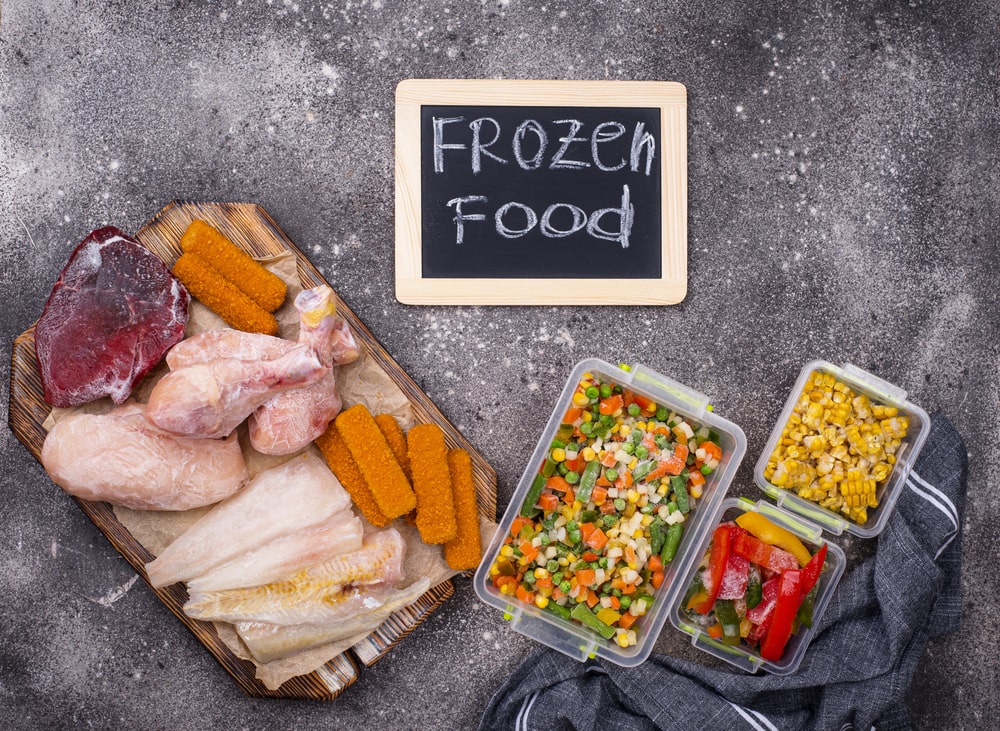
Frozen Food
- FDA Scope: Frozen foods are also subject to FDA Food Facility Registration and labeling rules.
- Labeling: A Nutrition Facts panel, net weight, ingredient list and allergen declaration are required. In addition, storage conditions (“Keep Frozen”) should always appear on the label.
- Storage and Logistics: The cold chain must be maintained at entry into the U.S. and during sale. FDA and CBP may also check product temperature during customs inspection.
- Risk Management: Frozen foods are kept under closer scrutiny mainly because of microbiological risks (Listeria, Salmonella, etc.).
Example: Frozen pizza, frozen vegetables, frozen fish, ice cream → in FDA inspections, both the contents and the storage conditions may be checked.Regular Food (Shelf-Stable / Ambient Food)
- FDA Scope: Regular foods are also subject to Food Facility Registration, but there is no cold chain requirement.
- Labeling: Nutrition Facts, ingredient list, net quantity and allergen declarations are still required.
- Storage and Logistics: Products can be shipped and stored at room temperature. No cold chain check is performed at customs.
- Risk Management: The focus is mostly on label and ingredient compliance. For example, shelf life, additives and allergen declarations tend to be front and center in FDA inspections.
- Example: Chocolate, biscuits, pasta, nuts → FDA mainly reviews label compliance and ingredient declarations.
Key Differences at a Glance
- Frozen food: Cold chain plus storage conditions on the label are required.
- Regular food: Can be shipped at room temperature; no cold chain requirement.
- FDA Inspection: Microbiological risks (Listeria, Salmonella) are checked more often for frozen food.
- Labeling: For frozen food, the “Keep Frozen” statement and appropriate storage conditions are required.
- Logistics: For frozen food, cold chain documentation and transport conditions may also be presented at customs
In other words, both product groups are subject to FDA registration and labeling rules, but frozen food is also checked for cold chain and storage conditions.

Which Documents Are Required to Export Food to the U.S.
The documents required for food shipments to the U.S. fall into two groups: the commercial documents customs asks for and the compliance records the FDA asks for. The product group can change the list; the order below shows the general flow.
- FDA food facility registration and U.S. Agent designation. The registration is made in the name of the manufacturing facility, not the exporting company. If the manufacturer is already registered, no new registration is opened; the existing registration is checked to confirm it is current.
- Prior Notice. It is submitted separately for each shipment. Facility registration is done once, while prior notice is repeated for every shipment; when the two are confused, a shipment may be held at the port.
- Commercial invoice, packing list and transport document (bill of lading or air waybill).
- Customs entry and customs bond. The bond is issued in the name of the party holding the importer record. Details are in our U.S. Customs Bond article.
- Label compliance. This is not a document but the information the product carries on its packaging; however, it is checked like a document at entry, and if something is missing the shipment can stop there.
- Additional registrations by product group. For low-acid canned and acidified foods, FCE and SID apply; for meat, dairy and certain plant products, USDA and APHIS may come into play.
Documents requested by the buyer or by tariff rules, such as a certificate of origin, fall outside this list and depend on the contract. For frozen food, documentation of the cold chain throughout transport is also expected; a temperature record is not a customs document, but the buyer or inspectors may ask for it.
The step most often skipped is the label. Label compliance sits in the middle of the list, not at the end, because it is the one step that has to be done before printing. A gap found after the packaging is printed means a reprint, while a gap in the registration or declaration can often be corrected the same day.
Food Facility Registration and U.S. Agent Support
Every manufacturing facility that ships frozen food to the U.S. is required to complete FDA Food Facility Registration. The registration must be renewed every two years (in even-numbered years), and a U.S. Agent must be designated in the U.S.
On behalf of manufacturers, we:
- Complete Food Facility Registration in full
- Provide the official U.S. representative (U.S. Agent) service
- Follow up on FDA inspections and correspondence on the manufacturer's behalf
- Check that labels and product ingredients meet FDA requirements
Registrations made without a designated U.S. Agent are not considered complete, and products may be refused at customs entry.

U.S. Customs Processes
FDA registration alone is not enough. The customs processes run by U.S. Customs and Border Protection (CBP) also need to be completed in full.
Our services:
- Import guidance service to help products clear U.S. customs smoothly
- Importer customs registration support
- Customs Bond: required for companies that export to the U.S. on a regular basis
- Accurate declaration of duties and costs
- Cost control with the DDP (Delivery Duty Paid) option for shipments to Amazon and retail chains
Duties: On August 29, 2025, the duty exemption for shipments under 800 USD was suspended. Two CBP interim final rules published on June 24, 2026 made the suspension indefinite (Federal Register 2026-12670 and 2026-12669), with no country-specific exception.
The 15% reciprocal tariff in effect at that time no longer applies. EO 14389 of February 20, 2026 revoked the additional ad valorem duties imposed under IEEPA (Federal Register 2026-03832). The layer that is certain today is the 12.5% under Section 301, and this rate is added to the product's own customs duty (Federal Register 2026-15181). The status of the temporary 10% additional duty under Section 122 is not clear, so it is worth confirming with your customs broker. We show with an example the order in which the layers add up and how they are calculated on a shipment in our article How U.S. customs duties affect Amazon sellers.
Food products, including frozen food, are not covered by the general exemption, but the additional lists may include product-level exceptions, so it is safer to check your own HTS code. This can increase costs for small-volume shipments.
Opportunities for Manufacturers
Frozen food manufacturers with strong quality and competitive costs can build a solid position in the U.S. market. With correct labeling, FDA registration and customs support, your products can be ready for sale through:
- Amazon FBA warehouses
- Retail chains such as Walmart and Target
- Distributors across the U.S.
with confidence.
FDA-compliant, professional labeling can also make inspections go more smoothly and help build your customers' trust in you.
You may also find these FDA articles useful:
FDA-Compliant Adhesives and Food Packaging
FDA and VS-16 Permit Processes for Exporting Pet Food to the U.S.
U.S.-Canada Customs Processes, FDA Registrations and Hazmat Logistics
The FDA Process for Selling Food and Cosmetics in the U.S.
Frequently Asked Questions
Is there an FDA certificate?
No. The FDA does not issue product certificates; it only manages the registration and compliance process.
Is FDA registration required for frozen food?
Yes. Every food product entering the U.S. must come from a facility registered with the FDA.
What is a Customs Bond?
It is a customs guarantee that companies exporting to the U.S. on a regular basis need to obtain.
Is FDA registration required to sell on Amazon?
Yes. In the food category, Amazon asks sellers for their FDA registration documents.
Are bilingual labels required?
No, English alone is sufficient. However, some importers may also ask for Spanish labeling.
What happens if no U.S. Agent is designated?
Your FDA registration is not considered complete, and shipments may be held at U.S. customs. We cover this in more detail in our article What Happens to Products Detained by the FDA at U.S. Customs?
Which documents are needed to export food to the U.S.?
Facility registration and a U.S. Agent, plus prior notice for each shipment, a commercial invoice, a packing list, a transport document, a customs entry and a bond. Depending on the product group, FCE, SID or USDA requirements may also apply. The full sequence is in the section above.
At what point in the export process is label compliance handled?
Before the packaging is printed. Label review runs independently of the registration and shipping steps; it can be ordered as a standalone service or as part of a package together with registration and customs work.
Last updated: September 25, 2026

