
Amazon FBA cash flow is the topic manufacturers entering the U.S. market talk about least, yet in practice struggle with most. The product is well chosen, the listing is ready, ads are running and sales are coming in. Even so, at some point the cash runs low, and inventory cannot be replenished right when sales start to pick up.
The cause is usually timing, not profitability. On Amazon, there can be months between earning money and actually receiving it. The gap between the day you pay for production and the day the revenue from that product reaches your bank account often turns out much longer than most companies first estimate. You can also read our article Amazon Product Liability Insurance, now a requirement, which covers this topic in more detail.
A payment rule that took effect for U.S. accounts on March 12, 2026 widened this gap a little further. Below, we first break down where the money goes item by item, then explain the mechanism on the payout side and show, with a sample calculation, how many days the cycle actually takes.
Why Amazon FBA cash flow matters more than profit
Calculating the per-unit profit margin in a spreadsheet is easy. You subtract product cost, Amazon's referral fee, FBA fees and the advertising share, and what remains is profit. We explained how these items are built in detail in our Amazon private label starter guide. Even when the math is right, a company can still end up in a tight spot, because profit is a ratio while cash flow is a calendar.
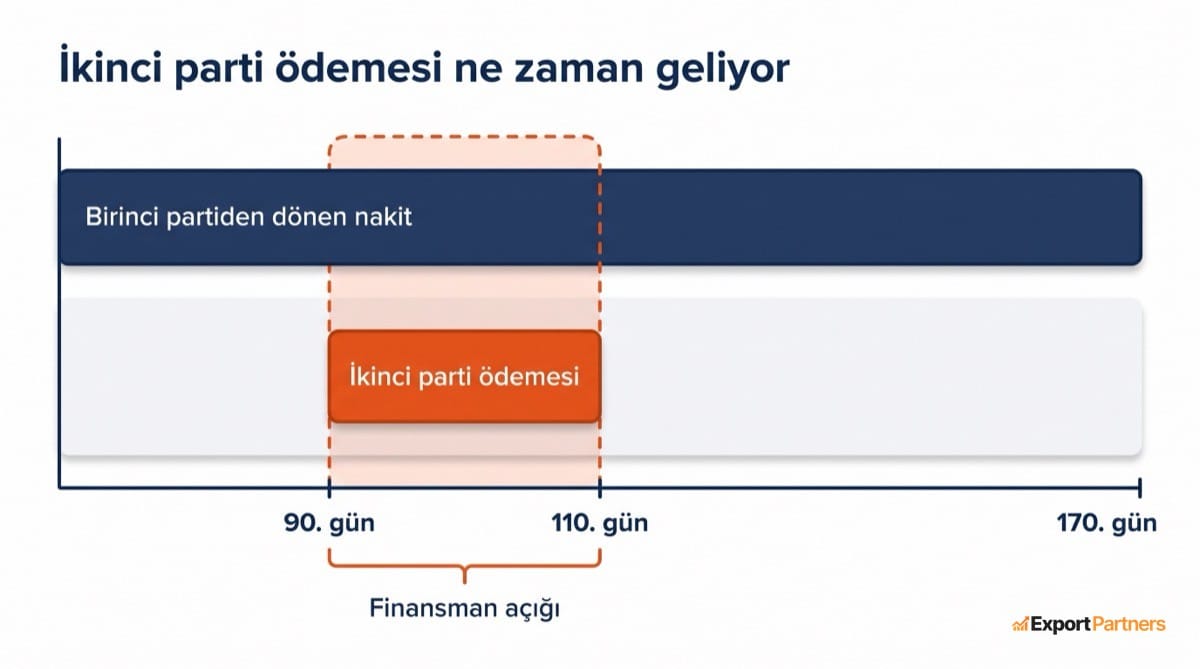
Even with a profitable product, this situation can come up: by the date payment is due for the second production run, the money from the first batch's sales has not yet been released. The product has sold and earned a profit, but the money is still in transit. At this point, either inventory runs out or outside financing has to be found.
Running out of stock on Amazon does more than cost you that day's sales. Because the listing's sales velocity drops, its organic ranking also slips, and getting back to your previous position after restocking usually takes a few weeks. In other words, cash planning is also part of ranking planning.
Where the money goes
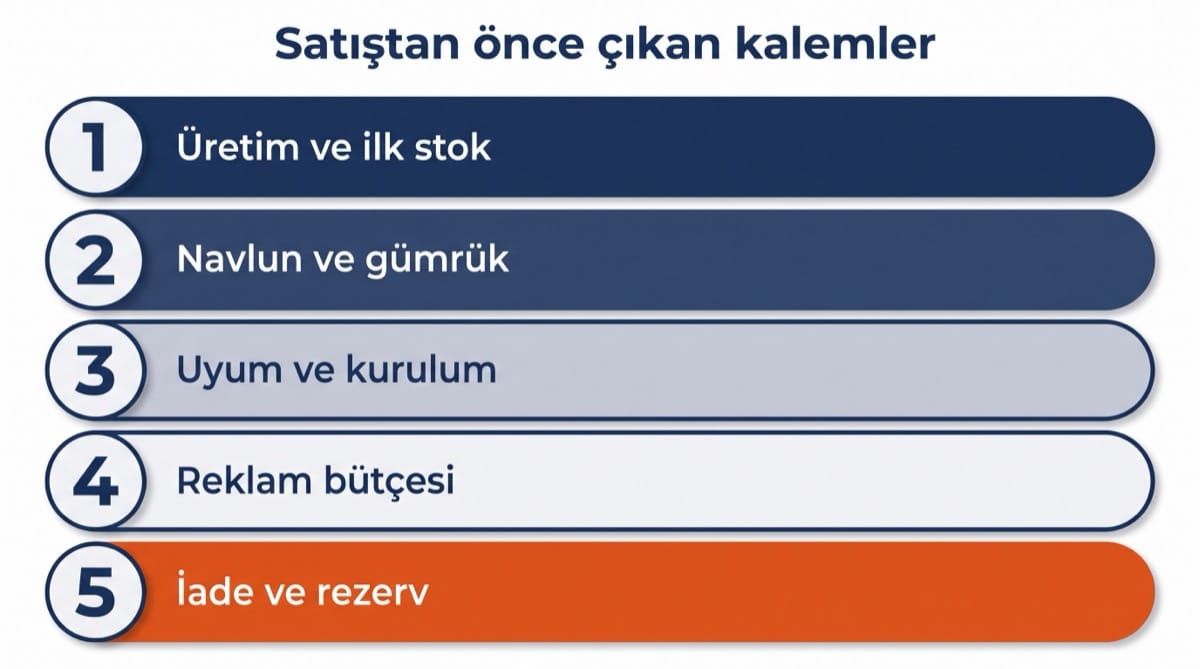
For a company selling private label in the U.S., cash goes out well before any sales and at more than one point.
Production and initial inventory
This is usually the largest item. Manufacturers often require full or partial prepayment, and even those that offer payment terms may not extend them on the first order. The first batch size varies by product category, but keeping the order quantity low raises the unit cost, so a balance needs to be found here.
Freight, customs and warehouse intake
When shipping to the U.S. by sea, freight, customs clearance and inland transport appear as separate costs. Import duties and, where applicable, inspection fees are added on top. Depending on the product category, additional documents and costs may also come up in U.S. and Canada customs processes. We explain which layers make up these duties as of 2026 in our article on Amazon U.S. customs duties.
Compliance and setup costs
For product groups such as food, supplements and cosmetics, the FDA registration and certification process, U.S. company formation and trademark filings are costs paid before any sales come in. Because they are one-time costs, they should appear as a separate line in the first-year cash plan.
Advertising budget
During launch, ad spend goes out before sales come in, and it is usually highest in the first weeks. Campaign structure and bid management directly affect how much of this spend comes back. The details are in our Amazon PPC advertising management guide.
Returns and reserve
Amazon deducts returns from the seller account and also holds a reserve in the account. This reserve is an amount held back against possible returns and claims. In other words, not all of the balance you see on screen is available to withdraw.
The returned product itself also enters the cash cycle. As of October 21, 2026, Amazon is changing the names and scope of its FBA returns programs: the Refurbishment program becomes Restore to New, the Grade and Resell program becomes Sell as Used, and Restore to New opens to more product categories. For enrolled sellers, Amazon evaluates the returned product; if it can be restored to new condition, it is relisted as “new” and a processing fee of $1.50 to $4.10 per unit is charged. A product that cannot be restored to new is listed as “used” if the seller is enrolled in Sell as Used; if not, the product is handled according to the account's unfulfillable inventory settings, and no fee applies in that case. Sellers can enroll in either program separately or in both, and enrollment is optional. For cash flow, this means that in a category with high returns, the fee should be weighed against the sales value recovered; if the return rate is low, the program's effect also stays small.
Where the money comes back: the Amazon payment cycle
Amazon does not pay out sales proceeds immediately. Three separate mechanisms come in between.
14-day settlement period
On professional seller accounts, payments are settled in two-week periods. After the period closes, the amount goes out as a bank transfer, and it usually takes another 3 to 5 business days to reach your account. So the settlement alone can take up to 20 days.
The DD+7 rule and the March 12, 2026 change
This is the most important topic of recent months. Amazon moved the point at which funds are released from the ship date to the delivery date. Under the new rule, the amount is released 7 days after the order is delivered to the customer. In the industry, this rule is known as DD+7.
The policy started on European accounts in fall 2025 and took effect on U.S. accounts as of March 12, 2026, covering the large majority of seller accounts. The logic is to give the customer time to inspect and return the product.
The practical effect: the clock that used to start the moment you handed over the shipment now starts after the product reaches the customer's door. For a single order the difference looks like a few days, but because it runs across hundreds of orders at once, it permanently raises the pending amount in the account. Companies that do not account for this rule see a lower withdrawable balance on the same revenue and often assume it is an error.
Holding periods and reserve levels on new accounts
On newly opened seller accounts, the first payout can take longer, with a wait of close to 30 days possible for the first period. As account history builds and the order defect rate stays low, the reserve rate gradually decreases. In other words, the picture in the first months is not the permanent picture.
How many days the cycle takes: a sample calculation
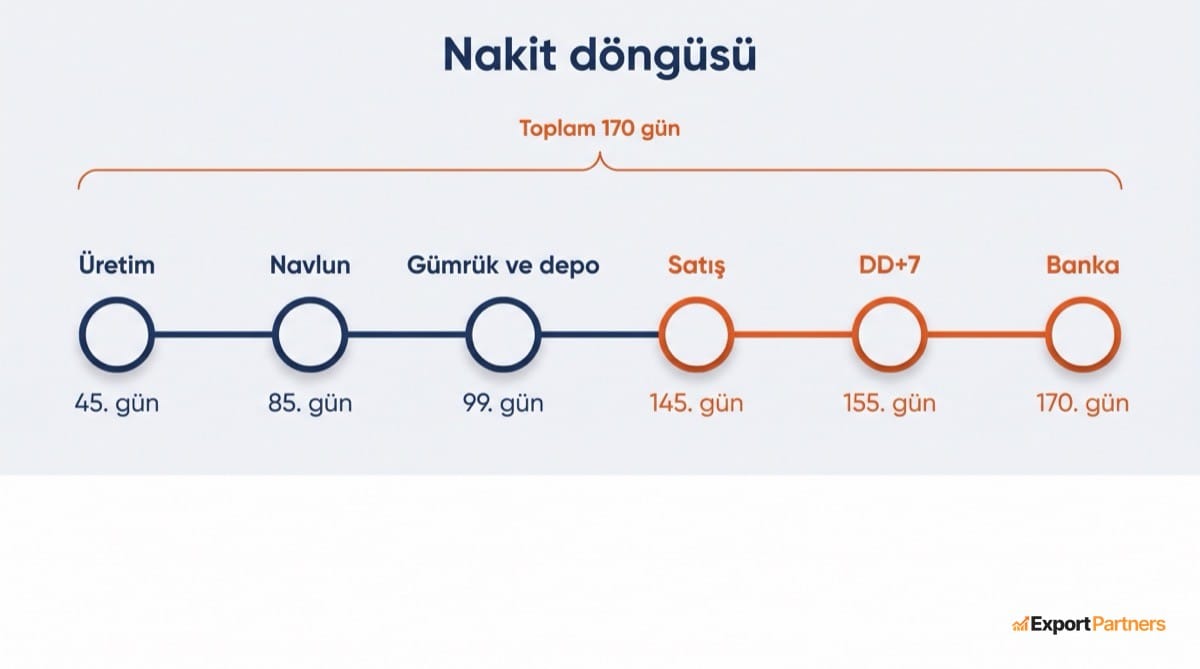
The table below shows a typical cycle for a company shipping to the U.S. by ocean freight. The figures may vary by product group, manufacturer and season; the goal here is to see the sequence and the order of magnitude.
| Stage | Typical duration | Cumulative |
|---|---|---|
| Payment to manufacturer and production | 30-45 days | Day 45 |
| Freight and ocean transit | 30-40 days | Day 85 |
| Customs clearance and FBA warehouse check-in | 7-14 days | Day 99 |
| Selling through inventory (average turnover) | 30-60 days | Day 145 |
| Delivery and DD+7 hold | 7-12 days | Day 155 |
| Settlement and bank transfer | 14-20 days | Day 170 |
So from the day you pay for production to the day the money from the last unit of that batch reaches your account, the gap can run longer than five months. Money from the first sales comes back earlier, of course, but converting the entire batch to cash follows this timeline.
The critical point is this: the date you need to pay for the second production batch usually falls between day 90 and day 110. By then, the cash returned from the first batch does not cover everything you spent. The gap has to be closed with working capital, and this is the item most often missed in planning.
Practical ways to shorten the cycle
You cannot change the whole timeline, but it is possible to make a real difference at a few points.
- Keep the first batch small and plan the second batch early. A large first order lowers unit cost but ties up cash for a long time. At the launch stage, speed can be worth more than unit cost.
- Discuss payment terms with your manufacturer. Even 30-day terms cut a month from the most expensive end of the cycle. This may be difficult on the first order, but it can be put on the table for the second.
- Consider air freight for the first batch. Freight costs more per unit, but because it reduces 30 days of ocean transit to a few days, it brings the launch forward and speeds up the return of cash. The decision comes down to comparing the extra cost per unit with the time gained.
- Measure inventory turnover instead of estimating it. Setting a reorder point based on weekly unit sales reduces both the risk of stocking out and the risk of tying up more cash than needed.
- Scale your advertising budget to match sales velocity. Spending more at launch and then moving in a controlled way toward your target ACoS once the listing settles can ease the pressure on cash.
The March 12, 2026 change: payouts now depend on delivery
As of March 12, 2026, Amazon tied payout eligibility for U.S. and Canada accounts to delivery rather than shipment. Reported as Deferred Transactions, the change covers both FBA and FBM sellers; a similar rule had already been introduced in Europe.
In practice, the same sales volume now turns into cash later. With FBA, the product ships from an Amazon warehouse, so delivery is short, typically around two days. With FBM, shipping time depends on the method the seller chooses and can reach five days, which noticeably extends the total cycle. You can see the effect on your own account under Payments in Seller Central.
The reserve amount and DD+7 are not the same thing
DD+7 is the standard holding period applied to every order. Account Level Reserve is an additional balance Amazon holds at the account level, usually linked to performance, return rate or new account status. Both can apply to the same account at the same time and appear on separate lines in the report. To answer "why hasn't the money arrived," it helps to first check which item is holding it.
Two items that delay cash: the return window and expense timing
In the U.S., the buyer's return window is thirty days in most categories. Even though the money reaches you about two weeks after delivery, the return risk does not end on that date; when a return happens, the amount is deducted from the next payout period. In categories with high return rates, setting aside part of each payout for the next period's return deductions tends to be a safer approach.
On the expense side, the real issue is a timing mismatch. The monthly storage fee is charged in the first half of the following month, and additional fees may apply to inventory that stays in storage for a long time. Advertising spend, on the other hand, accrues as it happens. In other words, the ad cost arises on the day of the sale, while the money from that sale arrives about two weeks later. In a week when you aggressively increase your campaign budget, that week's cash is not yet in your account.
Two additional delays when selling from abroad
The first is the time needed to transfer funds from your U.S. account to your home country or to your U.S. company's account. The second is the exchange rate: it can change between the sale and the transfer, and your cost calculation in local currency may shift.
These two are added to Amazon's timeline, not substituted for it. A cycle of about twelve days on the U.S. side is best planned as a longer period when you budget from your home country.
Do early payout options help?
Amazon's on-demand payout feature is still available, but it now only draws from amounts that have completed the DD+7 period. The button is still there, but the available balance behind it has shrunk; pulling forward the held amount this way does not appear possible.
Some financing companies on the market pay out seller receivables early. They can solve a real cash problem, but their cost is usually calculated on the full receivable rather than on the product margin. Before using one, compare the annualized cost with your own margin.
Three common planning mistakes
The first is mistaking profit margin for cash. A product with a 30 percent margin is profitable, but that profit may not be in your hands when it is time to finance the second batch.
The second is treating the balance shown in the Amazon dashboard as a withdrawable balance. Amounts held because of the reserve and DD+7 appear there but are not yet available.
The third is mixing one-time setup costs with operating expenses. FDA registration, trademark applications and company formation should stay as separate lines in the first year's cash plan; otherwise product-level profitability looks better than it is.
Frequently asked questions
How often exactly does Amazon pay out?
For Professional seller accounts, payouts are settled in 14-day periods. After the period closes, the bank transfer can take another 3 to 5 business days to reach your account.
Does the DD+7 rule apply to my account too?
The rule covers the vast majority of seller accounts. For accounts with a long history and a low defect rate, Amazon may apply reserve timing differently, but it is safer not to plan around that assumption.
When will I receive my first payout on a new account?
On newly opened accounts, the first payout can involve a wait of close to 30 days. Later periods move to the standard 14-day cycle.
Does the reserve rate go down?
As account history builds and the order defect rate stays low, the reserve held can gradually decrease. The picture in the first months is not permanent.
How much capital should I set aside for the first batch?
Giving a single figure would not be accurate, because the product category, target price and order quantity are decisive. A sound approach is to add a separate line for the second batch on top of the first batch cost. Cash crunches usually happen not with the first batch but on the payment date of the second.
What happens to my ranking if I run out of stock?
When stock runs out, sales velocity drops and organic ranking slips. Returning to the previous position after restocking can often take a few weeks, so setting the reorder point early matters.
Conclusion
Amazon FBA cash flow needs its own discipline, separate from and stricter than profitability math. The time from paying for production to money landing in your bank account can reach five months, and the DD+7 rule that took effect on March 12, 2026 stretched that timeline a little further. Seeing the full picture from the start helps you avoid both running out of stock and tying up more cash than necessary.
If you would like to plan your inventory, launch and advertising calendar together with your cash position as part of your U.S. market entry, we can review it with you through our Amazon launch and advertising service framework. In the same plan, we can also clarify how customs and compliance steps fit into the timeline for your product category.
Last updated: September 22, 2026

