
FDA registration is how a facility that ships products to the U.S. notifies the FDA of its existence. It is not an approval. For food, dietary supplements and cosmetics, the FDA does not approve any product; it only registers the facility, and registration is free of charge. Approval applies only to drugs, biological products, moderate- and high-risk medical devices, and food and color additives. This distinction matters, because describing a food product as “FDA approved” is considered a misleading claim in the U.S.
Food facility registration also carries a renewal obligation: registrations are renewed between October 1 and December 31 of every even-numbered year. Since 2026 is an even-numbered year, this year's window opens on October 1, 2026. The FDA treats a registration that is not renewed as expired and cancels it.
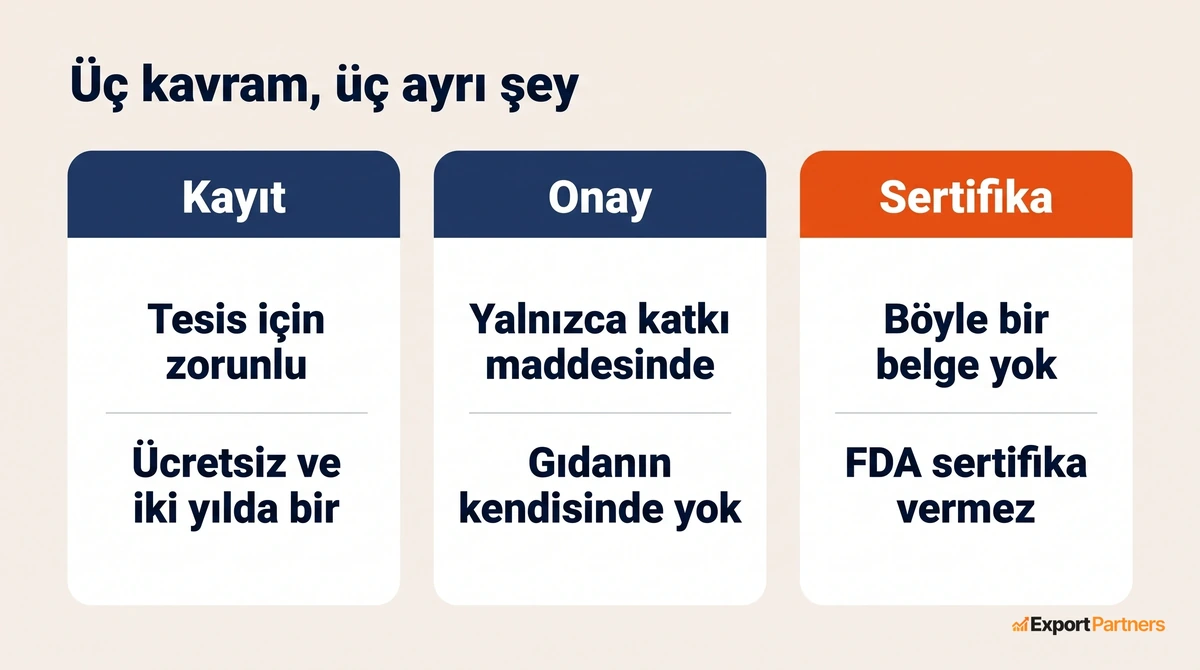
What is the difference between FDA registration, approval and certification?
Exporters often use these three terms interchangeably, which can cause problems in contracts, on product labels and in correspondence with buyers. The distinction depends on the product category:
| Product category | Facility registration | Product approval | Required for market entry |
|---|---|---|---|
| Food and beverages | Mandatory, free, renewed every 2 years | None | Facility registration + U.S. Agent + Prior Notice for each shipment |
| Dietary supplements | Mandatory | None | Facility registration + NDI notification for new dietary ingredients |
| Cosmetics | Mandatory (introduced by MoCRA) | None, except color additives | Facility registration + product listing |
| Food and color additives | – | Required | Premarket approval or GRAS notification |
| Medical devices, Class I-II | Mandatory | 510(k) clearance for most | Establishment registration + device listing + 510(k) |
| Medical devices, Class III | Mandatory | Required (PMA) | PMA approval |
| Drugs and biological products | Mandatory | Required (NDA, ANDA, BLA) | Clinical dossier and approval |
As the table shows, most products that foreign manufacturers ship to the U.S., namely food and cosmetics, fall under registration, not approval.
Is there such a thing as an FDA certificate?
The FDA does not issue a decorative certificate for registration. When you complete a food facility registration, what you receive is an eleven-digit registration number (FFR number). The FDA's own system generates this number; it does not send a PDF document.
The colorful documents titled “FDA Registration Certificate” that circulate in the market are not issued by the FDA. They are service documents printed on the letterhead of the intermediary firms that complete the registration on your behalf. Your buyer may accept such a document, but what carries official weight is a registration number that is valid in the FDA system, not the paper itself.
Another document that is often confused is the Certificate of Free Sale. It is issued to American manufacturers exporting out of the U.S. A foreign manufacturer exporting to the U.S. does not need such a document.
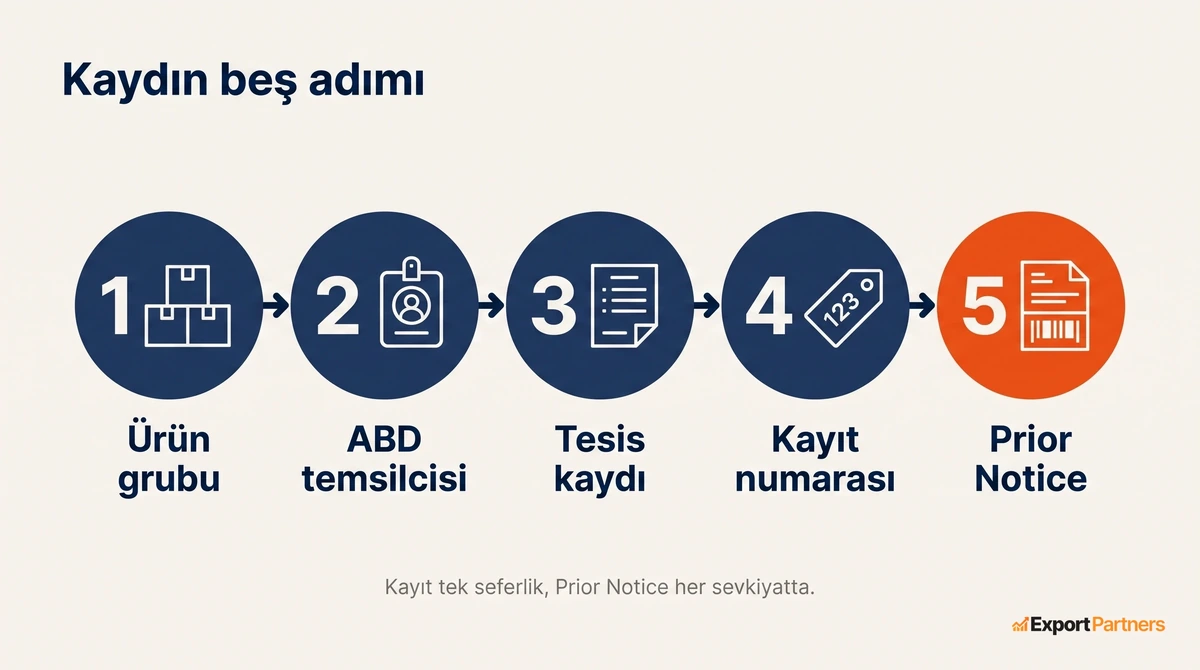
How do you get FDA registration?
For a food facility, the sequence is as follows:
- Determine the product category. Food, supplements, cosmetics and devices follow different processes. If the product contains animal-derived ingredients, USDA may also be involved.
- Appoint a U.S. Agent. This is mandatory for every foreign food facility. Communication between the FDA and the facility runs through this person. The agent's duties and how to change agents are explained in detail in our U.S. Agent article.
- Register the facility through FDA Industry Systems. Registration is free of charge.
- Obtain and keep the registration number. This number is used in shipping documents and in Prior Notice submissions.
- Submit Prior Notice for every shipment. Registration is a one-time step, while Prior Notice is filed per shipment. They are separate obligations.
For acidified and low-acid canned foods, FCE and SID filings are required in addition to facility registration. For a full breakdown of cost items, see our article on the cost of exporting food to the U.S.
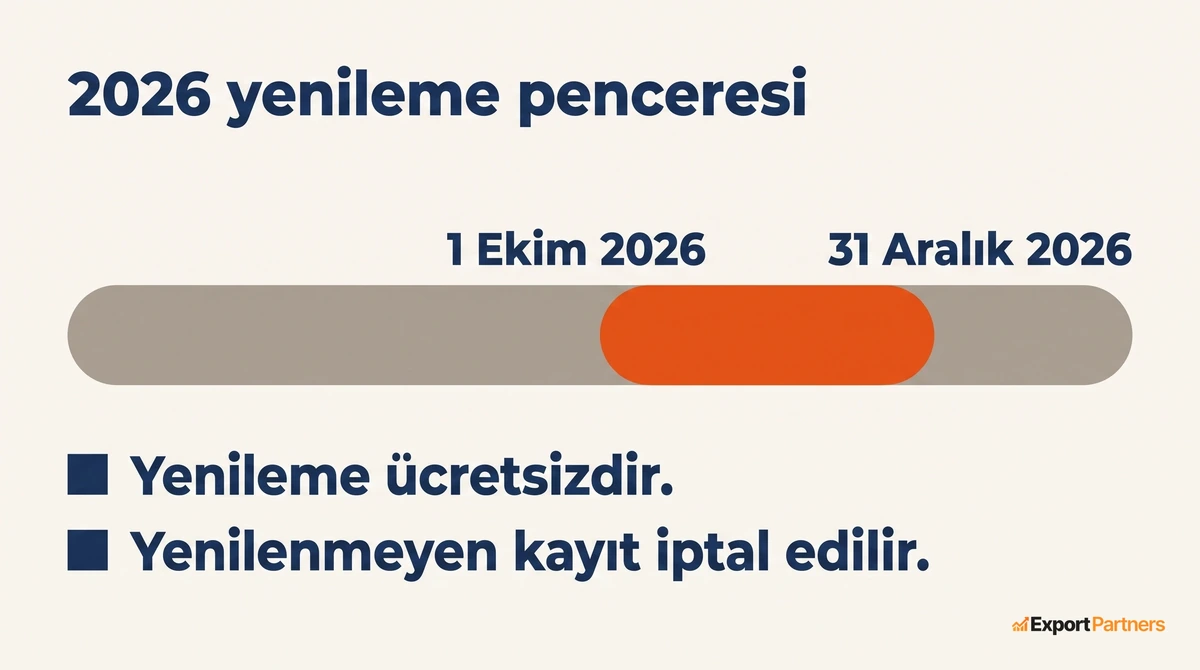
When is the 2026 renewal period?
Food facility registrations are renewed in even-numbered years, between October 1 and December 31. The 2026 window opens on October 1, 2026 and closes on December 31, 2026.
If a registration is not renewed, the FDA considers it expired and cancels it. A shipment sent under a cancelled registration may be held at U.S. customs. Failing to register is a prohibited act under U.S. law. Expiration, cancellation and suspension are different situations; we explain the differences in this article.
Like registration, renewal is free of charge. During this period it is common to receive high invoices titled “renewal fee” from intermediary firms; before paying, have someone verify through the registration number that the renewal was actually completed.
How do you look up an FDA registration?
The FDA does not publish a public search tool listing registered food facilities; food facility registrations are confidential. The areas that can be searched publicly are drugs, medical devices and certain other product groups:
- Drugs@FDA: approved drugs
- NDC Directory: National Drug Code list
- 510(k) Premarket Notification: device clearances
- PMA: Class III device approvals
- Establishment Registration: device establishment registrations
You can check the status of your own food facility registration in your FDA Industry Systems account. To verify a supplier's registration, ask the supplier for its registration number and the date of its most recent renewal.
Is a domestic food business registration the same as FDA registration?
No. A food business registration issued by authorities in your own country is a domestic document and is valid only there. FDA registration is a separate notification made to a U.S. authority for shipments to the United States. One does not replace the other; a manufacturer exporting to the U.S. typically needs both.
What is the FDA and what does it regulate?
FDA stands for the U.S. Food and Drug Administration. It oversees the safety of food, drugs, medical devices, cosmetics, dietary supplements, veterinary products, tobacco products and certain radiation-emitting electronic devices in the United States.
Some products outside its jurisdiction can cause confusion: meat, poultry and egg products are overseen by the USDA, most alcoholic beverages by the TTB, and pesticides by the EPA. If you ship animal-derived products, the process may not end with the FDA.

