
An FDA US Agent is a person residing in the U.S., or maintaining a place of business there, whom a food facility outside the U.S. designates to handle its communication with the FDA. It is a mandatory field in the registration for foreign facilities. The agent is the first contact the FDA calls in both emergency and routine situations, and the FDA considers any document delivered to the agent as delivered to the facility.
Many companies fill in this field as a formality and then forget about it. However, registration and renewal depend on the agent confirming to the FDA that they accept the role. Without that confirmation, the FDA does not verify the FDA registration and does not issue a registration number. In other words, naming the right person is not enough; that person also needs to answer an e-mail on time.
Below we cover exactly what the agent does, how the confirmation mechanism works, the steps followed when the agent changes, and the other roles that US Agent is often confused with.
Who is the FDA US Agent and what do they do?
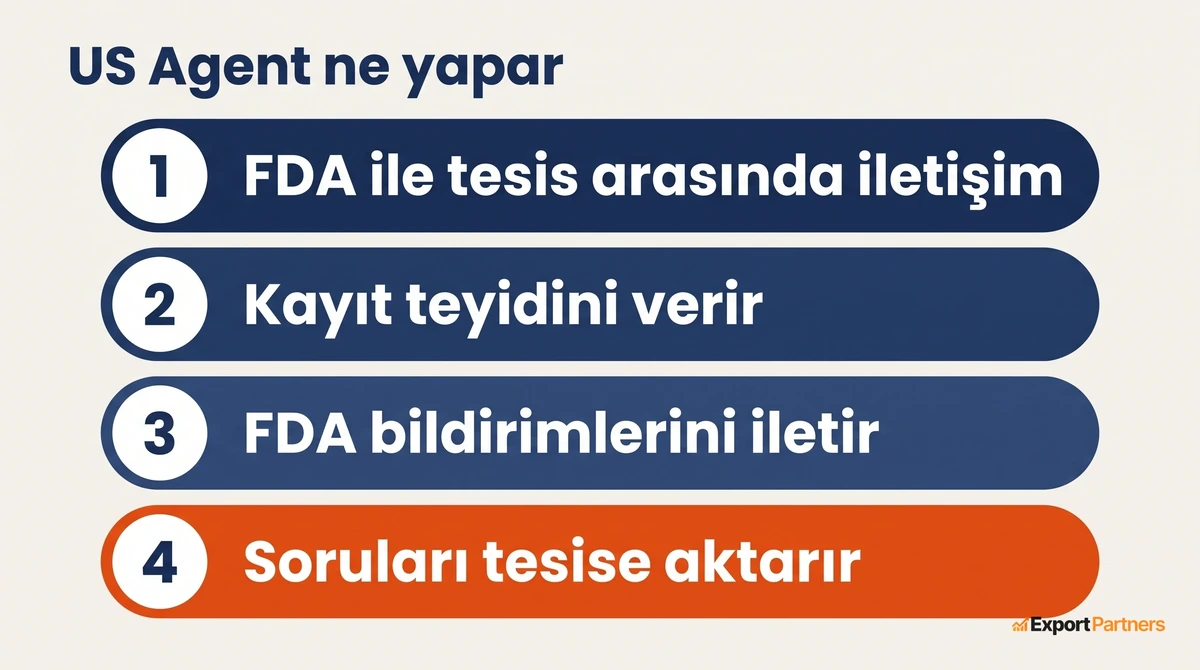
Under the definition in 21 CFR 1.227, a US Agent is a person residing in the U.S. or maintaining a place of business in the U.S. whom the foreign facility designates for this purpose. The role is to serve as the communication link between the FDA and the facility. If no separate emergency contact is listed in the registration, the agent is also the person the FDA calls in an emergency.
The regulation emphasizes one point: the FDA treats the agent's statements as the facility's statements and considers information or documents given to the agent as given directly to the facility. This means the agent cannot function as a simple mailbox. They are a party speaking on your behalf.
The same regulation also clearly states what does not count as an agent. A mailbox, answering machine or answering service, or any address where the agent is not physically present, is not accepted. Renting an address in the U.S. and listing it does not meet the registration requirement.
What the agent handles
In practice, three tasks stand out: receiving routine FDA correspondence and forwarding it to the facility, answering questions about the facility's products or obtaining the answer from the facility and passing it on, and coordinating between the FDA and the facility when processes such as inspections are scheduled. The weight of the role is usually felt when an issue arises.
Why is US Agent confirmation required at renewal?
Under 21 CFR 1.231(b)(7), the FDA does not verify a foreign facility's registration or renewal, and does not issue a registration number, until the person listed as US Agent confirms that they accept the role. The FDA usually handles this step through an e-mail sent to the agent. Submitting the form does not by itself mean the renewal is complete.
For this reason, the renewal period is when the accuracy of the agent information is really tested. During the renewal window from October 1 to December 31, 2026, this is where the most common delays occur; details are in our FDA registration renewal guide.
The typical cases where confirmation stalls look alike: the e-mail address entered two years ago is no longer in use, the message lands in the spam folder, or the person listed as agent is not aware they hold the role. In all three cases the facility appears to have finished its part, while the registration stays pending.
US Agent Voluntary Identification System (VIS)
The FDA runs a voluntary system that lets agents identify themselves in advance. An agent registered in VIS can see the list of facilities that name them and can manage the confirmation process in a more orderly way. It is not mandatory, but it can make the work easier for parties acting as agent for more than one facility.
What needs to be done if the agent changes?
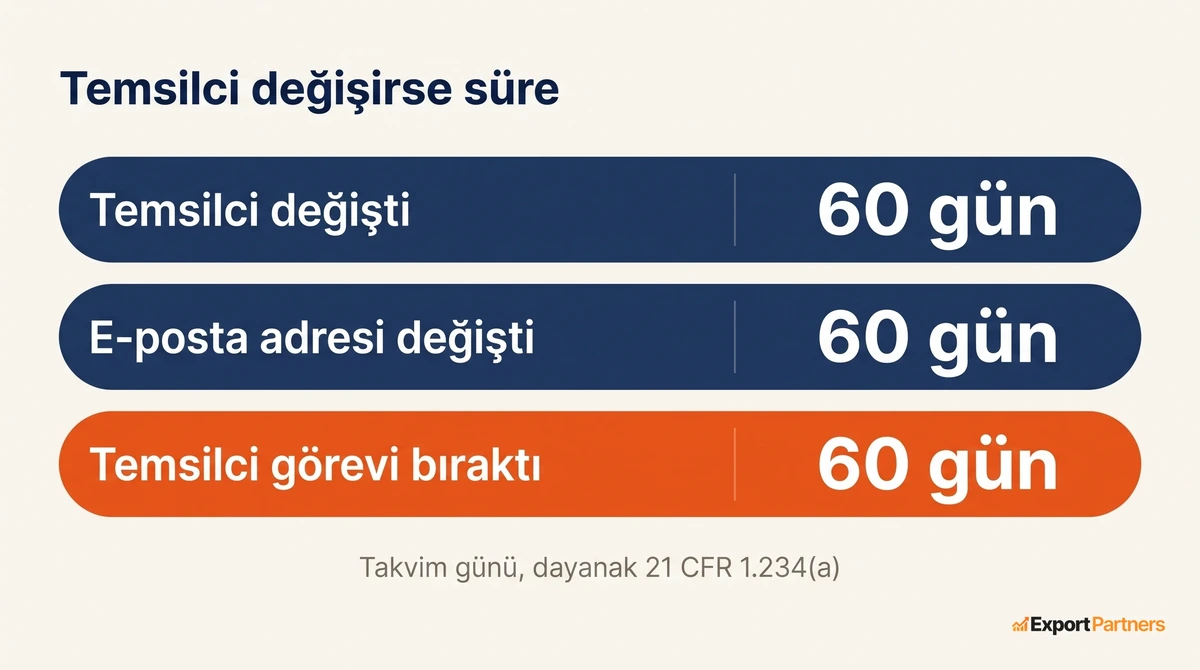
Under 21 CFR 1.234(a), when required information in the registration changes, the registration must be updated within 60 calendar days. The US Agent's name, address, phone number and e-mail address are among this required information. After the update, a confirmation e-mail is also sent to the new agent.
| Status | What is done | Duration |
|---|---|---|
| Agent changed | US Agent information in the registration is updated, and the new agent confirms | Within 60 calendar days (21 CFR 1.234(a)) |
| Agent's e-mail address changed | The registration is updated, and the address receiving the confirmation correspondence changes | Within 60 calendar days |
| Agent wants to step down | The facility appoints a new agent and updates the registration | Without a gap |
| Renewal period approaching | Details are reviewed in September and updated in advance if needed | Before October 1 |
Changes tend to go more smoothly when they are not squeezed into the renewal period. When a renewal and an agent change run at the same time between October and December, two separate confirmation exchanges overlap and it can become unclear which one is pending.
Which roles is the US Agent confused with?
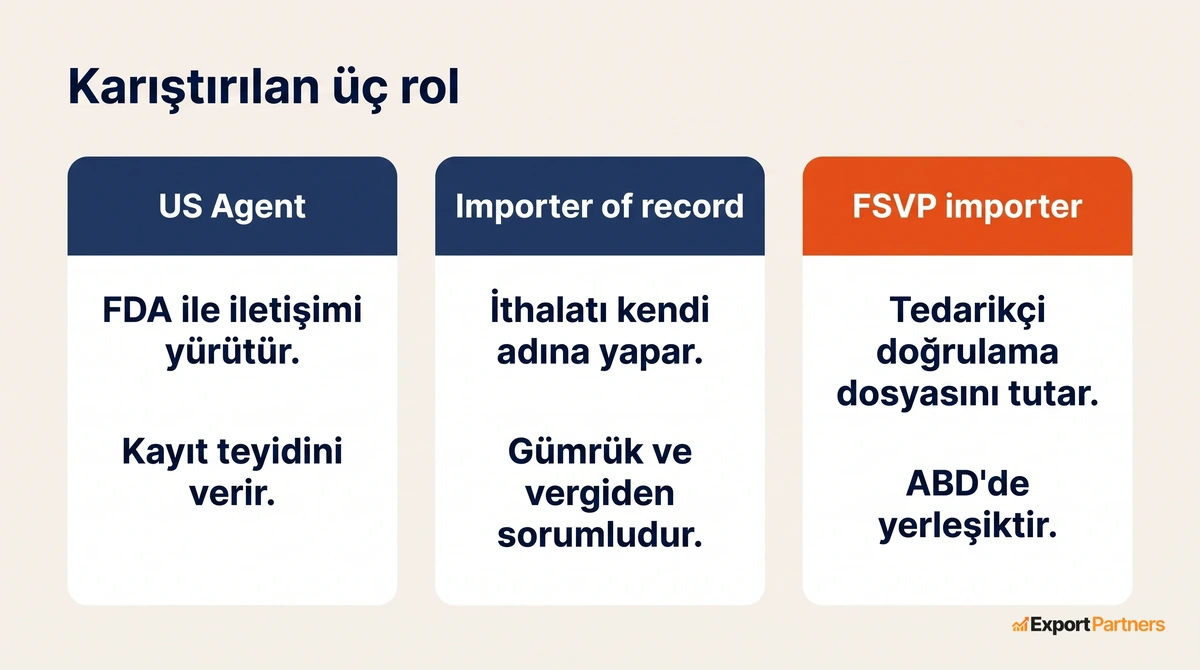
Exporting to the U.S. involves four separate parties that look similar, and they do not have to be the same person. The confusion usually comes down to who is responsible for what.
| Role | Who | What they do |
|---|---|---|
| US Agent | A person or entity located in the U.S. | Handles communication between the FDA and the foreign facility and confirms the registration |
| Importer of record | The party that imports the goods in its own name | Responsible for the customs entry and duties |
| FSVP importer | The importer in the U.S. | Maintains the foreign supplier verification file |
| Prior Notice submitter | Usually the customs broker or the importer | Submits the notice on time for each shipment |
If you have set up your own company in the U.S., some of these roles may overlap, but they are still not the same thing. We cover how the per-shipment notice works in our FDA Prior Notice guide, and the situations where registration status lapses in our article on FDA registration cancellation and re-registration.
How far does the agent's responsibility extend?
The agent's role covers communication and confirmation. The agent is not responsible for label compliance, the customs entry or import duties; those are obligations of the importer and the facility. At the same time, any information the FDA wants to deliver to the facility may go through the agent, so a message that is not passed on can affect the facility. The notice sent when a product is detained at entry also arrives this way, and because response times in the import refusal process are short, the agent's availability becomes important.
This distinction is useful when drawing up a contract. When you engage an agent service, a clearly written scope settles from the start which correspondence goes to whom and what the response time will be. When the scope is not written down, each side usually assumes the other is following up.
One more point: when the agent changes, correspondence sent to the previous agent does not automatically move to the new one. Until the registration is updated, the FDA may keep using the old contact. Keeping both parties on watch for a while during the handover can help prevent a message from getting lost.
What makes sense to look for when choosing an agent?
The regulation requires the agent to be in the U.S., but beyond that it does not set out a list of qualifications. In practice, three things matter: availability, subject knowledge and continuity. It helps when the agent is not just a number called once a year but a contact who can respond the same day when needed.
Availability
Confirmation and information requests from the FDA can be time-limited. The most practical requirement is that the agent monitors the email address regularly and responds within a reasonable time despite the time difference.
Subject knowledge
If the agent does not know the facility's product categories and registration status, they cannot answer an incoming question. Because the FDA treats the agent's statement as the facility's statement, an incorrect or incomplete answer can leave a record that later needs correcting.
Continuity
Agent representation is not a one-time transaction. When the biennial renewal confirmation, information requests in between and any inspection coordination are handled by the same party, the process becomes more predictable.
Frequently asked questions
Is an FDA US Agent mandatory?
It is a required field in the registration of food facilities located outside the U.S. Facilities inside the U.S. do not need to name a US Agent. For foreign facilities, the registration is not verified until the agent's confirmation arrives.
Can my U.S. importer be my agent?
Yes. The regulation requires the agent to reside or maintain a place of business in the U.S.; it does not require a separate company. The point to watch is keeping the roles distinct. Even if your importer is also your agent, the FSVP file and the customs entry remain separate obligations.
What happens if the agent does not confirm?
The FDA does not verify the registration or renewal and does not issue the registration number. Since the facility then does not appear as registered, issues may come up on the shipment side. If the confirmation is given later, the process continues from where it stopped.
Can one agent serve more than one facility?
Yes. In that case, the FDA's voluntary identification system, VIS, can make it easier for the agent to track which facilities they are named for. As the number of facilities grows, keeping track of confirmation correspondence also calls for an organized system.
Does the agent receive FDA approval?
No. The FDA does not approve food facilities, it registers them, so there is no approval or license for the agent either. The agent is not authorized by the FDA; it is the party appointed by the facility and reported to the FDA.
How much does an agent cost?
The FDA charges no fee for agent representation, and registration and renewal are also free. The amount paid is the service fee of the party acting as agent, and it varies by provider. When budgeting for this item, thinking in terms of the two-year renewal cycle rather than a single year gives a more realistic picture.
Conclusion
The FDA U.S. Agent takes up a single line on the registration form, yet it is the field where the process most often gets stuck. The registration is not verified until the agent confirms, a change of agent must be reported within 60 calendar days, and the FDA treats statements from the agent as statements from the facility.
As the renewal period approaches, the most practical check is to confirm that your agent is still in place and that the email address on file works. Rules can change, so it makes sense to verify on fda.gov before taking action.
For U.S. Agent service, a registration check or renewal, you can reach us through our FDA registration and certification service.

