
Exporting cocoa and chocolate to the U.S. means stepping onto a crowded shelf. Major brands, premium European chocolates and boutique makers in every state all sell to the same customer. Manufacturers entering this market can still build on two strong cards: product lines known for hazelnuts and pistachios, and specialty confectionery categories already established in ethnic grocery stores and online retail.
The challenge lies less in the product itself than in the rules and the calendar. To use the name “chocolate” in the U.S., a product has to meet ratios defined by the FDA; ingredients such as hazelnuts, milk and soy lecithin make an allergen statement mandatory; and because chocolate is heat-sensitive, Amazon warehouses accept it only during certain months.
In this article, we walk through, in order, the steps a chocolate or cocoa product manufacturer needs to complete before the first shipment to the U.S.

Which registrations are needed to ship chocolate to the U.S.?
In the U.S., chocolate is classified as food and falls under FDA oversight. The manufacturing facility needs an FDA food facility registration, a U.S.-based agent (US Agent), and a Prior Notice for every shipment. Registration is free, but it must be renewed every two years, between October 1 and December 31.
| Registration or step | Who handles it | When |
|---|---|---|
| FDA food facility registration | The manufacturer (or a service provider on its behalf) | Before the first shipment; renewed in even-numbered years |
| US Agent | U.S.-based agent | Together with registration |
| D-U-N-S number | Manufacturer | Required as a facility identifier during registration |
| Prior Notice | The shipper or customs broker | For every shipment, before the product arrives in the U.S. |
| FSVP | The importer in the U.S. | Supplier verification by the importer, before the first shipment |
The renewal period for registrations is currently open. For details, see our FDA registration renewal article; for the full registration process, see our FDA registration and certification service.
What does it take to use the name “milk chocolate”?
In the U.S., chocolate type names cannot be used freely. Under 21 CFR Part 163, the FDA defines minimum ratios for each type. If a product does not meet these ratios, the package cannot say “milk chocolate” or “white chocolate”; a different description such as “chocolate flavored” may be needed.
| Product name (U.S.) | Minimum requirement (by weight) | Basis |
|---|---|---|
| Milk chocolate | At least 10% chocolate liquor, 3.39% milk fat, 12% total milk solids | 21 CFR 163.130 |
| Sweet chocolate | At least 15% chocolate liquor | 21 CFR 163.123 |
| Semisweet / bittersweet | At least 35% chocolate liquor | 21 CFR 163.123 |
| White chocolate | At least 20% cocoa butter, 3.5% milk fat, 14% milk solids; no more than 55% sweeteners | 21 CFR 163.124 |
A product sold as milk chocolate in your home market may already meet these ratios; even so, it makes sense to compare the recipe against this table before the first shipment. The ratios are taken from the eCFR, 21 CFR Part 163 text.
Why is the label the most common sticking point for cocoa and chocolate?
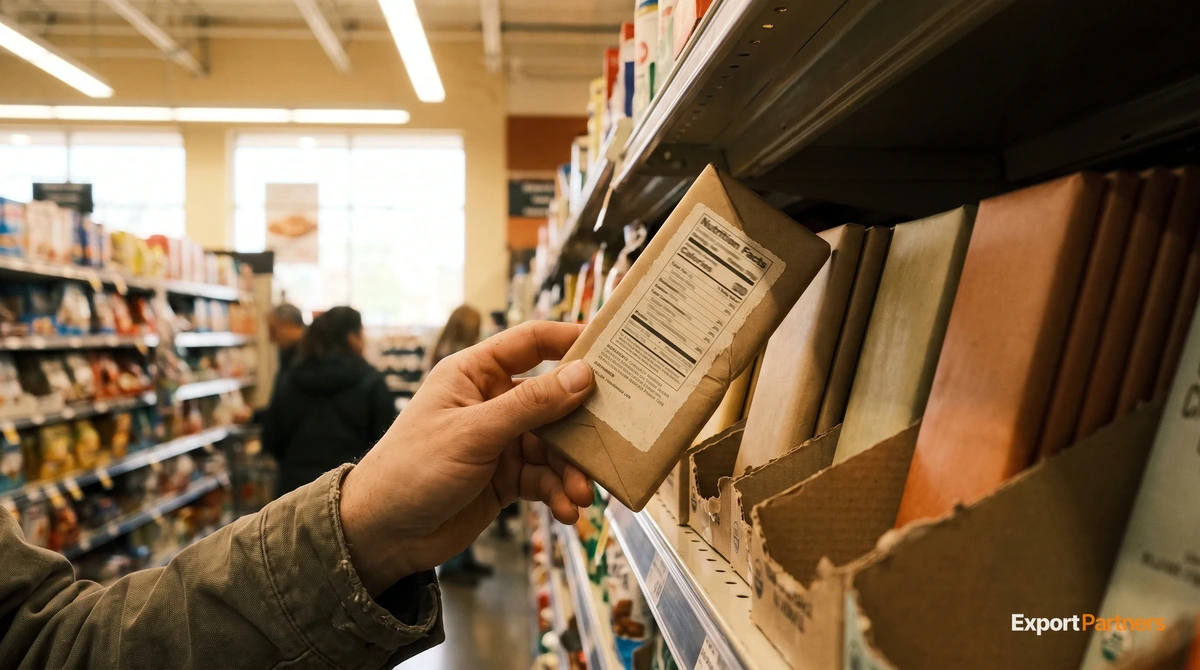
In FDA import refusal records, the nutrition label is one of the most frequently cited reasons for imported food products. In one case we reviewed, a chocolate pudding and a hazelnut spread were sent back for the same reason, a refusal coded 482 NUTRIT LBL (nutrition label). The products themselves were fine; the problem was that the labels were not in U.S. format.
In short, a U.S. label needs to include:
- Product name in English and net quantity (in both grams and ounces)
- A Nutrition Facts panel in U.S. format
- An ingredient list in descending order by weight
- An allergen statement
- Name and address of the manufacturer or distributor, and country of origin
For the full set of rules, see our U.S. labeling rules article.

How do you write the allergen statement for hazelnut and milk chocolate?
The U.S. recognizes nine major allergens: milk, eggs, fish, crustacean shellfish, tree nuts, peanuts, wheat, soybeans and sesame. Most chocolate products contain at least two of them: milk in milk chocolate, and soy in the soy lecithin used as an emulsifier. Hazelnuts and pistachios count as tree nuts, and the statement has to name the specific nut.
The statement can take one of two forms: in parentheses within the ingredient list (“lecithin (soy)”) or as a “Contains: Milk, Soy, Hazelnuts” line directly below the list. If products with and without nuts are made on the same line, a cross-contact advisory should also be considered.
In which months can chocolate be sent to Amazon FBA?
Amazon classifies chocolate as a meltable product. According to Amazon U.S.’s own help page, these products are accepted at FBA warehouses only between October 16 and April 14. Meltable products that are in a warehouse or arrive at one between April 15 and October 15 are marked unfulfillable and disposed of for a fee.
| Period | FBA status | What to do |
|---|---|---|
| October 16 to April 14 | Accepted at warehouses | Main sales season; the shipping plan is built around this window |
| April 15 to October 15 | Not accepted, remaining stock disposed of | Stock is sold or removed before early April; summer sales only through the seller’s own cold-chain fulfillment |
Because this calendar covers the holiday and Valentine’s Day season, planning the first shipment for October and November may make more sense. Amazon updates this policy from time to time, so the current page in Seller Central should be checked before shipping. For the Amazon U.S. process, see our Amazon service.
How do you manage temperature risk during shipping?
Chocolate is also exposed to heat in transit. In ocean freight, the temperature inside a container can rise easily in summer; in air freight, waiting time at transfer points is the deciding factor. In the summer months, a refrigerated container (reefer) or insulated packaging with cold packs can help the product arrive without bloom or deformation.
Temperature also matters once the product reaches the U.S.: when choosing a warehouse, ask about climate-controlled space. For stock going to Amazon, the schedule follows the table above.
Are there extra rules for chocolate sold in California?
California’s Prop 65 requires a consumer warning on products where substances such as lead and cadmium exceed certain levels. Because cocoa can naturally contain these substances, chocolate is a category where this rule comes up often. For a seller selling into California or the whole U.S., keeping a heavy metal analysis of the raw material on file may be a sounder starting point.
Which chocolate products can stand out in the U.S.?
The challenge first: in the U.S., the plain milk and dark chocolate bar market is held by large brands and price competition is tough. A new brand may find it hard to win shelf space on price alone. The opportunity appears to be in narrower categories.
- Hazelnut and pistachio products: The area where a raw material advantage is most visible for producers in nut-growing regions; the product story can be built from here as well.
- Gift boxes and chocolate-covered dried fruit: Products that can see demand during the holiday and Valentine’s Day season, which lines up with Amazon’s acceptance calendar.
- Ethnic grocery channel: Products already known in Middle Eastern and specialty grocery stores can be a more controlled entry point for a first shipment.
Whichever channel you enter through, the FDA registration, label and allergen requirements are the same; the only difference is in the shipping calendar and packaging.
What should you watch for at customs?
Chocolate and cocoa products are classified under heading 1806 of the tariff schedule, while cocoa powder and cocoa butter fall under other headings of Chapter 18. The correct tariff code determines both the duty rate and the product code under which FDA will review the product. Because duty rates change from time to time, it is advisable to confirm the current rate with a customs broker.
We explain how Prior Notice is filed in our FDA Prior Notice article.
Frequently asked questions
Is FDA registration required to export cocoa products?
Yes. Cocoa powder, cocoa butter and chocolate are considered food; the manufacturing facility needs an FDA food facility registration and a US Agent in the U.S. Registration is free, renewed in even-numbered years, and Prior Notice is filed separately for each shipment.
Can chocolate be refused in the U.S. because of its label?
It can happen. In one case we reviewed, a chocolate product was refused at customs because its Nutrition Facts panel was not in the U.S. format. Reviewing the label against the U.S. format before the first shipment can reduce this risk.
Can I sell chocolate on Amazon in the summer?
Summer sales through FBA are not possible; Amazon U.S. accepts meltable products at its warehouses only between October 16 and April 14. In the summer months, sales are possible only through the seller’s own cold-chain fulfillment.
When is a chocolate factory’s FDA registration renewed?
Food facility registrations are renewed in even-numbered years between October 1 and December 31. The 2026 renewal period is open; a registration not renewed by December 31 is considered invalid.
Can I label my product “milk chocolate”?
If the recipe contains at least 10 percent chocolate liquor, 3.39 percent milkfat and 12 percent total milk solids, yes. If it does not meet these levels, a different product name may be needed.
Conclusion
For cocoa and chocolate exports to the U.S., the order typically works like this: first FDA facility registration and a US Agent, then a comparison of the recipe against the chocolate standards of identity and of the label against the U.S. format, followed by the allergen declaration and the shipment plan. If you plan to sell on Amazon, the schedule is built around the October 16 to April 14 window. FDA registration, label review and the Amazon U.S. process can each be purchased on their own, or run together in a single package if needed. For more information, contact us.

