
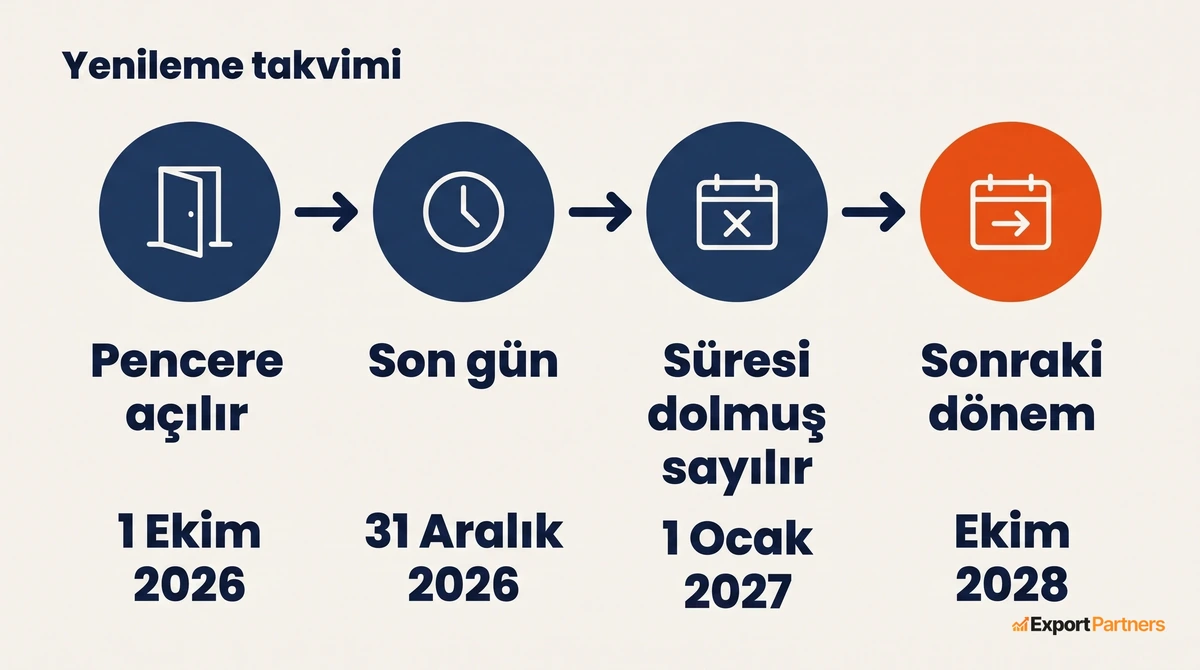
The FDA registration renewal period opens on October 1, 2026 and closes at the end of December 31, 2026. Every facility that manufactures, processes, packs or holds human or animal food for the U.S. must renew its registration in even-numbered years, and 2026 is one of them. The FDA charges no fee for renewal. A registration that is not renewed on time is considered expired on December 31, and food from that facility may be held at the port of entry until registration is completed.
What makes the process difficult is not the complexity of the steps. The system waits on outside responses at two points: your U.S. representative (US Agent) must reply to the FDA's confirmation e-mail, and the address linked to your D-U-N-S number must match the facility address in the registration. Both issues are often noticed only in the last week of December, which falls during the holiday season in the U.S.
Below we first clarify the calendar and the fee side, then walk through the points where renewal most often gets stuck and the Prior Notice rules that have changed since late 2025.
When is FDA registration renewal required, and for whom?
Under Section 415 of the FD&C Act, the renewal window runs from October 1 to December 31 of every even-numbered year. Foreign facilities that manufacture, process, pack or hold food shipped to the U.S. fall within this scope. Registration is not a document obtained once and left alone; it is a notification that must be confirmed every two years. If it is not renewed, the registration lapses automatically.
| Stage | Date |
|---|---|
| Renewal window opens | October 1, 2026 |
| Last day | December 31, 2026, 11:59 p.m. (U.S. Eastern Time) |
| Status of a registration not renewed | Considered expired as of January 1, 2027 |
| Next renewal period | October 1 to December 31, 2028 |
Some businesses are outside the scope. Farms, restaurants and retail outlets selling directly to consumers are generally not required to register. The FDA has also noted an increase in businesses registering when they do not need to, so a "let's register just in case" approach does not always lead to the right outcome.
Animal food facilities follow the same calendar. For pet food, the process may involve an APHIS permit in addition to FDA registration; we covered this distinction in detail in our guide to exporting pet food to the U.S.
Is there an FDA fee for renewal?
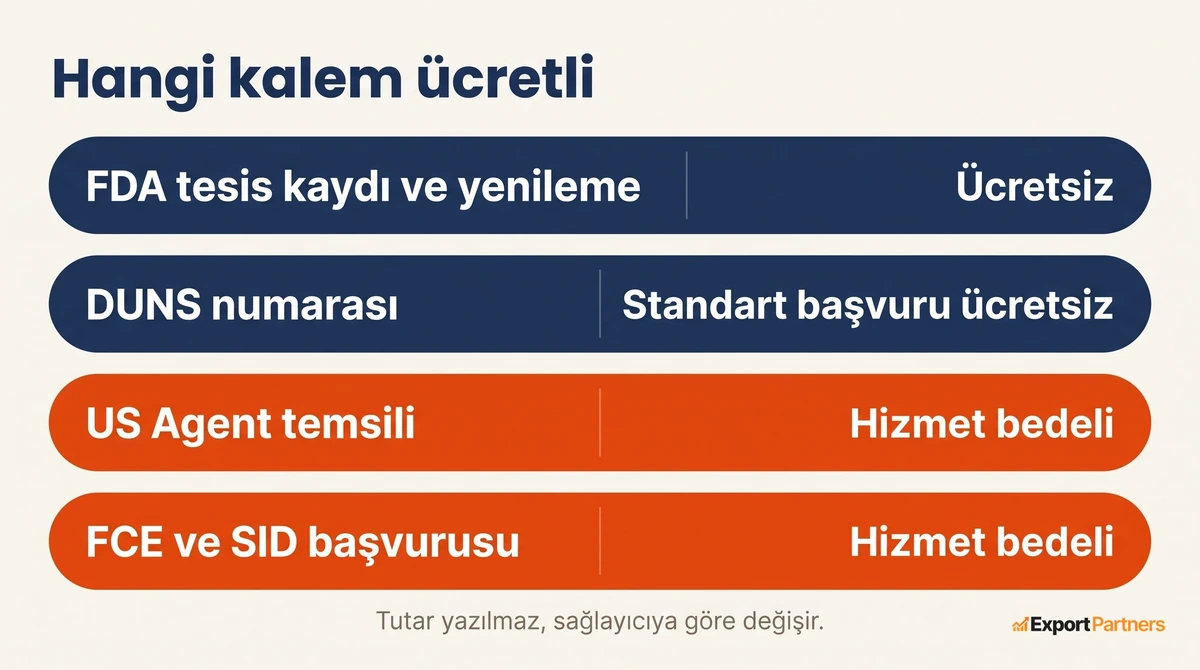
No. FDA facility registration and its biennial renewal are free of charge. The FDA has also stated that using a third-party "registrar" is not required and that it has no affiliation with such private companies. The costs come from the related steps around the registration, not from the registration itself.
| Item | Status | Source |
|---|---|---|
| FDA facility registration and biennial renewal | Free | FDA, Registration of Food Facilities |
| D-U-N-S number (Dun & Bradstreet) | Standard application is free, expedited option is paid | D&B |
| US Agent representation | Service fee, varies by provider | Market rate |
| FCE and SID filing (low-acid and acidified canned foods) | Free, but a separate process from facility registration | 21 CFR 108 |
| FDA reinspection, FY2027 | $354 per hour domestic, $414 when foreign travel is required | Federal Register, July 30, 2026 |
Reinspection fees apply to the fiscal year from October 1, 2026 to September 30, 2027. In the previous period these figures were $339 and $376 (Federal Register, July 30, 2025). This item applies only to inspections that follow up on a previously identified violation; it is not a routine cost.
For canned products that require FCE and SID, the timeline runs longer; details for this group are in our guide to exporting canned food, FCE and SID.
Why FDA registration is not the same as FDA approval
FDA facility registration is a record that notifies the FDA that a facility exists and which product categories it handles. It is not a permit, an approval or a quality certificate. The FDA does not approve food facilities, so there is no such status as an “FDA-approved facility.” Renewal works the same way: it simply refreshes the existing notification.
This distinction matters in practice, because companies holding a registration number sometimes read it as a guarantee of entry into the U.S. The registration number is not the only requirement for a shipment. Label compliance, Prior Notice and inspection at the port of entry remain separate topics. We covered the cases where a shipment can be held for inspection even with a complete registration, and the steps that follow, in our article on shipments held at customs despite FDA registration.
The reverse is also true: food from a facility without a registration number can be held at the port of entry until registration is completed. In other words, registration alone is not a guarantee, but its absence is a direct obstacle.
How does U.S. Agent confirmation work during renewal?
Foreign facilities are required to designate a U.S. Agent located in the United States. After a renewal is submitted, the FDA sends an e-mail to this person asking them to confirm that they accept the role. Under 21 CFR 1.231(b)(7), the FDA does not verify the registration or issue the registration number until this confirmation is received. In other words, submitting the form does not mean the renewal is complete.
This is where the most common renewal delay occurs. The confirmation e-mail goes to an address provided two years earlier, that address is no longer in use, or the message lands in a spam folder. Because the company has filled out the form on its side, it assumes the job is done, while the registration actually remains pending confirmation.
When U.S. Agent information changes, the registration must be updated within 60 calendar days (21 CFR 1.234(a)). This covers the agent’s name, address, phone number and e-mail. Checking that these fields are current before the renewal period begins helps prevent the most common December issue from the start.
U.S. Agent check before renewal
In practice, answering three questions is usually enough: Is the agent still taking on this role, does the e-mail address in the system work, and is the person who will respond to the confirmation message expecting it? If all three answers are clear, the renewal can usually be completed the same day.
Why do D-U-N-S number and address matching cause delays?
A Unique Facility Identifier (UFI) is required for FDA registration, and the only UFI the FDA accepts is the D-U-N-S number issued by Dun & Bradstreet. During renewal, the FDA verifies whether the facility address linked to the D-U-N-S number matches the address in the registration. When the two records do not match, verification is not completed.
The issue usually arises at this point: the company has moved, changed its legal name, or the D-U-N-S record was opened years ago with a different address. The address on the FDA side is current, while the address on the D&B side is outdated. The correction is made on the D&B side, not at the FDA, and since processing can take several business days, starting after mid-December can be risky.
The D-U-N-S application and verification work the same way for companies registering for the first time. A step-by-step explanation is available in our guide to FDA registration and the D-U-N-S process for beverage exports.
What happens to my shipment if I miss the renewal?
From the FDA’s perspective, an expired registration means the registration requirement has not been met. Food from a facility in this situation can be held at the port of entry or at a secure facility until registration is completed. Registration can be done afterward, but the time that passes in the meantime comes back to the company as storage and demurrage costs. The consequences of an expired registration differ from those of a cancelled or suspended registration; we explained the difference between the three in our article on FDA registration cancellation and re-registration.
The Prior Notice rule published in the Federal Register on September 25, 2025 (90 FR 46045) and effective October 27, 2025 added time limits to this picture. Previously there was no defined upper limit for these submissions; now there is.
| Status | Duration | Effective date | Source |
|---|---|---|---|
| Prior Notice submission after a refused or held shipment | 10 days | October 27, 2025 | 90 FR 46045, September 25, 2025 |
| Submission of facility registration for a shipment held due to an unregistered facility | 30 calendar days | October 27, 2025 | 90 FR 46045, September 25, 2025 |
| Carrier name and tracking number for food arriving by international mail | Required field in the notice | October 1, 2026 | 90 FR 46045, September 25, 2025 |
The last row is especially relevant for companies working with samples, first shipments and small-volume consignments. From October 1, 2026, the Prior Notice for food sent by international mail requires the carrier name and tracking number. This date is the same day the renewal window opens, so the two changes fall in the same week.
What else changed on the calendar at the end of 2026?
As the renewal period begins, three other topics are moving in parallel. Two are obligations separate from facility registration, and one is a postponed compliance date. None of the three affects the renewal itself, but they require planning during the same period.
FSMA 204 traceability rule postponed to 2028
The compliance date for the FSMA 204 rule, which introduces additional recordkeeping requirements for certain food groups, was January 20, 2026. The FDA published its proposed 30-month extension in the Federal Register on August 7, 2025, and the budget legislation passed in November 2025 directed the FDA not to enforce the rule before July 20, 2028. For companies working with covered product groups, this is extra time gained to build their systems.
The FSVP obligation rests with the U.S. importer
There is no rule change on the Foreign Supplier Verification Program side. Confusion usually arises over who holds the obligation: the party required to maintain the FSVP file is the importer in the U.S., not the manufacturer. The manufacturer's role is to provide the documents and records the importer requests on time. If you import through your own company in the U.S., these two roles merge and the FSVP file becomes your responsibility.
Reinspection fees have increased
For the fiscal year that began on October 1, 2026, the hourly reinspection fee was announced as $354 for domestic travel and $414 for foreign travel (Federal Register, July 30, 2026). Compared with the previous period, the increase on the foreign side is more noticeable.
Pre-renewal checklist
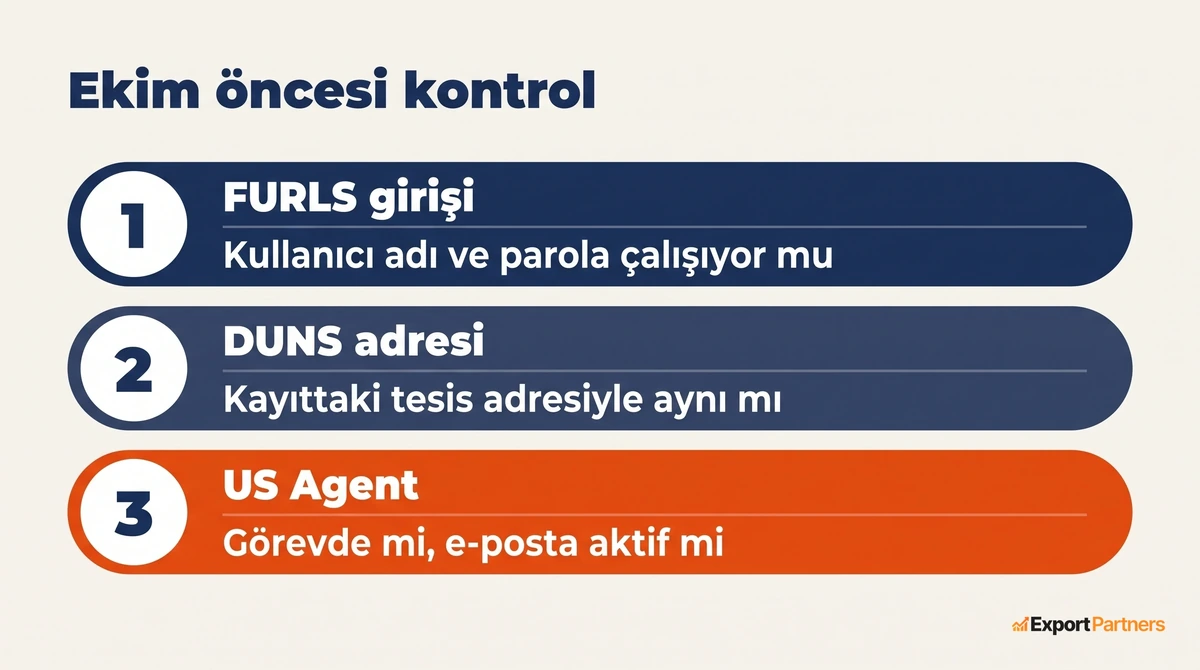
Preparations that can be completed before the window opens can significantly reduce the December rush. The first three of the six steps below can be done without waiting for October.
| Step | What is done | When |
|---|---|---|
| 1 | Log in to the FURLS account and confirm the username and password work | Before October |
| 2 | Compare the address linked to the DUNS number with the facility address on the registration | Before October |
| 3 | Confirm that the US Agent is continuing in the role and that their e-mail address is active | Before October |
| 4 | Update product categories if production has changed | During renewal |
| 5 | Submit the renewal and wait for US Agent confirmation | October, November |
| 6 | Check the registration status in the system and follow up if confirmation has not arrived | The week after submission |
A note on sharing registration information: FDA recommends protecting the facility registration number, PIN and FURLS login credentials. It is worth remembering that third parties requesting this information do not act on behalf of FDA.
Frequently asked questions
How long does FDA registration renewal take?
If the information is up to date and the US Agent confirms quickly, form submission and registration verification can be completed on the same day. What usually extends the timeline is not the form but the confirmation and DUNS address corrections. If an address correction is needed, planning for a few business days may be more realistic.
Can I renew my registration before October 1?
Renewal can only be done while the window is open, that is, between October 1 and December 31. However, the information on the registration can be updated throughout the year. Updating US Agent and address details in September can reduce the October renewal to a single step.
My registration has expired. Can I register again?
Yes, a new registration can be made. In that case, the process works like a new registration and US Agent confirmation is requested again. Since a shipment already in transit may face delays at the port of entry in the meantime, not missing the renewal is noticeably easier than fixing it afterward.
Production at my facility has changed. Do I need to update the categories?
Yes. The food product categories on the registration should reflect the products you actually manufacture. If you have moved into a new product group, updating it during renewal is the more accurate approach so the registration reflects the actual situation.
I want to change my US Agent. What should I do?
When a change occurs, the registration needs to be updated within 60 calendar days. FDA also sends a confirmation e-mail to the new agent, so completing the change beforehand, rather than squeezing it into the renewal period, tends to go more smoothly.
Conclusion
2026 is an FDA registration renewal year. The window opens on October 1, closes on December 31, and renewal is free of charge. The three items that cause delays are always the same: US Agent confirmation, DUNS address matching and up-to-date product categories. All three can be checked without waiting for October.
Added to this are the Prior Notice time limits that took effect on October 27, 2025, and the tracking number requirement for postal shipments that began on October 1, 2026. Rules can change, so it makes sense to verify them on fda.gov before taking action.
For renewal, US Agent representation or a review of your existing registration, you can reach us through our FDA registration and certification service. We can review together which stage your registration is at and identify any remaining steps.

