
A U.S. customs bond is the guarantee U.S. Customs relies on when your goods reach the U.S. border: an assurance that the duties and obligations on the shipment will be met. It is not insurance and it is not credit; it is a surety company guaranteeing the importer's obligations.
For manufacturers shipping to the U.S. for the first time, the process often stalls at the same point: the product is ready, the label is done, the FDA side is sorted, but while the cargo waits at the port the answer comes back as “no bond.” This article explains what a bond is, who should obtain it, how the amount is determined and why it is calculated differently for FDA-regulated products.
The amounts and thresholds in this article come from CBP's own regulations, and the sources are cited in the relevant sections. Regulations can change, so it is safer to have your customs broker confirm them before shipping.
What is a U.S. customs bond
A bond is a three-party commitment between the importer (principal), the surety company (surety) and CBP, the U.S. customs authority. If the importer does not pay duties, fails to redeliver goods when asked or does not produce its records, the surety steps in and pays CBP. It then seeks that amount from the importer.
In other words, a bond does not erase a debt you have not paid. It secures what Customs is owed, but it does not release you from the obligation to pay. Knowing this from the start avoids the misconception that “we have a bond, so we are covered.”
The contents of the bond are defined in 19 CFR 113.62. The basic importation bond, known in customs terms as “activity code 1,” can be issued either as a single transaction or a continuous bond.
When is a bond required
Two factors decide it: the value of the shipment and whether the product falls under another agency's oversight.
CBP requires a formal entry for commercial shipments valued at 2,500 dollars or more, and a bond is required for formal entries. Shipments below that value are generally processed as informal entries, where a bond is usually not required.
Staying below the value threshold may not be enough on its own. If your product is regulated by FDA, USDA or another agency, even a low-value shipment can be subject to formal entry. This is why most companies shipping food, supplements, cosmetics and animal products encounter the bond from their very first shipment.
When budgeting costs, the bond is not the only item. The article on the cost of exporting food to the U.S. brings customs, freight and compliance costs together in one place.
Two types of bond: single transaction and continuous
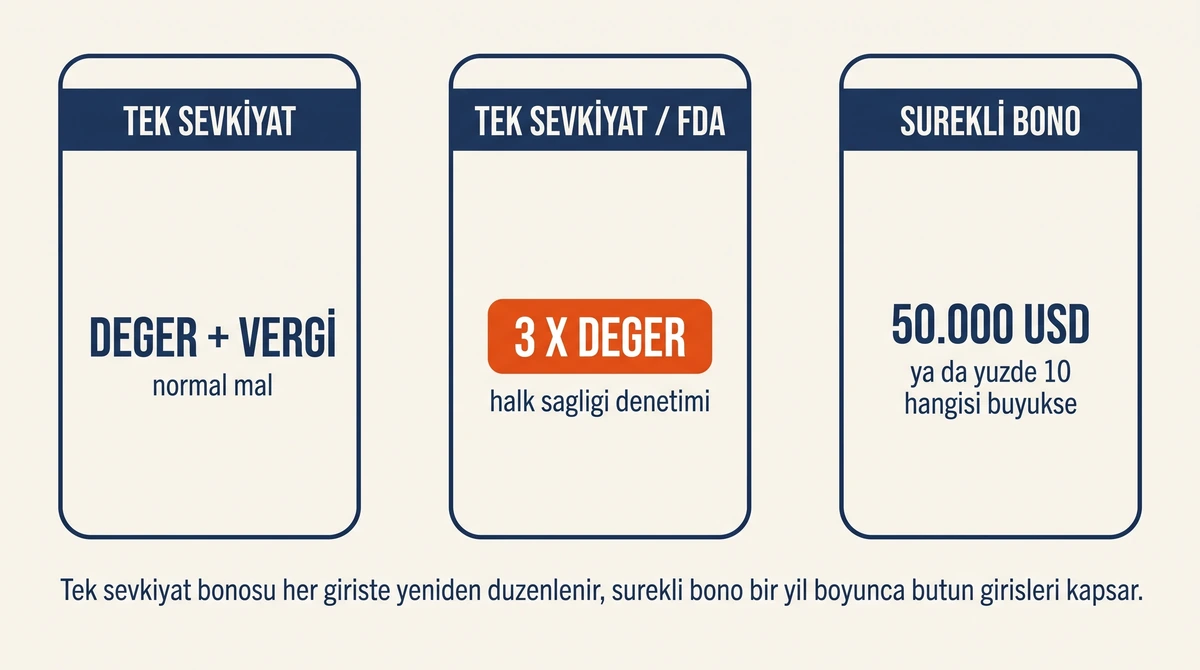
Single transaction bond. It covers one entry. It makes sense for a company that ships once or twice a year or is making its first trial shipment. It is issued again for each shipment.
Continuous bond. It is valid for one year and covers all entries within that year. For a company that ships regularly, it is both cheaper and removes the burden of handling paperwork each time. Being valid at all ports across the U.S. is another advantage.
In practice, the tipping point is this: after three or four shipments a year, a continuous bond generally becomes more economical. The exact number depends on the surety's pricing, so it is worth getting quotes for both options.
How the U.S. customs bond amount is determined
For a continuous bond, the basic formula CBP applies is: 50,000 dollars or 10 percent of the duties, taxes and fees paid over the last twelve months, whichever is greater. So for a new importer the floor is 50,000 dollars; as volume grows, the amount rises under the 10 percent rule.
For a single transaction bond, the calculation is specific to the shipment, and the general rule is that it is based on the declared value of the goods plus the duties, taxes and fees owed on them.
19 CFR 113.13 states that no customs bond can be less than 100 dollars. In practice you will not run into this minimum, because amounts for formal entries stay well above it.
Under the same regulation, CBP looks at six factors when setting the bond amount: your prior record of paying duties, your compliance with redelivery demands, the value and nature of the goods, the level of control customs exercises over the transaction, whether you have paid liquidated damages in the past, and any other information provided in the application.
The triple-value rule for FDA-regulated goods
This is the part that surprises exporters most. If the goods fall under another agency's oversight for public health and safety, a single transaction bond is issued for at least three times the total declared value. CBP states this rule explicitly for goods regulated by the FDA.
The reasoning makes sense: with these products, the main risk is not lost duty but noncompliant goods entering the market. CBP increases the guarantee in case the goods are not redelivered when it demands their return.
Here is how the numbers work. For a $40,000 food shipment, the single transaction bond is calculated on $120,000. Because the surety company sets its premium on that amount, the cost goes up as well. If you plan to ship regularly, this figure shows why a continuous bond quickly becomes the more sensible option.
This rule applies to all FDA-regulated products, such as food, beverages and dietary supplements. Because the facility's FDA registration is a separate step from the bond, the two should be planned on the same timeline. We explain how the sequence works for each product group in our articles on exporting olive oil, honey and animal-origin food to the U.S.
The step before the bond: importer of record registration
To obtain a bond, you first need an importer identity in the U.S. customs system. This is called the importer of record, and the registration is opened with CBP Form 5106.
There are three options for the identification number: an EIN if you have a U.S. company, a personal tax number, or, if you have neither, a number assigned by CBP. Foreign companies without a U.S. entity usually take this third route.
It is important not to mix up the order: importer registration first, then the bond, then the shipment. Without the registration, a bond cannot be issued and the whole process waits at the start. We covered the customs cost items from a seller's perspective in our article on Amazon U.S. customs duties.
IOR data accuracy is now checked more strictly
In a notice published in the Federal Register on August 19, 2026, U.S. Customs and Border Protection (CBP) announced that it will verify the accuracy of importer of record (IOR) information submitted on Form 5106 more strictly. The notice expects details such as the importer name, EIN or CBP-assigned number, mailing and physical address, phone and e-mail to be accurate and complete. The requirement applies from September 18, 2026.
According to the notice, inaccurate or incomplete information may lead to the IOR number being deactivated immediately; once deactivated, the number may not be usable for import transactions. For this reason, it may be wise to make sure the company name, address and contact details match official documents exactly during bond and IOR registration. We recommend confirming your own situation with a licensed customs broker. For details, see the Federal Register notice.
Who gets the bond: you or the U.S. buyer?
This depends on the delivery terms of the shipment.
If the buyer imports in its own name, the buyer is the importer of record and the bond is its responsibility. You bring the goods to the border, and customs clearance is handled on the buyer's side.
If you clear the goods through U.S. customs yourself and deliver them to the buyer, in other words if you set up a DDP-type arrangement, you are the importer of record. In that case both the importer registration and the bond are opened in your name. This may require a legal entity in the U.S., and the decision needs to be made well before shipping.
For sellers shipping through Amazon FBA, the situation is clear: Amazon does not act as importer of record. Registration and the bond are the seller's own responsibility.
What happens if the bond is found insufficient
CBP periodically reviews whether existing bonds are sufficient. If it decides a bond is insufficient, written notice is sent to the importer and the surety company, and 15 days are given to correct the shortfall.
If customs believes revenue is at risk, it may also request additional security without waiting: a cash deposit or a single transaction bond. Acting quickly when such a notice arrives helps keep shipments moving.
Three common mistakes
Confusing a bond with insurance. A bond does not protect your goods; it protects what customs is owed. Cargo insurance is a separate product, and one does not replace the other.
Getting a continuous bond too late. Approval of a continuous bond application can take time. Rather than applying while the shipment waits at the port, it is easier to start a few weeks before your shipping schedule.
Mistaking Prior Notice for a bond. They are separate obligations. Prior Notice is a pre-arrival notification submitted to the FDA; the bond is a financial guarantee given to customs. Completing one does not replace the other, and food shipments require both.
Frequently asked questions
What is a customs bond, and is it the same as an import bond?
Yes, they are the same thing. Sources may say customs bond, import bond or simply bond. The official term on the U.S. side is CBP bond.
Are Prior Notice and a customs bond the same thing?
No, they are two separate obligations. Prior Notice is a pre-arrival notification submitted to the FDA and must be filed a set time in advance depending on the mode of transport. A bond is a financial guarantee given to CBP. Food shipments require both.
What is an importer of record number, and how do you get one?
It is the number that identifies the importer in the U.S. customs system. It can be an EIN, a personal tax number or a number assigned by CBP. The application is made with CBP Form 5106 and should be completed before the bond.
Do the importer of record and the buyer have to be the same party?
No. The buyer is the party that takes delivery of the goods, while the importer of record is legally responsible for the import before customs. In most shipments they are the same company, but in DDP-type arrangements the exporter can act as the importer of record.
Is there a link between a bonded warehouse and a customs bond?
Not directly. A bonded warehouse is a facility where goods are stored with duty payment deferred. A customs bond is the financial guarantee for the entry. Warehouse use has its own separate bond type.
Conclusion
A U.S. customs bond is a step that almost every company making commercial shipments to the U.S. will face. The value threshold is 2,500 dollars, the floor for a continuous bond is 50,000 dollars, and for FDA-regulated products a single transaction bond is three times the declared value. Before any of this, the importer of record registration should already be in place.
Getting the sequence right usually costs far less than waiting at the port. For food, cosmetics and supplements, we plan FDA registration and customs steps together; the full process is described on our U.S. and Canada customs service page.
Sources: 19 CFR 113.13 and 19 CFR 113.62 (govinfo.gov), CBP guidance on determining bond amounts and CBP Form 5106 pages (cbp.gov). Amounts and thresholds may change; confirming them before shipment is recommended.
Last updated: October 17, 2026

