
Exporting pet products to the U.S. has become one of the most frequently asked-about lines for manufacturers in recent years.
There is demand for dog treats, chews and pet food; freeze-dried
treats in particular stand out, because the product is light, has a long shelf life and
does not require a cold chain, which can noticeably simplify freight and
storage for overseas shipments. More product fits into the same carton volume,
and the risk of spoilage drops.
That said, the processing method does not automatically change how the product is
classified in the U.S. Competition is not easy either: the U.S. market has established
brands in this category, and buyers look at documentation before price. The real challenge
is not in production but in knowing in advance which agency steps in
at which stage.
The general framework for chews is covered in our article on natural dog chews for the U.S.; here we look at the full sequence. Below, the sequence is laid out item by item: which permit waits on which, where sellers
assume they are “done”, and where delays most often occur.
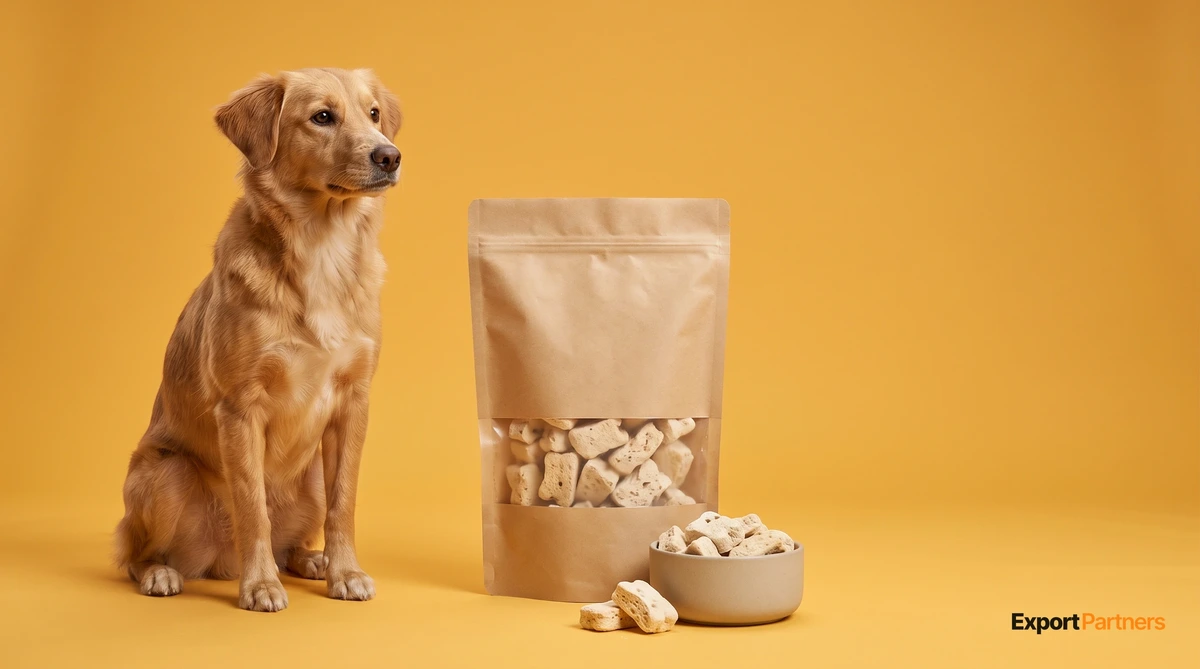
Being dried does not exempt a product from the rules
This is the misconception we encounter most often in practice. Drying turns the product into
something quite different in terms of shelf life, but on the U.S. side, what
determines its classification is not the processing method alone. The animal and
country the raw material comes from are evaluated together with how the product is processed.
The practical takeaway: the statement “it’s dried, so no permit is needed” is not a safe
assumption. If the product’s specific breakdown is checked before the shipment is planned,
corrections are easy; if it is checked after the container is on its way, the cost is
a different story.
The FDA side: facility registration and US Agent
For products within the scope of food and feed, entry into the U.S. requires the production facility to be
registered in the FDA system. Registration is opened for the facility, not the product, so a registration
made for one product can also cover other products from the same facility.
Completing the registration requires appointing a US Agent based in the U.S. The
registration is not finalized until this appointment is made. In addition, Prior Notice
is submitted before each shipment; this is not a one-time action but a recurring step.
The USDA APHIS side: where animal-based content comes in
Most dog treats contain animal-based ingredients. For these products, the agricultural side of
U.S. entry falls under USDA’s APHIS unit, and an import permit may be
required depending on the product. The permit is evaluated based on the product itself, its country of origin and
its degree of processing.
The critical point here is the order: the permit is a document obtained before shipment. How the process works on the agency side is covered in detail in our article on how to obtain a USDA VS Permit.
A permit process started after production is complete and the goods have reached the port
keeps the goods waiting. Many manufacturers working in the same product group learn this step
on their second shipment.
When the VS Permit comes up
The permit type that comes up for animal products is commonly referred to as the “VS permit”.
Since which product requires which permit is evaluated case by case,
a permit obtained by another company does not serve as a precedent for your product. When the application
includes the product description, ingredient percentages and production flow, the review
tends to move faster.
A third agency: Fish and Wildlife may get involved
This topic is rarely on manufacturers’ radar, yet it does come up
in searches. Some animal-based ingredients may also fall under the Fish and
Wildlife Service at U.S. entry and may require a separate declaration or permit.
Which species fall within this scope varies by product.
Why this matters in practice: having permits from two agencies does not mean a third one is
not required. How this permit is obtained is covered step by step in our article on the FWS import and export license. If the product contains an unusual animal-derived
ingredient, this question should be raised before shipment.
Labeling: the item most often sent back
In our client files, label review is the most frequently recurring
item after registration work. The reason: a label has to meet U.S. rules and also
the buyer's platform requirements. A small error in the product name, net quantity statement, ingredient list
or manufacturer information can mean the entire product has to be
relabeled.
Dried products carry one more detail: the rehydration instructions and the serving
statement. If the product is sold dry but mixed with water before use,
it should be clear which state the label statement refers to.
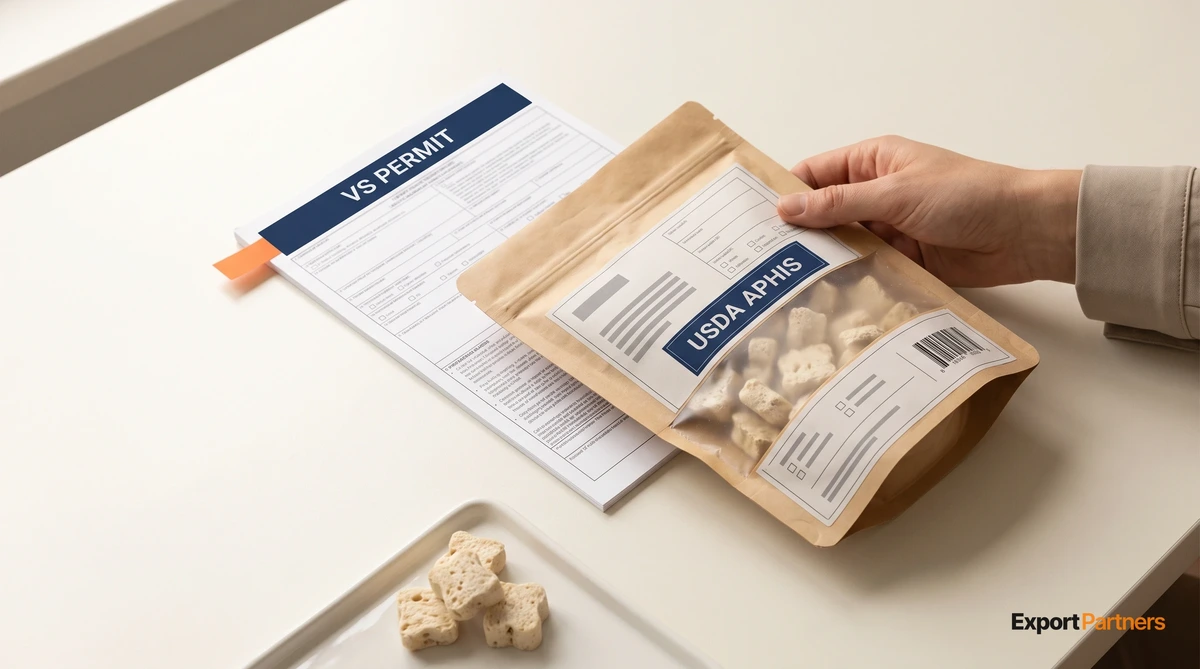
Three things buyers ask
Questions from a U.S. buyer in the first meeting usually fall under the same three headings
and all three can be prepared before shipment:
- Origin of the raw materials and a breakdown of animal-derived content
- Registration status and registration number of the manufacturing facility
- The label prepared according to U.S. rules
Once these three are ready, the conversation moves to price. When they are not, the delay happens
in the paperwork round rather than in shipping, and the buyer often treats it as a reason
to wait.
How to build a catalog, using an example
For a manufacturer preparing its own catalog, it helps to see how products are
presented in the U.S. market: product naming, weight breakdown, how the ingredient
statement is written and how product images are composed. A sample product catalog presenting freeze-dried dog
treats can be reviewed from this angle.
The goal is not to copy it; it is to understand what information a U.S. buyer expects
to find and where. The same product can read like a different product when its
statement is written differently.
Frequently Asked Questions
What is a USDA VS Permit, and is it required for every animal product?
It is the import permit that comes into play when animal products enter the U.S. It is not
automatically required for every product; the decision is made by looking at the product's ingredients, country of origin and degree of
processing together. For this reason, a permit obtained by another company
does not serve as a precedent for your product.
Is a separate FDA facility registration needed for a dried product?
Registration is made for the manufacturing facility, not the product. If the facility is already registered, no new
registration is needed for a dried product made at the same facility. What is required is that the registration
be current and active and that a US Agent has been designated.
When does a Fish and Wildlife permit come into play?
It depends on the type of animal-derived ingredient in the product. Completing the USDA and FDA
steps does not automatically settle this question;
if there is an unusual ingredient, it should be checked separately before shipment.
How long does the process take?
When the documents arrive complete, the facility registration part is usually finished within two
weeks. The time on the permit side depends on the agency's review,
so the company cannot shorten it; the only thing that can be shortened is making sure the application
is submitted complete.
Can the label be corrected after production?
It is possible, but costly. Changing a printed label means both reprinting
and relabeling labor. When the review is done before production,
this cost item disappears entirely.
Conclusion
In exporting pet products to the U.S., the challenge is not production but sequence. FDA facility registration, the label and the USDA permit depend on each other;
when one is skipped, the problem usually surfaces not at customs but in the second
meeting with the buyer.
To clarify which category your product falls into and which steps are actually needed,
you can review our FDA
registration and certification service; if a step is not needed, we tell you that
up front as well.

