
Selling collagen and protein powder in the U.S. has become one of the most notable export opportunities in recent years for manufacturers targeting the American sports nutrition and dietary supplement market. Protein powder, meal replacement and collagen products see strong and steady demand both in retail and on Amazon. Manufacturers with established dairy and meat processing infrastructure and private label production capacity can gain a meaningful cost and quality advantage in this category.
However, this product group has a more layered structure than an ordinary food product when it comes to entering the U.S. There are two reasons: first, most of these products fall into the “dietary supplement” category, and second, animal-derived ingredients such as collagen may bring USDA requirements into play alongside the FDA. When these two topics are not set up correctly, shipments and listings may run into delays regardless of product quality.
In this guide, drawing on projects we have supported, we walk through the U.S. market entry process for collagen and protein powder products step by step.
Why Is the U.S. Supplement Market So Attractive?
The U.S. is one of the world's leading markets in per capita spending on dietary supplements. Collagen positioned for beauty and joint health and protein powder positioned for performance and everyday nutrition form separate, growing segments. The meal replacement category also continues to expand as convenient nutrition habits become more common.
Amazon captures a significant share of this demand. With the right label, the right claim structure and the right launch plan, a product made abroad can find shelf space in the U.S., provided the regulatory side is in place before the product goes to market.
Two Points That Set Collagen and Protein Powder Apart from Other Foods
The Dietary Supplement Category
In the U.S., if a product's label includes the term “dietary supplement,” the product falls under a different framework than conventional food. A Supplement Facts panel is required instead of Nutrition Facts, the ingredient statement follows a different format, and the claims on the product are evaluated separately.
For some products, leaving this term off the label entirely may make more sense, since it can keep the product under a lighter regime. This decision depends on the formulation, the target segment and the claims, so it should be made before the label design is finalized.
Animal-Derived Ingredients
Collagen peptides may be bovine or marine derived. Protein powders contain dairy derivatives such as whey and casein, and some formulations include egg derivatives. These animal-origin ingredients may bring USDA requirements into play alongside the FDA when entering the U.S. This is the most important difference that separates the category from a plant-based supplement.
Step 1: U.S. Company and Tax ID (LLC + EIN)
A U.S. legal entity and an EIN tax ID form the foundation for becoming a professional seller on Amazon U.S. and acting as the importer. Technically, selling is possible without a U.S. company; however, an LLC + EIN structure makes the process noticeably easier in terms of bank accounts, trademark filings, customs registration and payment collection.
Step 2: FDA Food Facility Registration, US Agent and DUNS
The facility that manufactures the product must be registered with the FDA and must designate a U.S. Agent. Registration is renewed every two years. A DUNS number is also obtained to identify the facility.
Before each shipment, an electronic prior notice must be submitted to the FDA and customs, and the importer in the U.S. must have an FSVP plan that verifies supplier compliance. These three items form the product's gateway into the U.S.
For the practical FDA steps: our FDA Registration and Certification guide · FDA Labeling and Customs Service Guide
Step 3: Label and Formulation Compliance Review
In this category, the label is the most decisive item in the process. The review is done by product group and covers the following:
- Review of the formulation under the FDA framework, including whether ingredients are approved additives, GRAS or otherwise acceptable
- Compliance of the Supplement Facts panel with the U.S. format, including serving size and daily value calculations
- Ingredient list and allergen declaration (major allergens such as milk, egg, soy and fish)
- Structure/function claim analysis, meaning which statements can be used on the product
- Mandatory label elements such as net quantity, manufacturer/distributor information, lot number and expiration date
The entire label must be in English. Statements that the product treats or prevents a disease cannot be used; such claims can create problems on both the regulatory side and the Amazon side.
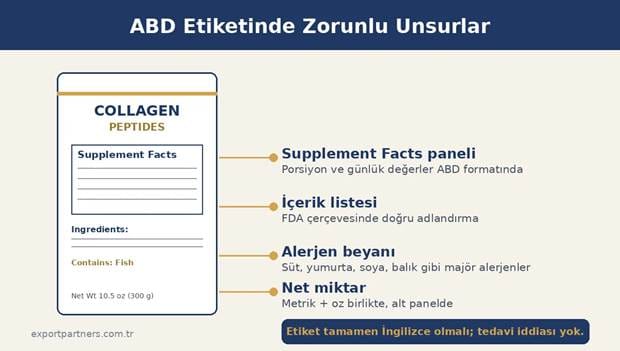
Mandatory elements on a U.S. label (file: supplement-facts-etiket-unsurlari.webp · alt text: Mandatory elements required on a U.S. Supplement Facts label)
Step 4: Animal-Derived Ingredients and the USDA APHIS VS Permit
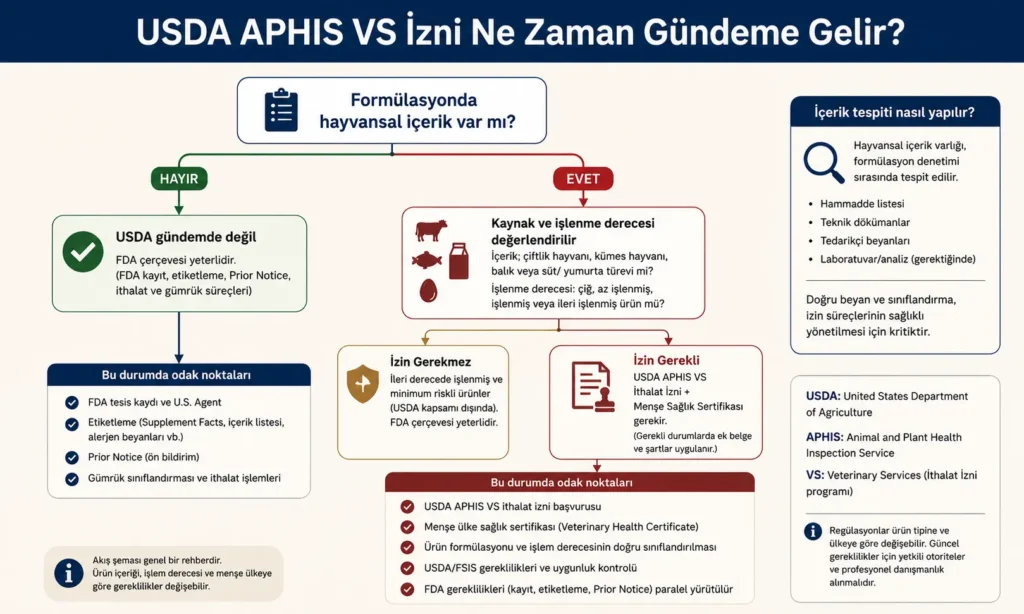
This is what sets collagen and dairy-based protein products apart from other supplements in the category. For products containing animal-origin ingredients, a USDA APHIS Veterinary Services (VS) import permit may come into play, with the aim of preventing the entry of foreign animal diseases.
Whether a permit is required depends on the source of the animal-derived ingredient in the formulation, its degree of processing and the country of origin. For this reason, identifying the ingredients during the formulation review is important for planning the process correctly. In some cases, a health certificate from the country of origin may also be requested.
The practical approach is this: animal-derived content is clarified during the label and formulation review, and then it is confirmed whether the USDA side is needed. This sequence helps avoid surprises at the shipping stage.
Step 5: Customs Registration and Customs Bond
To make commercial shipments to the U.S., an importer registration needs to be set up and an annual customs bond issued. These two items form the operational foundation for shipments to clear customs smoothly and are usually put in place once the first shipment starts being planned.
Step 6: Amazon Gated Category Approval and Launch
Dietary supplements are a gated category on Amazon U.S. Without approval, these products cannot be sent to FBA warehouses or listed. The approval application usually asks for:
- Invoices dated within the last 180 days, from an authorized supplier, showing the purchase of a specified quantity of units
- Product photos clearly showing all sides of the packaging and mandatory areas such as the Supplement Facts panel
- FDA compliance documents depending on the product type
- In some cases, a laboratory certificate of analysis (COA)
Once approval is granted, listing preparation, A+ content, Storefront setup, FBA shipment planning and PPC setup come into play. Reaching the initial social proof stage of the launch is generally considered the point at which the setup process is complete.
For the Amazon side: Selling Dietary Supplements on Amazon U.S. and the FDA Compliance Process · Amazon Private Label Starter Guide
A Two-Part Working Model
In this category, running the regulatory and sales sides separately is often not efficient. A decision made on the label directly affects the Amazon listing, and positioning built into the listing directly affects the claim structure on the label. For this reason, running the process within a single two-part framework can make more sense.
| Component | Scope |
| FDA and Regulatory Compliance Package | FDA food facility registration, U.S. Agent appointment, D-U-N-S number, label and formulation compliance analysis by product group, customs registration, customs bond. If animal-derived ingredients are identified, the USDA APHIS VS permit is handled separately. |
| Amazon Launch and Management Package | Seller account setup, gated category approval file, listing preparation, A+ content and Storefront setup, FBA shipment planning, launch strategy and PPC setup, regular reporting. |
The clearest advantage of this model appears when it starts while the products are still in the design stage. Packaging, label and ingredient decisions can be planned together from the start in line with the Amazon launch, which reduces the need for later revisions.
Roadmap Summary
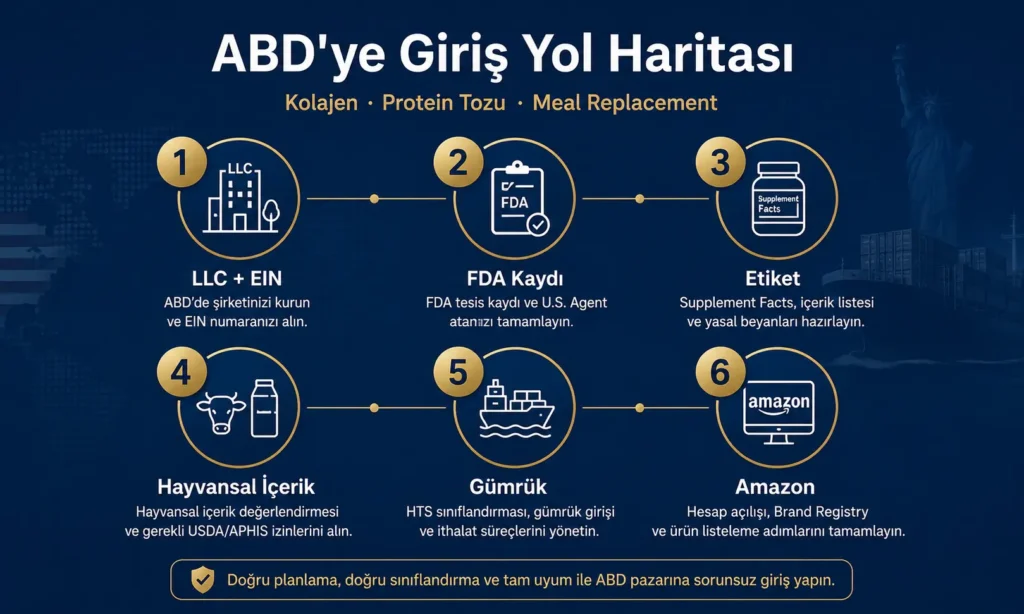
| Stage | Work Done |
| 1. Company and Tax | U.S. LLC formation, EIN application |
| 2. FDA Registration | Food facility registration, U.S. Agent appointment, D-U-N-S number |
| 3. Label and Formulation | Supplement Facts panel, ingredient and allergen declaration, claim analysis |
| 4. Animal-Derived Ingredients | USDA APHIS VS permit assessment for collagen and milk/egg derivatives |
| 5. Customs Infrastructure | Importer registration, customs bond, prior notice setup |
| 6. Amazon | Gated category approval, listing, FBA shipment, launch and PPC |
This structure aims to put the regulatory side in place before the product launch. In a heavily regulated category like supplements, the right sequence can noticeably reduce risks on both the customs side and the Amazon account side.
Frequently Asked Questions
Does a collagen product need FDA approval?
The FDA does not approve supplement products individually. However, obligations such as facility registration, U.S. Agent appointment, prior notice, FSVP and label compliance are mandatory. Amazon also requests these documents in its own approval process.
Do I have to state “dietary supplement” on the label?
It is not mandatory. Depending on the product's positioning and formulation, not using this term may allow the product to stay under a lighter compliance regime. The decision is made during the formulation review.
Is a USDA permit required for collagen in every case?
No. The requirement depends on the source of the animal-derived ingredient and how far it has been processed. That is why ingredient screening is done during the formulation review, and the outcome is confirmed based on the results.
My product is still in the design stage. Does it make sense to start the process now?
This is usually the most efficient timing. A compliance review done before packaging and labels are printed can eliminate later revision costs and helps structure ingredient decisions so they fit the Amazon launch.
Can my label be in my own language?
No. Under both FDA and Amazon rules, the label generally needs to be in English and include all mandatory elements.
Conclusion
Entering the U.S. market with collagen, protein powder and meal replacement products can be a strong opportunity for manufacturers. Success, however, depends on the regulatory structure before product quality: LLC and EIN, FDA facility registration, label and formulation review, assessment of animal-derived ingredients, customs setup and Amazon approval.
Completing these steps in the right order can reduce risk on both the customs and the Amazon side and makes the launch more predictable.
If you plan to enter the U.S. market with a dietary supplement or another food product, Export Partners can support you end to end with FDA registration and certification · selling dietary supplements in the U.S. · U.S. trademark registration.
Other guides in this series
This guide is part of a series on FDA processes for exporting to the U.S. Related guides:
- How supplement exports to the U.S. work
- Selling Dietary Supplements in the U.S.
- FDA registration, D-U-N-S and labeling for beverage exports to the U.S.
- For registration and certification support, see our FDA registration and certification service.

