
Exporting Beverages to the U.S.: FDA Registration, D-U-N-S and Label Review, Start to Finish
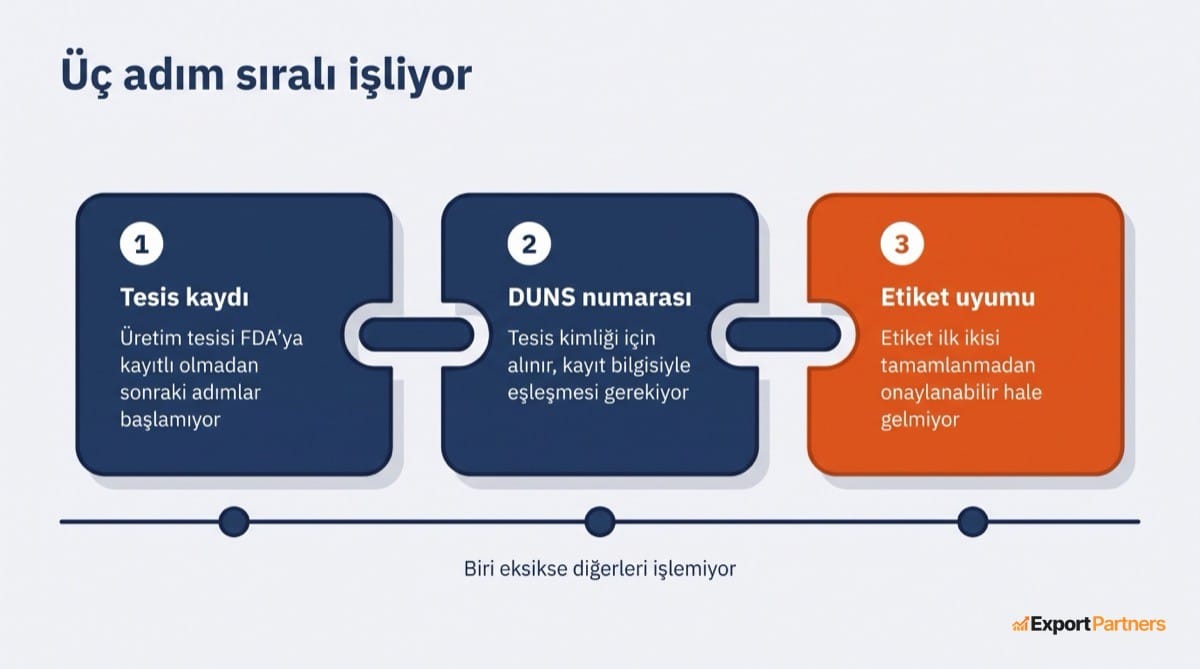
Most manufacturers planning to export beverages to the U.S. think of the process in three main steps: FDA food facility registration, a D-U-N-S number and label compliance. However good the product is, if these three layers are not set up correctly from the start, the product may not clear the U.S. border, may be held at customs, or may move forward only through revisions that become costly later.
In this article, based on the FDA entry process of a beverage manufacturer we supported, we explain how we handle the registration, D-U-N-S and label review steps in practice. The goal is to give manufacturers learning the process for the first time a clear roadmap, and to help companies considering the same path make the right decisions from the start.
3. Label and Ingredient Compliance Review
FDA registration makes it possible for a product to enter the U.S.; the next requirement for clearing customs smoothly and staying on the shelf is a label that complies with FDA rules. In the beverage category, label review has more layers than for standard foods, because additional rules specific to juice apply.
What Does a Label Review Cover?
- Statement of Identity: The product name and description; correct use of terms such as “juice”, “nectar” and “juice drink”.
- Net quantity statement: Both metric and U.S. units (fl oz); placement, type size and format are defined.
- Nutrition Facts: The current U.S. format; for beverages, the ‘added sugars’ line and the serving size calculation are especially important.
- Ingredient list and allergens: Listed in descending order by weight; allergens such as sulfites are declared.
- Percent juice declaration (21 CFR 101.30): Required on all beverages that contain juice; calculated based on Brix.
- Pasteurization warning (21 CFR 101.17(g)): A required warning statement on untreated juices; the format is defined.
- Manufacturer information and origin: A country of origin statement (‘Product of [country]’); the manufacturer or distributor name and address.
- Language: The entire label must be in English.
The Revisions We See Most Often in Reviews
In the multi-product review in our case, the most frequent corrections centered on three points:
- Incorrect percentage declaration: For products made from concentrate, the actual percentage reached through the Brix calculation often differs from the percentage printed on the label.
- Product name not matching the category: A product sold as “nectar” in its home market may fall into a different category in the U.S. based on its actual juice content, and the product name is revised accordingly.
- Outdated Nutrition Facts format: The current U.S. format includes the ‘added sugars’ line; the old format is not accepted.
The review is done per SKU; a separate compliance report is prepared for each product, and the necessary revision guidance is provided to the client. This report then becomes a document used again and again at customs, in buyer meetings and on marketplaces, including Amazon. For the full picture on labeling, our FDA Labeling and Customs Guide can serve as a reference.
After Registration and Labeling Are Complete
Once the three steps are complete, the manufacturer is formally “ready” to export to the U.S.; however, the full process does not end with these three steps. Additional topics that come up in the next stage include:
- Prior Notice: An electronic advance notice to FDA and CBP before each shipment.
- Importer registration and customs bond: The operational foundation that allows a shipment to clear customs.
- FSVP: In U.S. food imports, the importer is expected to maintain a supplier verification program; this obligation belongs to the importer, not the manufacturer.
- Trademark registration and Brand Registry: Important for brand awareness if sales on Amazon or in retail are planned.
- Amazon and online sales setup: Once the regulatory foundation is in place, building the sales side moves much faster.
The Roadmap at a Glance
| Stage | What Is Done | Why It Matters |
| 1. D-U-N-S | D&B application and obtaining the number | Technical prerequisite for FDA registration |
| 2. FDA registration | Foreign Facility Registration + US Agent | Prerequisite for entry into the U.S. |
| 3. Label review | Per-SKU compliance analysis and reporting | A common language for customs and the shelf |
| 4. Shipment | Prior Notice + customs bond + customs | Operations repeated with every shipment |
| 5. Sales infrastructure | Brand, Amazon and distributor channels | Built on regulatory compliance |
Frequently Asked Questions (FAQ)
Do I need a DUNS number before FDA registration?
Yes. To register as a foreign food facility in the FDA system, you first need to obtain a DUNS number from D&B. If the steps are taken out of order, the system rejects the registration.
Can the manufacturer choose its own US Agent?
Yes. The US Agent only needs to be located in the U.S.; it can be a service provider or an individual. A corporate US Agent service offers advantages in continuity and correspondence tracking. We explain how the agent confirmation step and change notifications work in detail in our FDA US Agent guide.
How long does FDA registration take?
If the documents are complete and the US Agent confirms quickly, it can be finished within a few days. Missing or inconsistent information is the main reason the process takes longer.
Is the FDA registration number shown to retailers?
No. An FDA registration number is not an approval or a quality certificate, and it is not printed on the product. The phrase “FDA registered” can be used in marketing, but “FDA approved” is misleading.
Can we revise the labels later?
Yes, but it adds printing and packaging costs. In our experience, completing the label review before printing is the most economical approach.
Does FDA registration need to be renewed every two years?
Yes. Registrations are renewed between October and December of even-numbered years; an expired registration is cancelled automatically, and products from that facility may not be able to enter the U.S.
Three Items, One Complete Setup
In practice, the outcome of a beverage export to the U.S. often depends on whether these three items are set up together. Viewed separately, DUNS, FDA registration and label review look like small operational steps; handled together and in the right order, they form a solid and predictable foundation for entering the U.S. market.
We manage FDA registration, DUNS and label compliance end to end for manufacturers exporting beverages and food to the U.S. We also coordinate customs and import operations, U.S. tax and accounting, and trademark registration under one roof. On request, we can build your Amazon and e-commerce setup on top of this regulatory foundation.
Related guides: FDA registration and certification · FDA Labeling and Customs Service Guide · Trademark registration in the U.S. · Amazon Brand Registry
Other guides in this series
This guide is part of a series on FDA processes for exporting to the U.S. Related guides:
- FDA registration and labeling for juice exports to the U.S.
- FDA registration, GMP and customs for vegetable oil exports
- FDA and labeling for collagen and protein powder sales
- For registration and certification support, see our FDA registration and certification service.

