For a manufacturer who has decided to form a company in the U.S., the first question is usually
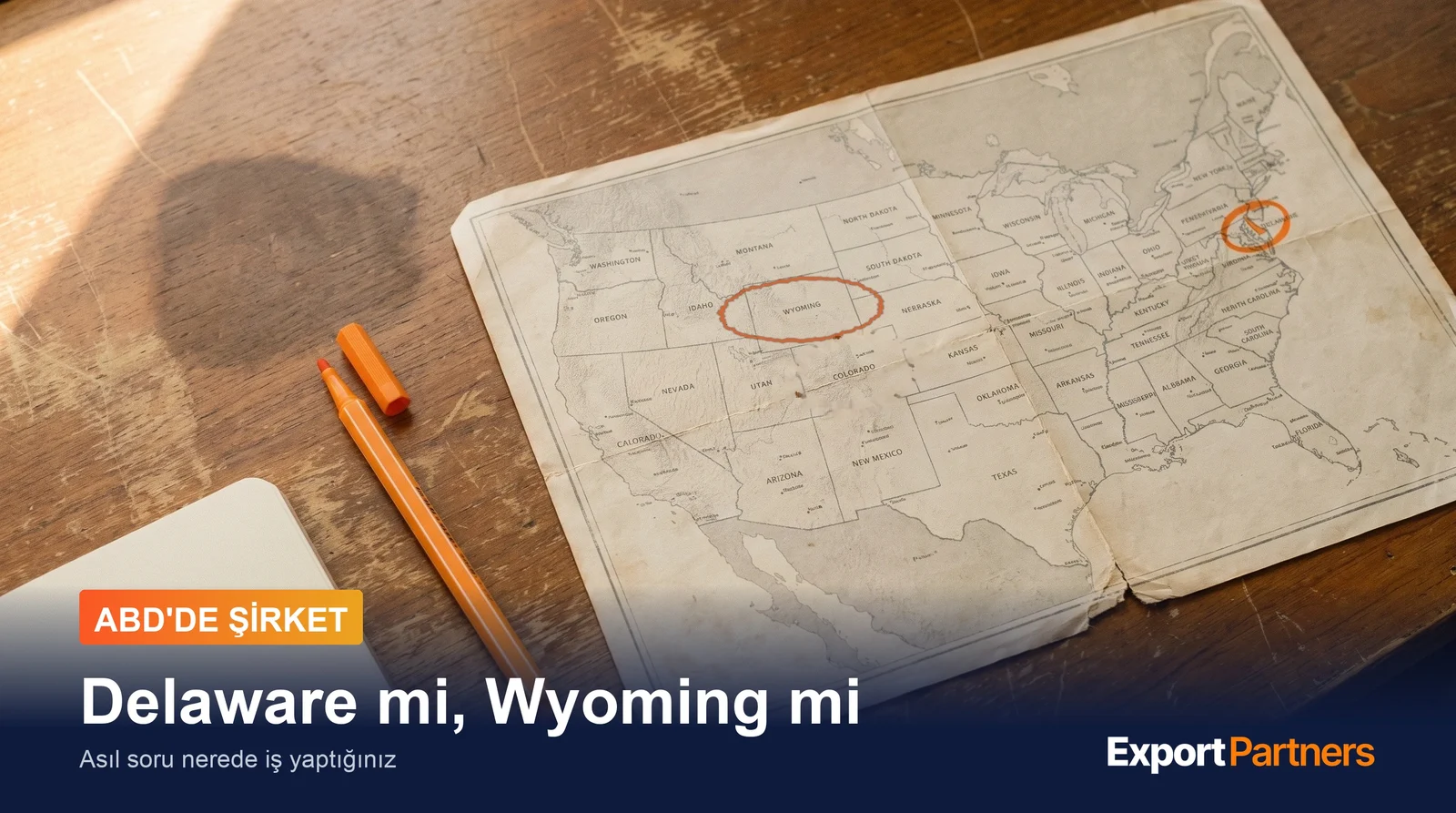
the state. Delaware and Wyoming dominate the search results, both are
described as “the most advantageous,” and the decision turns into a list
comparison. The answer to which U.S. state to form a company in, however,
is not on that list. It depends on where your business is actually conducted.
This article does not rank the states. It explains the three things that drive the decision:
where the business actually operates, whether a second state registration is needed, and
how much upkeep the choice requires in the years that follow.
First, set aside the wrong question
The question “which state is cheaper” compares formation fees.
Yet the cost of a U.S. company does not end at formation: there is a recurring
state tax every year, a registered agent fee and the accounting side. Saving
fifty dollars at formation and then paying two states every year
is where that comparison falls short.
The right question is: where will this company do business? Under U.S. law,
the state where a company is formed and the state where it does business are separate concepts, and the second one
creates its own registration requirement.
Foreign qualification: registering in a second state
A company formed in one state registers in another state as well
once it starts actually doing business there. This process is called foreign qualification;
here “foreign” does not mean another country, it means another state.
A company formed in Delaware that operates a warehouse in California
is domestic from Delaware’s point of view and foreign from California’s.
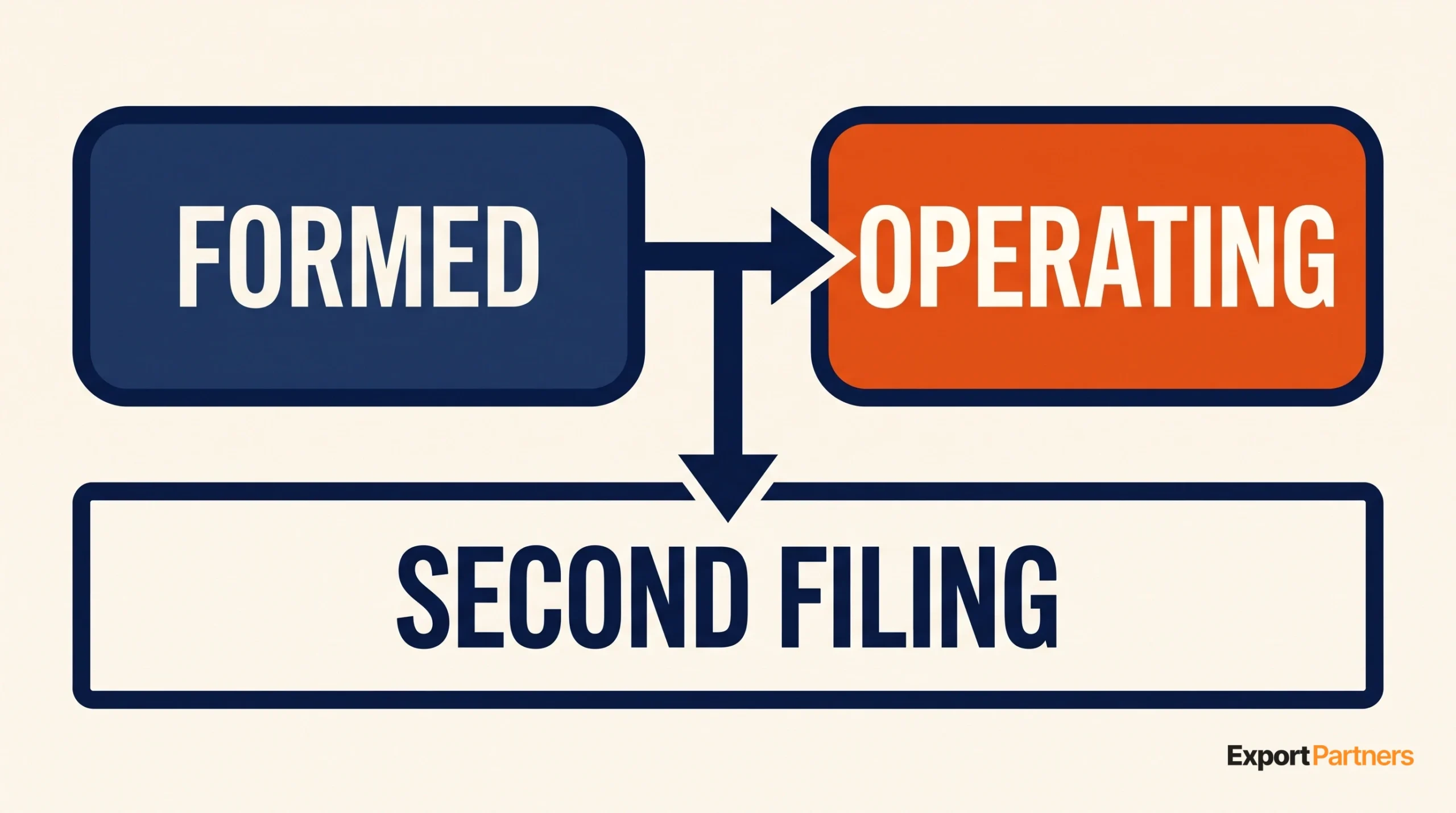
The result: registration in two states, two registered agents, two annual
filings. A company that picks Delaware as “advantageous” but does its business in another state ends up carrying the upkeep costs of two states for a single company.
What “doing business” means
The definition varies from state to state and there is no single list. In general,
physical presence, employees, an office or a warehouse are considered within its scope.
Selling online alone is often not enough on its own,
but inventory held in a state can change the picture. In borderline
cases, confirming with a U.S. accountant tends to be the safer route.
Why Delaware gets so much attention
Delaware’s reputation comes from its corporate law and from having a separate
court that handles business disputes. That is a real advantage for companies raising capital from investors
with complex share structures. It is why venture-backed technology companies
are typically formed in Delaware.
For a manufacturer exporting to the U.S., however, that same advantage often
does not apply: no shareholder disputes are expected, there are no investors, and the company
has a single owner or a family structure. What remains is the cost side.
Every entity formed in Delaware must maintain a registered agent and
a registered address in the state; for LLCs, the annual state tax is due
by June 1. Delaware LLCs are not required to file an annual report,
so that side is simple. Current amounts should be confirmed on the state’s own website,
as the figures are updated from time to time.
Wyoming and similar states
Wyoming, Nevada and New Mexico are generally known for low annual costs and simple filing
requirements. For a small, single-owner structure with no physical presence
in the U.S., these states can be a reasonable option.
The condition here is the same: the company has no actual presence in another state.
As soon as a warehouse, office or employee comes into play, registration in that state also
becomes relevant and the low-cost advantage fades.
If you sell on Amazon, where is your inventory?
For a company selling through FBA, the product sits in Amazon’s warehouses, and Amazon
can move inventory between states within its own network. This can create
a connection on the sales tax side.
In practice, sales tax on marketplace sales is now largely collected and remitted by Amazon,
so the burden of filing separately in every state
comes up less often than it used to. If you also sell
through your own website, the picture changes. We cover sales tax permits and resale certificates
separately in
our Sales
Tax ID and Resale Certificate guide.
Which steps the choice of state affects
The state decision does not stand alone; it also sets the order
of the steps that follow.
| Step | State-dependent? | Note |
|---|---|---|
| Company formation | Yes | The formation document is issued by the chosen state |
| Registered agent | Yes | Required separately in each state where you register |
| EIN | No | Federal number, issued by the IRS |
| Bank account | Indirectly | Banks may ask for different documents depending on the state and structure |
| Sales tax registration | Yes | Depends on the state where nexus arises |
| Annual report and state tax | Yes | In every state where you are registered |
A detail that is often missed: the EIN does not depend on the state. We explain the difference
between an EIN and an ITIN in
our EIN vs ITIN
article.
How the decision is made
The order works like this:
- Will you have a physical presence in the U.S.? If you will have your own warehouse, office
or employees, the company is formed directly in that state. Adding a second
state only adds cost. - Is there an investor or multi-member structure? If so,
Delaware's corporate law becomes meaningful. - If neither applies, states with low annual costs
are considered; at that point the decision comes down to cost and ease of maintenance.
In other words, choosing a state is not a list of preferences but a three-question filter. When the order
is skipped, the typical result is a company that pays fees every year
in a state where it does no business.
Annual maintenance calendar
Choosing a state looks like a one-time decision, but the result is a calendar that repeats
every year. For each state where you are registered, the following comes around:
- Registered agent renewal. Annual, paid to the
provider. It repeats for every state where you are registered. - State tax or annual report. The name and due date
vary by state. In Delaware, the deadline for LLCs is June 1 and
no separate annual report is required; in other states the annual report and tax
may come together. - Federal filing. Independent of the state, it depends on the company's
structure, and a filing may be required even when there is no profit.
A missed annual filing usually results in a late fee; when filings are not renewed
for a long time, the company's good standing with the state
may be affected, which can cause problems when a bank or marketplace
asks for documents. When comparing costs, the number to look at is not the formation fee
but the annual total of this calendar. For an item-by-item cost breakdown, see
our LLC
formation cost article.
What comes next: four steps after formation
Once the state is chosen, the sequence works as follows, and the order itself matters,
because each step requires the output of the one before it.
Formation document. Once the state approves, the company's legal
existence begins. The document is requested in every step that follows.
EIN. The federal tax number. You cannot apply
without the formation document. For a founder without a U.S. tax number, the application
follows a different route and may take longer.
Bank account. Opened with the formation document and EIN.
Banks may request additional documents depending on the founder's residence and company structure;
this step is usually the one that takes the longest.
Sales tax registration. Done only in the state where nexus arises, and
only when needed. Registering in every state from the start is a common
mistake: each registration creates a filing obligation even without sales.
Three common mistakes
The first is choosing a state based on advice read in a forum.
That advice usually reflects the needs of investor-backed tech companies
and does not fit the situation of an exporting manufacturer.
The second is not accounting for foreign qualification at all.
When a warehouse or office comes into play, registration in a second state
follows, and the comparison changes at that point.
The third is dropping the calendar after formation. Annual filings
and registered agent renewals do not run automatically; without reminders,
late fees can follow.
Frequently asked questions
Which state should you form your company in?
There is no single right state. If you will have a physical presence in the U.S., that state;
if you are building an investor-backed structure, Delaware; if neither applies, states with low annual costs
stand out. The input to the decision is not a list of states but
where the business will actually operate.
Is Delaware the best choice for everyone?
No. Delaware's advantage is its corporate law and a separate court for business
disputes; this matters for companies with complex ownership structures. For a single-member
export company, the same advantage carries little weight, and what remains is the annual
maintenance cost.
Can I move my company to another state later?
Yes, and there are two ways: moving the company to the new state, or registering in the new state
through foreign qualification. Both involve fees and paperwork,
so getting the first choice right from the start is usually cheaper.
Is a registered agent required?
Yes. States, Delaware among them, require a company to maintain a registered
address in that state and a registered agent to accept legal notices.
One is required separately in each state where you are registered.
Does the choice of state matter for the EIN?
No. An EIN is a federal number issued by the IRS, regardless of
the state where you form your company. The state-level parts are sales tax registration and
the annual state report.
Conclusion
Which state to form a company in the U.S. is decided by where the business actually operates,
not by comparing states. If you have a physical
presence, choose that state; if you have investors, Delaware; if neither, a state with low annual
costs. Skipping this order can leave you with a company paying maintenance fees
in two states at once.
If you would like to plan company formation, EIN, bank account and taxes together,
you can contact us through our export
services page.