
Selling textiles on Amazon Germany means entering one of Europe's busiest apparel markets. German shoppers see major brands and very low-priced products on the same search page; competition is intense, return rates in apparel are high and oversight is strict. If one of the registrations is missing, sales can stop even after the product page goes live.
On the other hand, when the sequence is set up correctly, the process is predictable. For a brand that manufactures in its own factory and can explain its fabric and stitching quality, there is still room in the mid and upper price range. In this article we walk through a textile brand's entry into Amazon Germany from scratch: which registration is needed and why, in what order it is obtained, what can happen if it is missing, and how the launch is built. The article is the first part of our work with a brand that manufactures seamless underwear; we do not name the company.
Step-by-step sequence: a 13-week plan
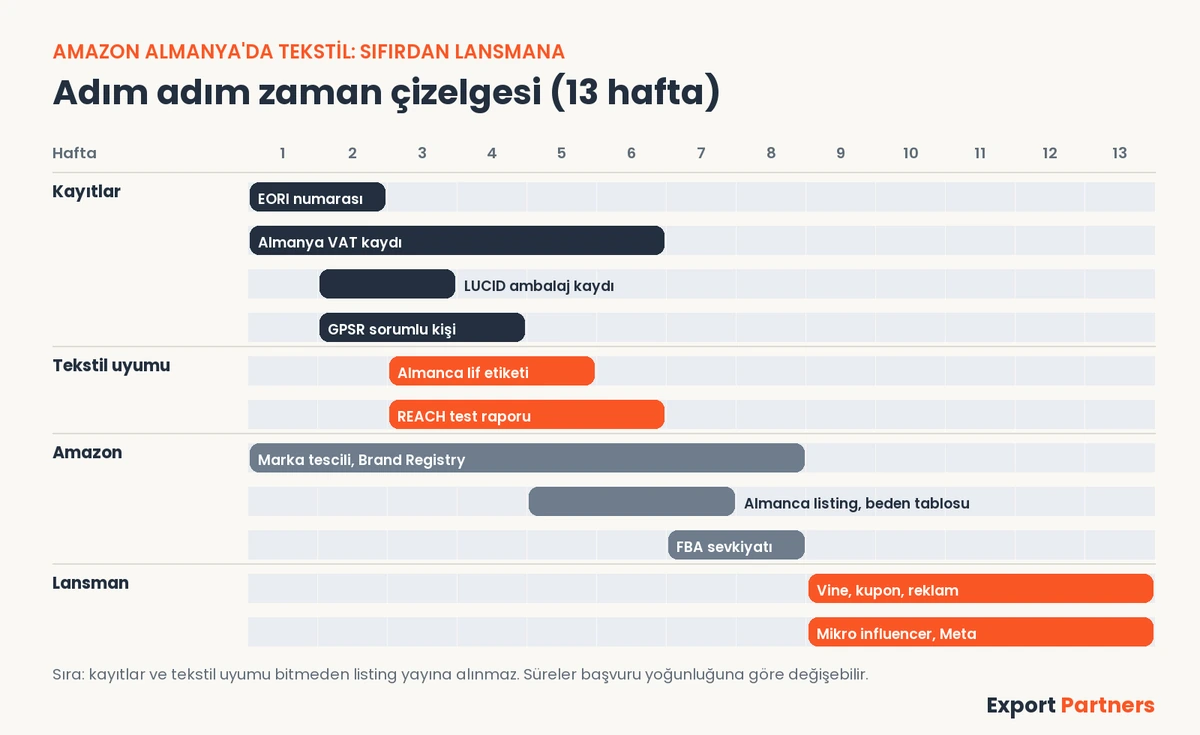
Some registrations run in parallel, while others depend on one another. The timeline below shows the typical sequence for a brand starting with none of the registrations in place. Depending on application volume and how ready the documents are, timelines can be shorter or longer.
Step 1: EORI number
EORI is the number that identifies the importer at EU customs. If goods enter Germany from outside the EU through customs, this number is required on the import declaration. A company established outside the EU can obtain an EORI from the customs authority of the country where it makes its first import; for Germany, the application is filed with the German customs administration (Zoll).
EORI on its own is not a permit to sell; it is a customs identity. It should be in place before the first FBA shipment leaves, though; otherwise goods may wait at customs and the arrival date at the Amazon warehouse can slip.
2. Step 2: German VAT registration
If inventory will be stored in Amazon's warehouses in Germany (FBA), German VAT registration is required. For companies established outside the EU, Germany assigns a designated competent tax office based on the company's home country, and the application is filed there. Registration is completed with a VAT identification number and a tax number; Amazon asks for these numbers in the seller account.
VAT registration is usually the longest step in the process, so it makes sense to start it on day one. Amazon can collect VAT itself on certain sales; this does not remove the registration and filing obligations. Working with a tax advisor in Germany may be necessary to keep filings on schedule.
Step 3: LUCID packaging registration
Germany's Packaging Act (VerpackG) requires every seller who places packaging that reaches end consumers on the market to be registered in the central register LUCID. The product's own packaging, poly bags and shipping boxes fall within this scope. In addition to registration, a license agreement is signed with a dual system and the expected packaging volume is reported.
What can happen without a LUCID registration: Since 2022, marketplaces have been required to check sellers' LUCID registration. A seller without a registration, or whose number has not been entered in the Amazon account, may have its product pages in Germany deactivated and its German sales suspended. The law also treats placing packaging on the market without registration as a violation subject to fines. For this reason, LUCID registration should be completed before the listing goes live, and the LUCID number should be entered in the relevant field in Seller Central.
Step 4: GPSR and the EU responsible person
The EU General Product Safety Regulation (GPSR) has applied since December 13, 2024. A product whose manufacturer is outside the EU needs a responsible economic operator established in the EU. This person's name and EU address appear on the product, its packaging or a document accompanying the product; the same information is also shown on the Amazon product page.
What can happen if GPSR information is missing: Amazon may remove products with missing responsible person and manufacturer details from EU marketplaces or deactivate the product page. Entering the information at account level may not be enough; it is worth checking separately that each product (ASIN) is linked to the responsible person. A responsible person service can be obtained from specialist firms that do this work in the EU, and setting up a company in Germany is not required.
Step 5: German fiber label
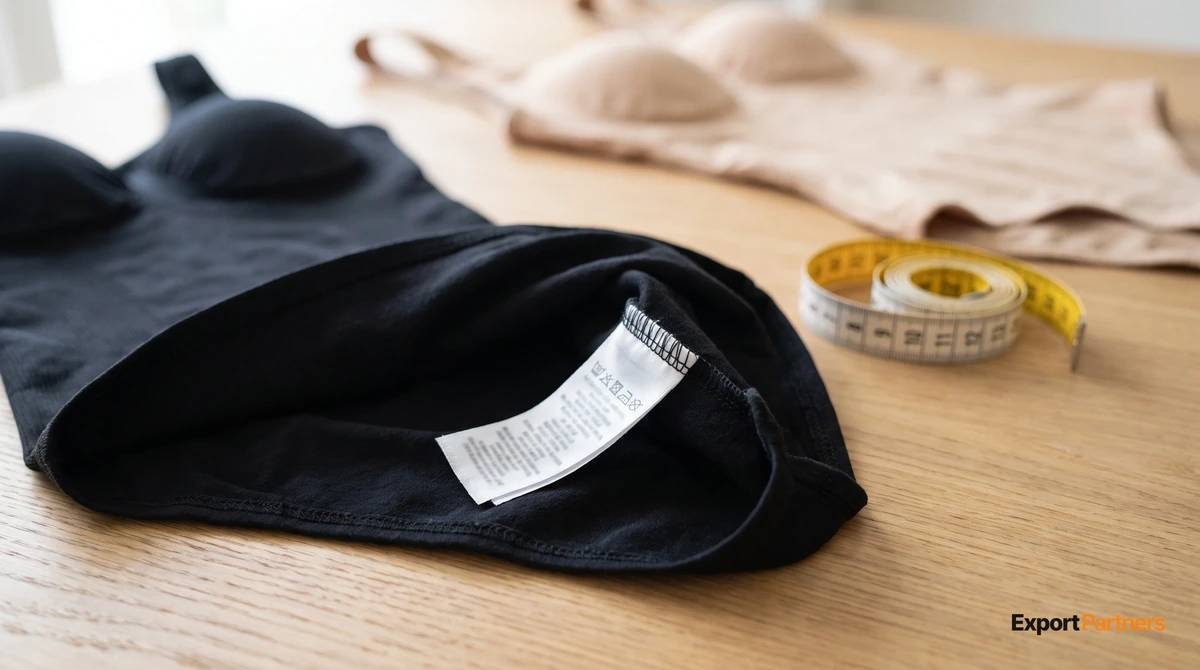
In the EU, the fiber composition of textile products is labeled under Textile Regulation (EU) No 1007/2011. The label shows the name of each fiber and its percentage by weight; if the product is sold in Germany, it is written in German, for example "Polyamid", "Elasthan" or "Baumwolle". Fiber names are chosen from the list in the regulation, and trade names alone are not considered sufficient.
In online sales, the buyer should be able to see the fiber composition before purchase. For this reason, the percentages on the sewn-in label should appear exactly the same on the Amazon product page. Products labeled in another language, or only in English, may need a German label or an additional label.
Step 6: REACH and test report
For textiles that come into contact with the skin, the EU's REACH regulation restricts certain azo dyes; underwear, sportswear and shapewear fall squarely into this group. Amazon.de may request documents in some categories, and market surveillance authorities may ask the same question.
The step to take is to obtain a declaration of conformity from the supplier for the fabric and dye used, and a test report from an accredited laboratory. A certificate such as OEKO-TEX can make this easier; it is worth checking that the certificate's scope actually covers the product being sold. The report should be kept in a folder where it can be shown right away when requested.
Step 7: Trademark registration and Brand Registry
Amazon's brand tools (A+ content, Brand Store, Vine) are unlocked through Brand Registry. This requires the trademark to be registered or a trademark application to have been filed. For Germany and the EU, the application is filed with EUIPO; for apparel, the relevant class is 25. Once an application number is issued, a Brand Registry application can be submitted. For the process, see our European Union trademark registration page.
Step 8: German product page and size chart
In apparel, the product page's job is not only to sell but also to prevent the wrong sale. For shapewear and underwear, size is the most common reason for returns. Three things are built together on the product page:
- German title and description: not a translation, but copy written with the words buyers in Germany actually search for (such as "Shapewear Damen", "Miederbody", "Bauchweg")
- Size chart in centimeters: based on waist, hip and bust measurements, with guidance for "if you are between sizes"
- Images: model photos in different sizes and skin tones, a how-to-measure image, and a section on choosing the right size in the A+ content
For hygiene reasons, underwear that is returned may not always be resold. A return allowance should be kept as a separate line item in pricing.
Step 9: FBA shipment
Once registrations and product pages are ready, inventory is shipped to Amazon's fulfillment center in Germany. In apparel, the Prime badge and fast delivery are among the first signals a buyer looks at. Each unit's Amazon label (FNSKU), carton labels and poly-bagging rules are applied to the shipment; EORI and VAT numbers are used in the import declaration.
Step 10: Launch, promotions and micro-influencers
Rather than opening with a broad catalog, it makes more sense to start with three to five best-selling styles. Each style is grouped on a single parent product page with its color and size variations, so reviews accumulate on one page. In the first weeks, the goal is not sales but reviews and conversion data:
- First reviews through Amazon Vine (Brand Registry required)
- Speeding up first sales with coupons and introductory pricing
- Low-budget advertising that starts with narrow keywords containing the product name
- Micro-influencer work with fashion and fitness creators in Germany; product seeding and personal discount codes
- Traffic from outside Amazon through a German web page and Meta ads
In Germany, paid posts or posts made in exchange for products are expected to be labeled "Werbung" or "Anzeige". Traffic from outside Amazon can be measured with Amazon Attribution links, which shows which content drives sales.
Which registration can stop what
| Registration | What can happen if it is missing |
|---|---|
| EORI | The import declaration cannot be filed; goods may be held at customs |
| Germany VAT | Inventory cannot be stored in Germany; sales on the Amazon account may be restricted |
| LUCID | Product pages in Germany may be deactivated and sales stopped; risk of fines |
| GPSR responsible person | The product may be removed from EU marketplaces |
| German fiber label | Non-compliance in market surveillance; request to correct the product page |
| REACH test report | Cannot be shown when Amazon or authorities request documents |
We also explain the general order of registrations for non-textile products in our guide to selling on Amazon Germany.
Frequently asked questions
Which registrations are needed to sell textiles on Amazon Germany?
The core registrations are EORI, Germany VAT, LUCID packaging registration and an EU responsible person for GPSR. For textiles, a German fiber label and REACH compliance are added to these.
Can you sell on Amazon Germany without a LUCID registration?
Marketplaces are required to check LUCID registration. A seller whose registration or number is missing may have their product pages in Germany deactivated, so the registration should be completed before selling.
Do you need to set up a company in Germany for GPSR?
No need to set up a company. If the manufacturer is based outside the EU, a responsible economic operator established in the EU is designated; this service can be obtained from specialist firms.
Does the textile label have to be in German?
For products sold to consumers in Germany, the fiber composition is stated in German. Products labeled in another language may need a German label or a supplementary label.
How long does it take a brand starting from scratch to begin selling?
If none of the registrations are in place, the first sale usually takes about two to three months. The longest step is often the VAT registration; starting it on day one can shorten the timeline.
Conclusion
When selling textiles on Amazon Germany, the order matters: first the registrations (EORI, VAT, LUCID, GPSR), then textile-specific compliance (German fiber labeling, REACH), followed by the brand, product page, FBA and launch. Because sales can stop even after the product page goes live if one of the registrations is missing, it makes more sense to complete all of them before the listing is published.
We will share the next parts of this work under the same heading. For your own products, you can learn more about our Amazon Germany selling service and our Amazon launch and advertising service.

