
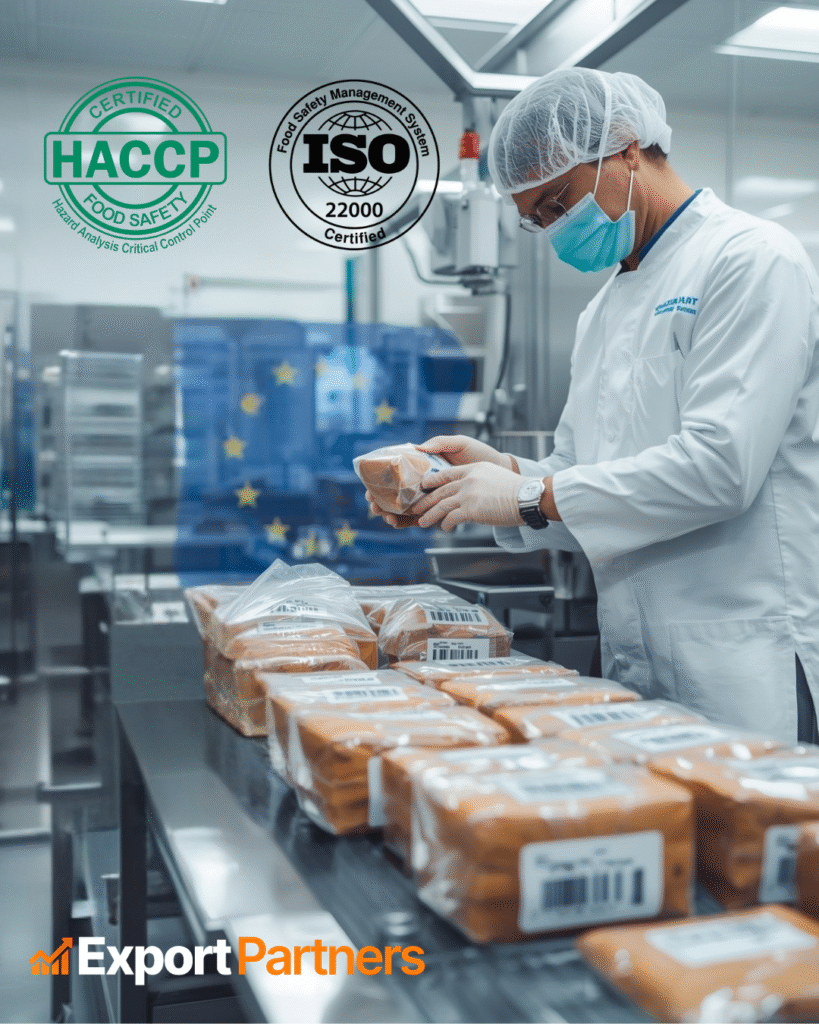
Food exports to Europe are both a high-volume and a highly regulated field for manufacturers. In countries such as Germany, the Netherlands, France, Austria and Belgium, products are expected to meet documentation and standards requirements both at the production stage and across the distribution chain.
This article covers the documentation side step by step: which certificates are mandatory, which are requested by buyers, and which are required only in certain countries. The difference matters, because trying to obtain all of them at once can make the process unnecessarily long.
Basic steps for food exports to Europe
If a food manufacturer wants to sell in Europe, the basic steps are as follows:
- Food business registration or approval from your national food authority
- Production infrastructure that complies with your national food regulations
- Product labeling, ingredient declaration and allergen information that comply with EU regulations
- Where required, importer labeling, meaning the importer's details on the label
- Translated technical files (ingredient list, nutrition facts)
Moving on to certification before these five steps are complete is often inefficient, because the audit also reviews the production infrastructure.
What is HACCP certification, and why is it required for food exports to Europe
HACCP (Hazard Analysis and Critical Control Points) is a system for hygiene, process safety and risk prevention in food production.
The legal basis is clear: Article 5(1) of Regulation (EC) No 852/2004 requires food business operators to put in place, implement and maintain a permanent procedure based on HACCP principles. The consolidated version of the regulation is dated March 24, 2021 and is in force. Under paragraph 3 of the same article, this obligation applies to operations after primary production.
In practice there are two separate requirements, and they should not be confused:
- Having the system in place is what the regulation requires. The inspector wants to see that the system actually works, not just a certificate
- Certification, on the other hand, is often a buyer or marketplace requirement. Document uploads in Amazon's European food categories are the most visible example
With a HACCP system, the manufacturer identifies the stages where microbiological, chemical or physical risks may arise, controls them and keeps records. Certification is often obtained as part of an ISO 22000 system.
The difference between HACCP and ISO 22000
| HACCP | ISO 22000 | |
|---|---|---|
| What it is | A system and method | The international standard that covers this system |
| Scope | Food safety risk control | Risk control plus quality management |
| For Europe | Usually sufficient as a first step | Can be a deciding factor for corporate buyers |
ISO 22000 is built on HACCP. HACCP is usually sufficient as a first step into the European market, while ISO 22000 can set you apart in talks with supermarket chains and large distributors.
Other certificates commonly requested in Europe
- ISO 22000 Food Safety Management System certificate
- GMP (Good Manufacturing Practices) certificate. Details in our article on how to obtain a GMP certificate
- Consumer labels such as halal, organic and vegan, which vary by the requesting country
- Laboratory analysis reports: microbiological, chemical and pesticide residue
- Product label compliance report, based on the target country's language and content rules
- LUCID registration for packaging notification in Germany. Details in our Amazon Germany FBA private label article
- GTIN and barcode information for traceability
Additional requirements if you sell through e-commerce
If the product will be sold on Amazon, Etsy or your own website, three more items are added:
- Application and document upload for the Amazon Europe grocery category
- A CE certificate is not required for food, but conformity such as EN 1186 may be requested for packaging materials. If you are curious about the CE side, you can also read our what is a CE certificate article
- EORI and VAT number. For the customs side, our customs process in Germany article gives the details
How the process works on the manufacturer's side
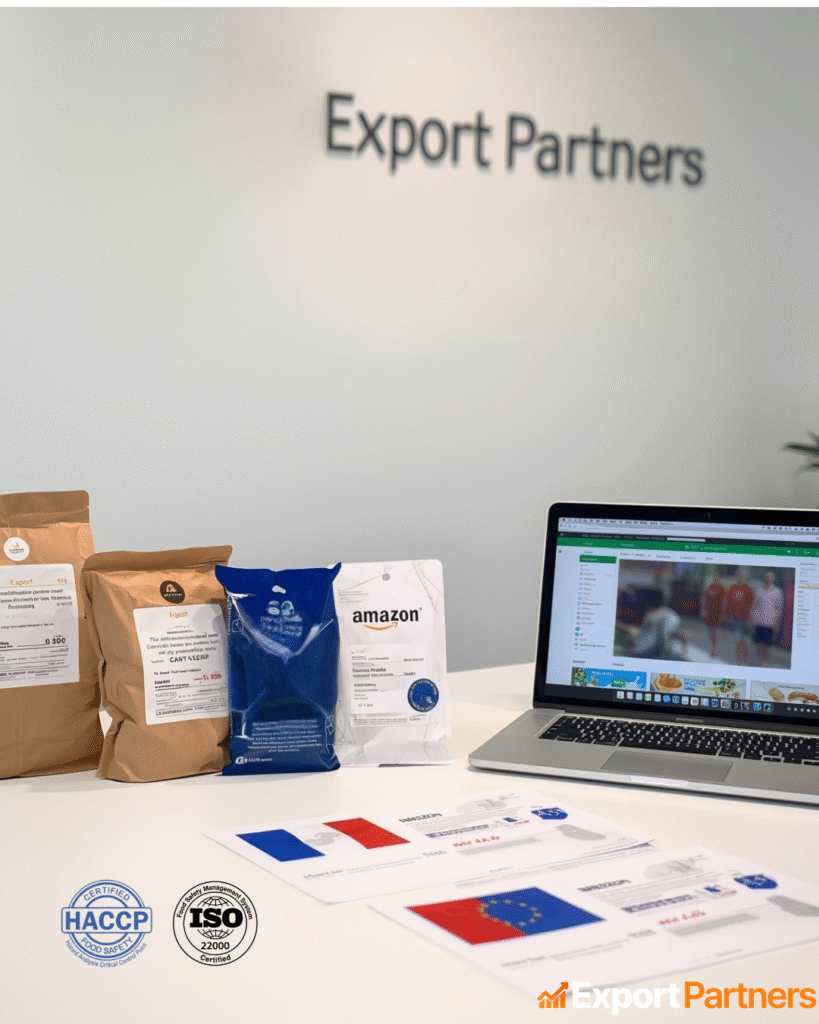
Certification is split into four separate work items, and these can run in parallel:
- HACCP certificate. Carried out with accredited certification bodies. System setup, documentation and audit coordination are three separate steps
- ISO 22000. System setup is planned specifically for each company and completed with internal training and an external audit
- Laboratory tests. Microbiological, physical and chemical analyses at accredited laboratories, with reports prepared in a format suitable for export
- Label compliance check. Adapting the label to the target EU language and regulations, and checking ingredient and nutrition declarations
If you would like support in this process, our export service page can help.
Points that vary by country
Although the EU is a single market, some topics differ by country in practice. The table below summarizes the main differences in five markets where manufacturers most often ship.
| Country | Key topic |
|---|---|
| Germany | LUCID packaging registration and German-language labeling, the two items most often returned on marketplaces |
| Netherlands | Entry through a distribution center is common, and importer details are requested on the label |
| France | High expectation for French-language labels, with attention to format in the nutrition information |
| Austria | Similar to Germany, packaging notification is tracked separately |
| Belgium | Multilingual labels are expected, and French and Dutch may be requested together |
The items in the table are not fixed rules but situations frequently encountered in practice. Since they can vary by product group, the current rules of the target country should be confirmed separately once it is selected.
How long does the process take
Giving a fixed timeline is not realistic, because the duration varies a lot depending on whether the production infrastructure is ready. Knowing the sequence, however, makes planning easier:
- Preliminary analysis. Identifying which parts of the existing system and documentation are missing
- System setup and training. Closing the gaps and establishing the record-keeping routine. This is the step where the duration varies most
- Audit. On-site audit by the certification body
- Certificate and after. Issuance of the certificate, followed by periodic surveillance audits
The label and laboratory work can run in parallel with these four steps. Doing them one after another stretches the timeline unnecessarily.
There is one more reason this sequence works. The buyer's audit checklist usually follows the same order: first the production site and system, then product analyses, and finally labeling and packaging. When you align your own preparation with that order, you have ready answers to most of the buyer's questions.
One more note: certificates are not indefinite. HACCP and ISO 22000 involve periodic surveillance audits, and laboratory reports are also expected to be recent. Keeping track of this schedule after the buyer contract is signed is as important as obtaining the first certificate.
The four most common mistakes
- Trying to get the certificate before the system. The audit also looks at the production infrastructure. Applying before the documentation is ready often restarts the process from the beginning
- Leaving the label to the last minute. The label is reworked according to the target country's language and content rules. Correcting printed packaging is much more expensive than correcting the file
- Confusing legal requirements with buyer requests. Some documents come from regulations, others from the buyer's own list. Trying to obtain all of them without separating the two can mean unnecessary cost and time
- Skipping the packaging notification. In Germany, LUCID registration remains a separate obligation even when the product documents are complete
For one dried food manufacturer we reviewed, the process was extended by three months for a single reason: the laboratory reports were ready, but the nutrition information on the label was not in the format the target country expected, and the packaging had to be reprinted.
Frequently asked questions
Which companies issue HACCP certification for supplements?
The certificate is issued by accredited certification bodies. There is no separate list for food supplements; accredited bodies with a food scope generally cover this product group as well. When choosing one, you should confirm that its accreditation scope includes your product group.
What is a GMP certificate, and how is it different from HACCP?
GMP shows that production conditions comply with good practice rules, while HACCP shows that risk points are controlled. One does not replace the other, and they are often requested together. Details are in our article on how to obtain a GMP certificate.
What is a GMP certificate, and is it mandatory in Europe?
It is not a mandatory EU requirement for food, but buyers frequently request it for food supplements and cosmetics. The difference between a legal requirement and a buyer request applies here as well.
Is a CE certificate required for food products?
It is not required for the food itself. The CE mark is a conformity mark for specific product groups, and food is not within that scope. For packaging materials, however, separate conformity rules may come into play.
Is a HACCP certificate mandatory for exporting to Europe?
Article 5 of Regulation (EC) No 852/2004 requires food businesses to put in place and maintain a procedure based on HACCP principles, so the system itself is mandatory. The certificate, on the other hand, is usually requested by buyers and marketplaces. It is worth confirming the exact requirements for your product and target country with your customs broker.
Conclusion
In food exports to Europe, competitiveness is not built on price and product quality alone; document and process management also play a decisive role. A sequence that tends to work: first the production setup and the label, then HACCP, and after that the additional documents the buyer asks for.
Separating which documents are mandatory and which are buyer requests can shorten the process. If you would like to work through this distinction together, our export service page may help.

