
The first questions a manufacturer asks about selling on Amazon Europe tend to be the same: do you need to set up a company to sell in Europe, how do goods enter Germany, what is an EORI number, and how do you sell from a warehouse in Germany to Spain, France or the UK? Amazon Pan-EU, EFN and the EU's OSS system are three separate tools that handle the second half of those questions, namely where the stock sits and how VAT is declared.
This guide walks through two starting points side by side: the manufacturer that wants to sell directly through its existing company in its home country, and the brand considering a GmbH in Germany. First the company and customs decision, then shipping from your country to the Amazon warehouse, then the two routes from German stock to the rest of Europe, and finally the UK and the U.S.
How many Amazon stores are there in Europe, and how is an account opened?
In Europe, Amazon's seller panel, Seller Central Europe, is a single account. By Amazon's own description, this account covers ten stores: Germany, France, Italy, Spain, the Netherlands, Poland, Sweden, Belgium, Ireland and the United Kingdom. In other words, one registration lets you create listings in all of these stores. When opening the account, Amazon asks for company documents, the ID of the company's authorized representative, a credit card and bank details, and confirms this information through a video verification step.
A point that is often confused: the account is single, the tax is not. Which country requires VAT registration is determined not by the account itself but by where the company is established, where the stock is held and to whom the goods are sold.
Do you need a company to sell on Amazon Europe: your home company or a GmbH?
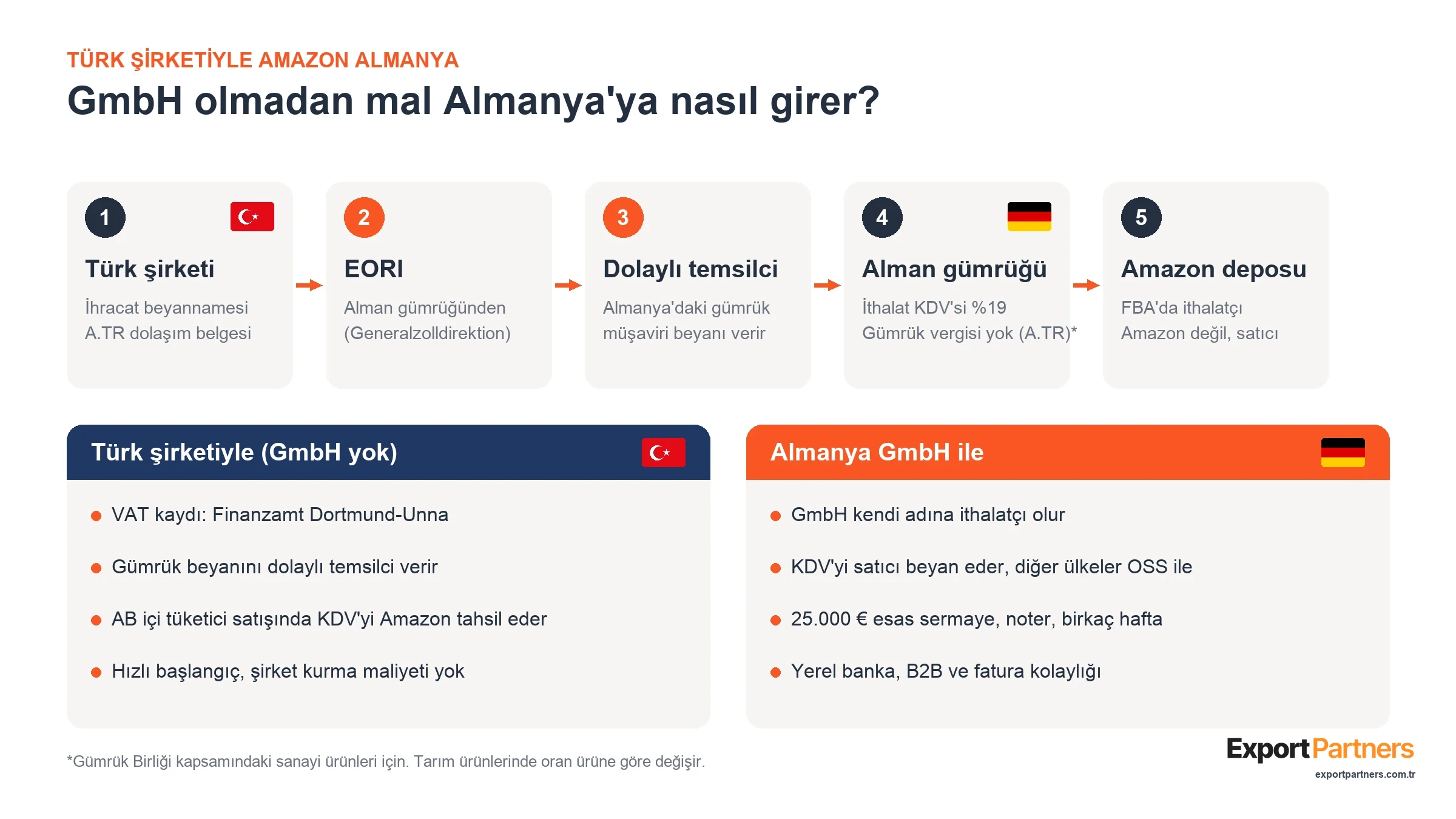
Setting up a company in Germany is not mandatory to sell on Amazon Europe. A company based in your own country can also open a Seller Central Europe account, register for VAT in Germany and sell on Amazon.de. A GmbH (German limited liability company) is usually chosen for commercial reasons such as a local bank account, B2B sales, local invoicing and scaling. The difference between the two routes can be summarized as follows:
| Area | With your home company | With a German GmbH |
|---|---|---|
| Formation | Your existing company is used, no additional formation cost | 25,000 euro share capital (at least half paid in at formation), notary, commercial register; a few weeks |
| German VAT registration | A central German tax office assigned to businesses based in your country, for example Finanzamt Dortmund-Unna for certain countries | The local tax office the company is registered with |
| Customs | An EORI number is obtained; the import declaration is filed by an indirect representative in Germany | The GmbH becomes the importer in its own name |
| VAT on sales to consumers | For a seller not established in the EU, Amazon collects and remits the VAT on sales to consumers from stock held in the EU | The seller declares the VAT; sales to other EU countries go through OSS |
| Best suited for | Manufacturers who want to test the market and ship a first batch quickly | Brands that want a permanent European structure, B2B sales and a local counterpart |
The VAT row in the table makes an important difference. Since July 1, 2021, the EU has treated the marketplace as the "deemed supplier" for sales made by non-EU sellers from stock held in the EU to consumers; on these sales Amazon collects VAT from the customer and remits it to the tax authority itself. This does not remove the need for your company's VAT registration in Germany: because the stock sits in Germany and the import takes place in Germany, registration and periodic returns are still required. All of the German registrations (EORI, VAT, LUCID, GPSR) are explained step by step in our guide to selling on Amazon Germany.
EORI: how do goods enter Germany without a GmbH?
EORI is the number that identifies a business in the EU customs system and is required for anyone bringing goods into the EU. A company established outside the EU can also obtain an EORI number; in Germany it is issued by the German customs administration, the Generalzolldirektion, and since October 1, 2026 applications have been submitted through the Zoll-Portal. The number is obtained once and is valid in all EU member states.
The real question comes after the number: even with an EORI, a company established outside the EU cannot file the import declaration in Germany in its own name. The declaration has to be filed by a party established in the EU, and there are two ways to do this. Both are marketed as "IOR services" (importer of record), but IOR is not a defined term in EU customs law, and the difference between the two models changes the invoice, the ownership of the goods and the VAT. Amazon does not take on this role: Amazon's own table lists the seller as the importer for standard FBA shipments.
Option one: indirect representation, the goods remain your company's property
Under indirect representation, the customs broker or logistics company in Germany files the declaration in its own name but on behalf of your company (Union Customs Code, Regulation (EU) No 952/2013, Article 18). The declaration lists the representative as the declarant and your company as the owner and consignee of the goods. The goods never become the representative's property at any point; no sale is made to it and no goods invoice is issued. The only invoice the representative issues is for its own service fee.
Your company issues the commercial invoice for the shipment: the buyer is again your company, the delivery address is the Amazon warehouse or an intermediate warehouse in Germany, and the invoice states that it is a transfer of your own stock rather than a sale. Since there is no sale price, the customs value is determined using the secondary methods of the Customs Code (Article 74); in practice it is usually documented as the production cost plus a reasonable profit margin. How the value will be declared should be agreed with the customs broker before shipment.
The representative's responsibility is the accuracy of the declaration and the payment of the taxes: because it files the declaration in its own name, it is jointly liable with your company for customs duty and import VAT (Article 77). This is why most representatives ask for a guarantee or an advance first. The representative cannot deduct the import VAT, however; in 2023 the German Federal Fiscal Court (V R 13/21) made clear that a party that only clears or transports the goods has no right of deduction. The deduction is made by your company, which holds the power of disposal over the goods at the time of import, through its own German VAT registration.
Option two: an importer that purchases the goods
In this model your company sells the goods to a company in Germany; the invoice is issued to that company and the goods become its property. The buyer imports the goods in its own name, pays the import VAT and deducts it in its own VAT return. The customs value is the actual sale price, so the valuation question from option one does not arise.
The cost is an extra step: if the goods are to be sold on Amazon through your company's own account, the importing company has to sell the goods back to your company within Germany with an invoice carrying 19 percent VAT, and your company then deducts this VAT through its own German VAT registration. If the importing company itself sells on Amazon, or the goods go to a distributor or a B2B buyer, this model works directly.
| Area | Indirect representation | Purchasing importer |
|---|---|---|
| Owner of the goods | Your company | Importer in Germany |
| Goods invoice | From your company to your company (stock transfer) | From your company to the importer (sale) |
| Customs value | Secondary method, usually cost plus profit | Sale price |
| Who deducts import VAT | Your company | Importer |
| Selling on Amazon through your own account | Direct | Requires buying back from the importer |
| Best suited for | Manufacturers selling their own brand through their own Amazon account | Manufacturers selling through a distributor, B2B or the importer's account |
For a manufacturer that will sell its own brand through its own Amazon account, our recommendation is indirect representation. This should also be the first question you ask the firm you plan to work with: "Will you purchase and import the goods, or will you file the declaration on our behalf as an indirect representative?" The answer determines who the invoice is issued to and who deducts the VAT.
Two items arise at customs. The first is customs duty: the rate depends on the product's tariff classification and on whether a trade agreement between your country and the EU applies; for agricultural products the rate varies by product. The second is import VAT: the standard rate in Germany is 19 percent, calculated on the total of the goods value, freight and insurance. Depending on the model above, either your company or the importing company deducts this amount in its own VAT return; in other words, it is a cash-flow item rather than a cost. We explain step by step how the importer structure is set up for the first shipment in our article on sending products to the Amazon Germany warehouse.
Shipping to the Amazon Germany warehouse: road, air, sea
Goods can reach Germany by three routes, and the choice is usually made according to the volume and urgency of the shipment:
| Route | Speed | Cost | When it makes sense |
|---|---|---|---|
| Road (groupage or full truckload) | Medium | Medium | The most common route for regular pallet and carton shipments from nearby countries |
| Air and express freight | Fastest | Highest | Small, high-value products, initial sample stock, urgent restocking |
| Sea (container) | Slowest | Lowest per unit | Large volumes and stock planned in advance |
Whichever route is chosen, delivery to the Amazon warehouse is made by appointment, and the carton, label and pallet requirements must be met in advance. For this reason many sellers first bring the goods to an intermediate warehouse in Germany, label them there and send them to Amazon in batches; surplus stock can also wait at the intermediate warehouse without incurring Amazon's storage fees.
EFN: Inventory stays in Germany, orders ship everywhere
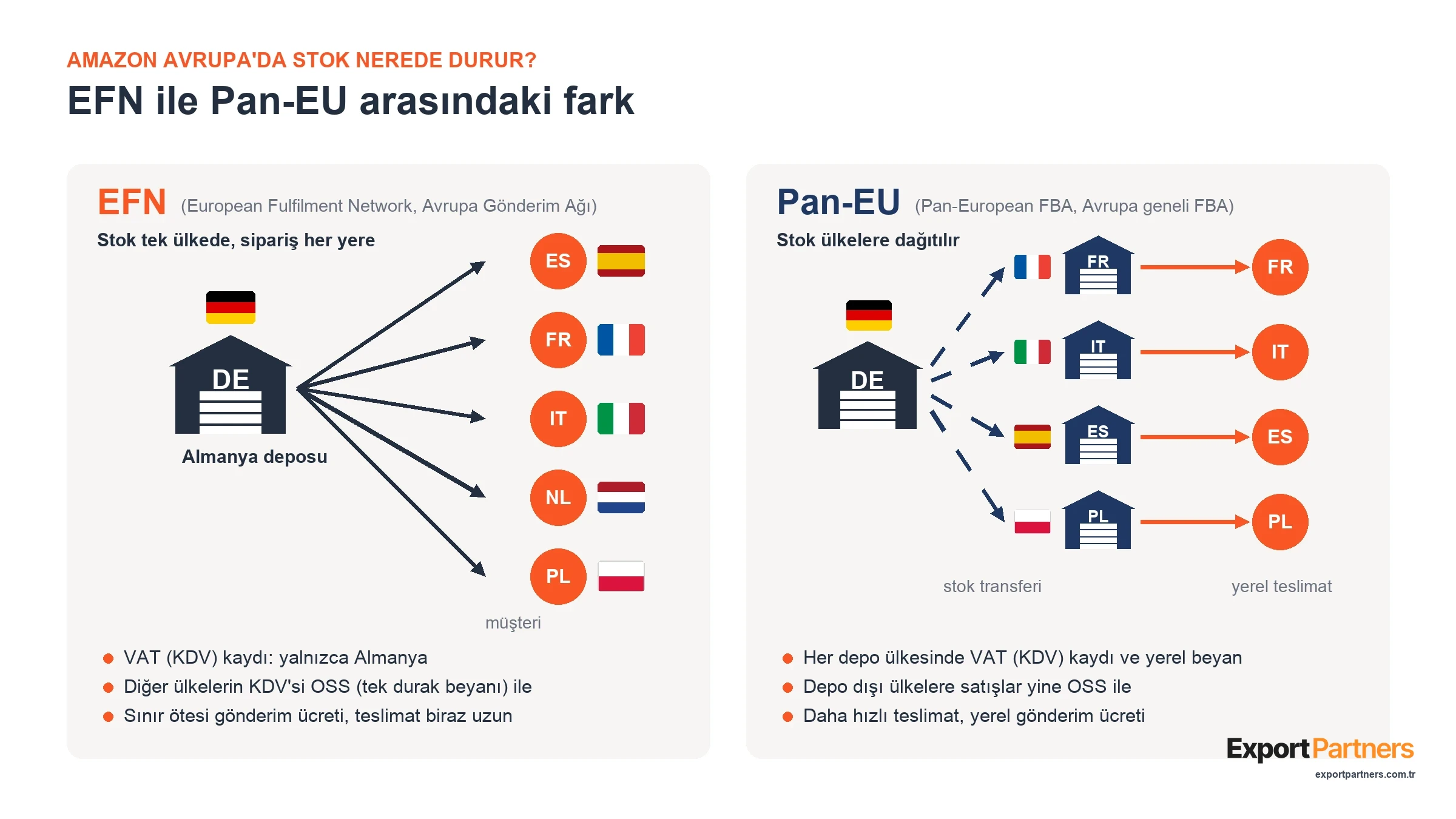
Once the goods are in the German warehouse, the next step is selling to the rest of Europe. EFN (European Fulfilment Network) is the setup where inventory sits in only one country, for example Germany. When a customer in Spain orders on Amazon.es, the product ships from the warehouse in Germany. Amazon charges a cross-border EFN fee for this that is higher than the local fulfillment fee; the current amounts are listed in Amazon's FBA rate card.
On the tax side, the advantage of EFN is its simplicity. Amazon's Germany page states that a VAT number is required for every country where products are stored, and generally not for the target marketplace. If inventory is only in Germany, a German VAT number may be enough to get started.
Amazon Pan-EU: Inventory is distributed across countries
With Pan-European FBA (Amazon Pan-EU for short), you still send inventory to Germany, but Amazon also moves products to its warehouses in France, Italy, Spain and Poland based on demand. Amazon's current list of storage countries is Germany, France, Italy, Spain and Poland; joining the program requires enabling at least two of them, and Amazon states that you can start with two VAT numbers. In return, products ship from a warehouse closer to the customer, delivery is faster and the local fulfillment fee applies.
The critical point: under Pan-EU, VAT registration and that country's own VAT return are required in every country where inventory is stored. A sale to a French customer while the inventory is in a French warehouse is not a distance sale from Germany; it is a domestic sale within France. Amazon's Central Europe program can also store German inventory in Poland and the Czech Republic, which may create additional VAT obligations; this should be evaluated separately before joining.
EFN or Pan-EU: comparing cost, speed and registrations
| Area | EFN | Pan-EU |
|---|---|---|
| Where inventory is held | One country (usually Germany) | Warehouses in Germany, France, Italy, Spain, Poland |
| Delivery speed | Can take a few days longer to neighboring countries | From a local warehouse, faster |
| Fulfillment fee | Cross-border EFN fee, higher than local | Local fee |
| VAT registration | Only in the inventory country | In every storage country |
| Filing burden | Single-country return, OSS if needed | Separate local return in every warehouse country |
| When | The first months, when it is not yet clear which country sells | When sales become regular in several countries |
Our recommendation: do not move to Pan-EU until sales are regular in several countries. A more controlled path is to first see with EFN which country actually sells, then enable those countries as storage countries. The speed advantage of Pan-EU becomes meaningful once there is enough sales volume to cover the cost of the additional VAT registrations and returns.
OSS: VAT for 27 countries in a single return
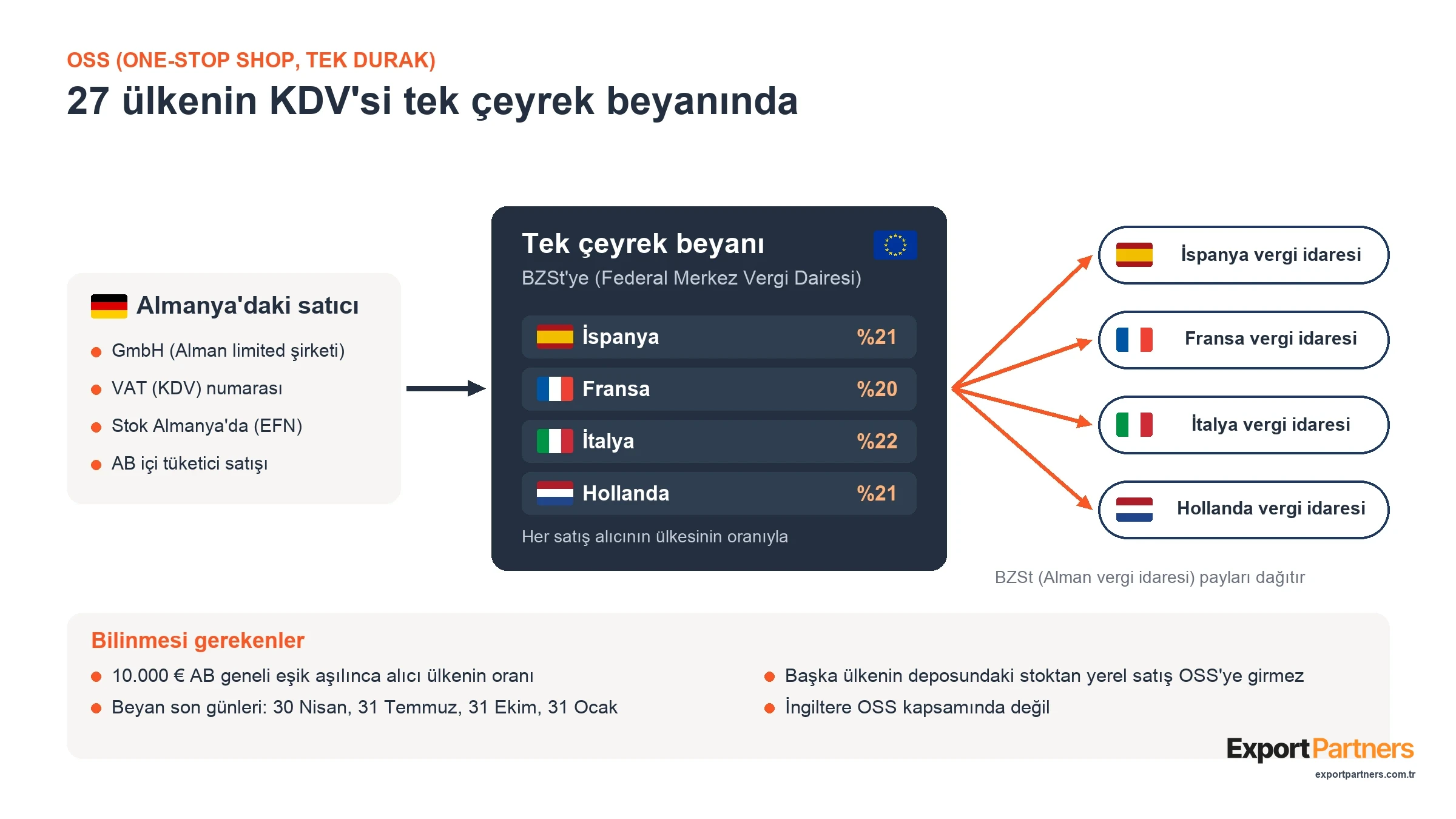
A sale from a warehouse in Germany to a consumer in Spain is, in EU terms, an intra-EU distance sale. For a seller established in the EU there is an EU-wide threshold of 10,000 euros: if the total of such sales in the previous and current year stays below the threshold, the sale may remain subject to German VAT. Once the threshold is exceeded, the VAT rate of the buyer's country applies to every sale; the Spanish rate for a customer in Spain, the French rate for one in France.
OSS (One-Stop Shop) offers a single return instead of 27 separate registrations for this: a seller established in Germany registers for OSS through the German Federal Central Tax Office BZSt, reports the VAT of all countries in a single quarterly return and pays it in one payment. BZSt transfers these amounts to the relevant countries itself. The filing deadlines are April 30, July 31, October 31 and January 31; a zero return is filed for periods with no sales.
OSS matters most for sellers operating through a GmbH. When selling through a non-EU company, Amazon itself collects and remits the VAT on sales to consumers from inventory inside the EU under the rule described above, so the sales that enter the seller's OSS return remain limited. One limit is the same in both cases: a sale made within a country from inventory held in that country's warehouse does not go into OSS; it is tied to that country's local registration. This is why EFN combined with OSS builds the simplest structure, while Pan-EU adds a separate registration cycle for every storage country.
Rules in force and rules to come: date by date
When setting up sales in Europe, it helps to know not only today's rules but also the changes already on the calendar. Some of them affect not bulk shipments to an Amazon warehouse but direct shipments from your country to the consumer (FBM); the table notes who is affected in each case.
| Date | Change | Who is affected |
|---|---|---|
| July 1, 2026 | The customs duty exemption for shipments under 150 euros has been removed (Council Regulation 2026/382); a flat duty of 3 euros per item applies until July 1, 2028 | Sellers shipping directly to consumers from outside the EU (FBM) |
| August 12, 2026 | The EU Packaging Regulation (PPWR) and Germany's VerpackDG law are in force; sellers not established in Germany must appoint an authorized representative in Germany for LUCID | Anyone shipping packaged products to Germany |
| September 20, 2026 | The new EU Customs Code (Regulation 2026/2108) has entered into force; implementation is phased | Anyone importing into the EU |
| November 1, 2026 | A handling fee for every item shipped to consumers from outside the EU; 2 € per item (European Commission, October 7, 2026) | Sellers shipping directly to consumers (FBM) |
| September 21, 2027 | Most provisions of the new Customs Code begin to apply; in distance sales to consumers from outside the EU, the seller and the platform carry "importer" responsibility, and repeated violations may carry penalties of between 1 and 6 percent of annual import value | Sellers and platforms engaged in distance selling |
| 2028 | The flat per-item duty gives way to the regular duty based on the product's tariff classification; certain e-commerce provisions apply this year | Sellers shipping directly to consumers (FBM) |
The two models in use today for bulk shipments to an Amazon warehouse (indirect representation and an importer that purchases the goods) do not change under this timeline. After 2027, the details of the importer role will be clarified by implementing regulations; we will update this table as those dates approach. A detailed explanation is in our fall 2026 regulatory update article.
Other registrations before you start selling: LUCID, GPSR and trademark
There are three more registrations that take as much time as the company and customs decisions. LUCID is Germany's packaging register; since August 12, 2026, sellers not established in Germany have been required to appoint an authorized representative in Germany for this registration. GPSR is the EU's General Product Safety Regulation, and it requires the name of a responsible person in the EU to appear on the product and the listing. On the trademark side, an EUIPO application is enough for Amazon Brand Registry; Amazon also accepts a pending application before registration is complete. The order and timeline of all three are covered in our article on selling on Amazon Germany.
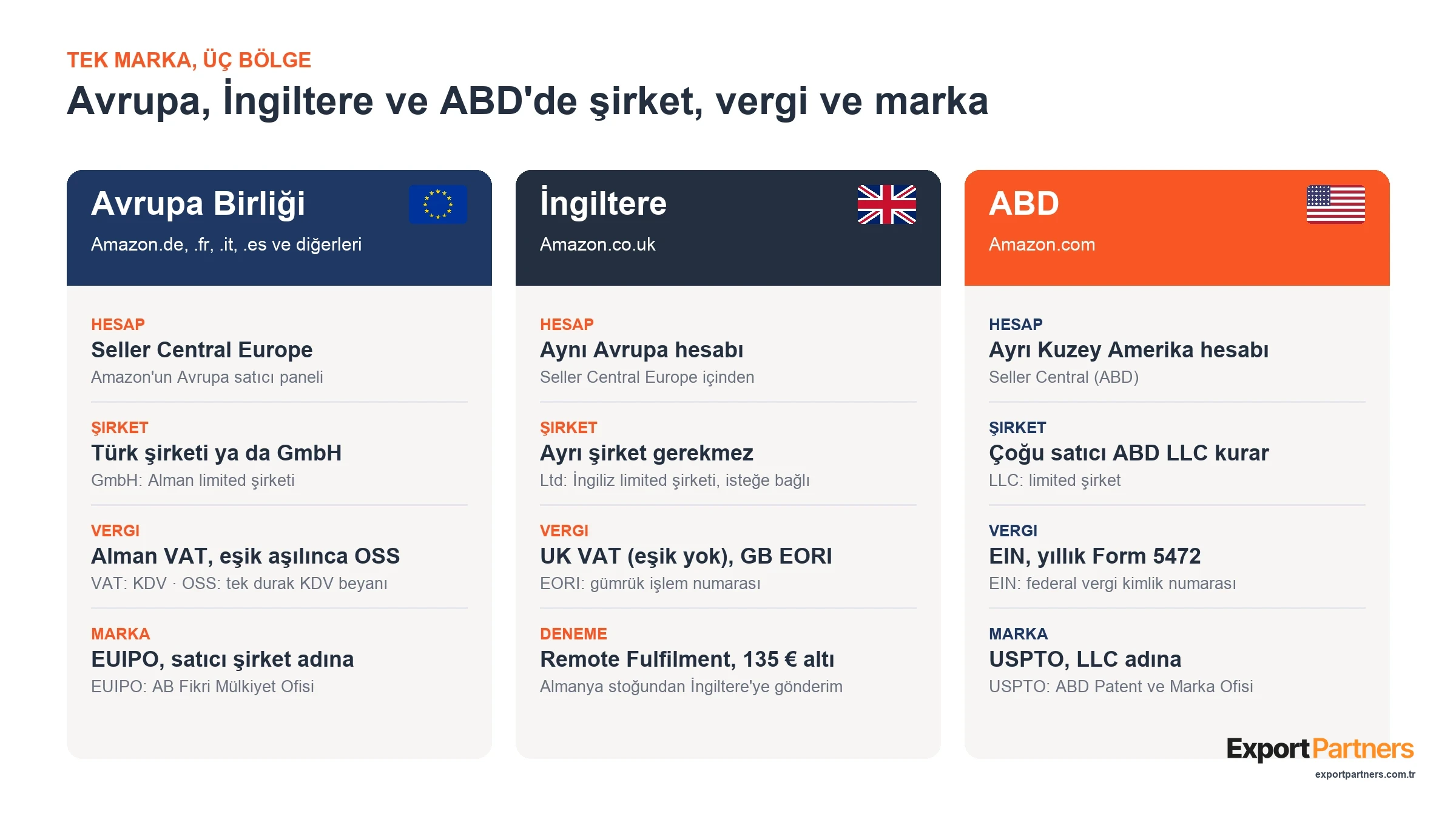
United Kingdom: Same account, separate tax system
Although Amazon.co.uk sits inside the same European account, the UK has been outside the EU VAT system since Brexit. OSS does not cover the UK, and the UK has also left Pan-EU.
Setting up a separate company for the UK is not mandatory. HMRC, the UK tax authority, expects sellers not established in the country to register for VAT without waiting for a threshold; registration is completed within 30 days of the first taxable sale, and no UK company or branch is required for it. If you want to hold your products in an Amazon warehouse in the UK, Amazon asks for a UK VAT number. Importing goods into the UK also requires a separate EORI number starting with GB; the EORI obtained for the EU is not valid in the UK. Details are in our articles on the UK VAT system and setting up a company in the UK.
There is also a lighter way to start: Amazon's Remote Fulfilment program. Under this program, products priced below 135 euros (122 pounds in the UK direction) can be shipped from stock in Germany to UK customers; Amazon does not require a VAT number in the target store, collects and remits the VAT itself, and also handles the customs process. Testing the UK with products priced below this limit can be a good step for gauging demand before registering for UK VAT.
United States: Separate region, separate account, separate company
The U.S. side is not added to the European account. Amazon.com belongs to the North America region and runs on a separate seller account. Opening a U.S. account with your home-country company or a German company is technically possible, but in practice most sellers prefer to form an LLC in the U.S.: a U.S. bank account, Amazon payouts, contracts with U.S. suppliers and logistics providers, and U.S. tax filings are all consolidated in a single local company.
The members of the LLC do not have to be the same as the shareholders of the company in your home country or in Germany; for example, Delaware's LLC law allows any natural or legal person to be a member. Foreign-owned LLCs have U.S.-specific obligations such as the annual Form 5472 filing with the IRS, and since how the tax is calculated depends on the company's structure, this part should be clarified with a U.S. accountant. For formation costs, see our article on the cost of forming an LLC in the U.S., and for tax numbers, the difference between EIN and ITIN.
Trademark registration: In the name of the selling company in each region
To join Amazon Brand Registry, the trademark must be registered in the relevant region or an application must have been filed. The natural split is this: the USPTO application in the U.S. is filed in the name of the company selling in the U.S., and the EUIPO application in the EU in the name of the company selling in Europe. If the trademark owner and the company using the seller account are different, the trademark owner enrolls in Brand Registry and adds the other party as an additional user; a short license or authorization agreement between the two companies clarifies from the start who will keep the trademark later on. You can see the fees by number of classes using the calculator on our U.S. and European Union trademark registration pages.
Which structure suits whom?
| Status | Recommended route | Required registration |
|---|---|---|
| Wants to test Europe, has no company in Germany | Amazon.de with your home-country company, EFN | EORI, indirect representative, German VAT, LUCID and GPSR representative |
| Wants a permanent structure and B2B in Europe | German GmbH, starting with EFN | GmbH, EORI, German VAT, OSS once the threshold is exceeded |
| Regular sales in several EU countries | Pan-EU (at least two storage countries) | VAT and local filings in each storage country |
| Wants to test the UK, products under 135 euros | Remote Fulfilment | No VAT number required in the destination |
| Wants to hold stock in the UK | Amazon.co.uk FBA | UK VAT and GB EORI; no company required |
| Wants to sell in the U.S. | Amazon.com, separate North America account | Usually a U.S. LLC, EIN, U.S. tax filings |
Frequently asked questions
Do you need to set up a company to sell on Amazon Europe?
No. A Seller Central Europe account can be opened with your existing company in your own country, VAT registration can be completed in Germany, and you can sell on Amazon.de. This requires an EORI number, an indirect representative to file the customs declaration, and a representative in Germany for LUCID and GPSR. A GmbH is chosen for commercial reasons such as local banking, B2B and a permanent structure.
How do you obtain an EORI number?
A business importing through Germany obtains the number from the German customs administration, the Generalzolldirektion; since October 1, 2026, applications have been made through the Zoll-Portal. Companies established outside the EU can also apply. The number is obtained once and is valid in all EU countries; the UK requires a separate EORI starting with GB.
Which countries have Amazon Pan-EU warehouses?
On Amazon's current list, the Pan-EU storage countries are Germany, France, Italy, Spain and Poland. Joining the program requires enabling at least two countries and holding a VAT registration in every country where inventory is stored. Sales can also be opened on the Netherlands, Sweden, Belgium and Ireland marketplaces.
Does selling to Spain from inventory held in Germany require a VAT registration in Spain?
If inventory is held only in Germany and sales are shipped through EFN, it is generally not required. For a seller established in the EU, once EU-wide distance sales exceed 10,000 euros, Spain's VAT rate applies, but that VAT is paid through the OSS return in Germany rather than through a separate registration in Spain. If inventory is moved to a warehouse in Spain under Pan-EU, a VAT registration in Spain becomes necessary.
Are the VAT amounts of different countries offset against each other under OSS?
They are not offset against each other; they are combined in a single return. Each country's sales are listed on a separate line at that country's rate, the total is paid to the BZSt in one payment, and the BZSt distributes the shares to the countries. The practical result for the seller is one return per quarter instead of 27 separate returns.
Do I need to set up a company in the UK to sell there?
No. A company in your home country or a German company can register for VAT as a non-established seller in the UK and sell on Amazon.co.uk with the same European seller account. A separate UK company is usually chosen for commercial reasons such as local banking, investment or high sales volume.
Can I enroll in Brand Registry before the trademark registration is complete?
Amazon also accepts pending applications, so enrollment can be opened with the application number. The record is updated once registration is complete. If the U.S. application is filed in the name of the company selling in the U.S. and the EU application in the name of the company selling in Europe, each company appears as the brand owner in its own region.
Conclusion
The first decision when expanding to Europe on Amazon is not the company but how the goods will enter Germany: when selling through your home-country company, an EORI number and an indirect representative are needed, while with a GmbH the company itself becomes the importer. Once the goods are in a warehouse in Germany, the simplest starting point is selling from a single warehouse through EFN; Pan-EU is the next step once sales have settled in several countries. For the UK, what is needed is a UK VAT registration and a GB EORI rather than a company, and for the U.S., a separate North America account and, in most cases, a U.S. LLC.
As Export Partners, we handle account setup, FBA planning, trademark registration and Brand Registry steps for Amazon Europe, the UK and the U.S. within a single plan. For the scope and a quote on the Germany side, see our Amazon Germany selling service page, and for the overall structure, see our Amazon service page.

