Cost of Forming an LLC in the U.S.
The cost of forming an LLC in the U.S. has three parts: the state filing fee, the registered agent and address service, and the annual state report or tax that recurs every year. For a foreign-based entrepreneur who wants to form a U.S. company, the real difference shows up not at formation but in the years that follow; that is why the choice of state is the cost itself.
In this article we compare Wyoming, Delaware, Florida and Texas from the perspective of an Amazon or Shopify seller. Filing fees and annual obligations were verified on the states' official websites in October 2026. Registered agent and formation service fees are commercial prices, so they vary by provider.
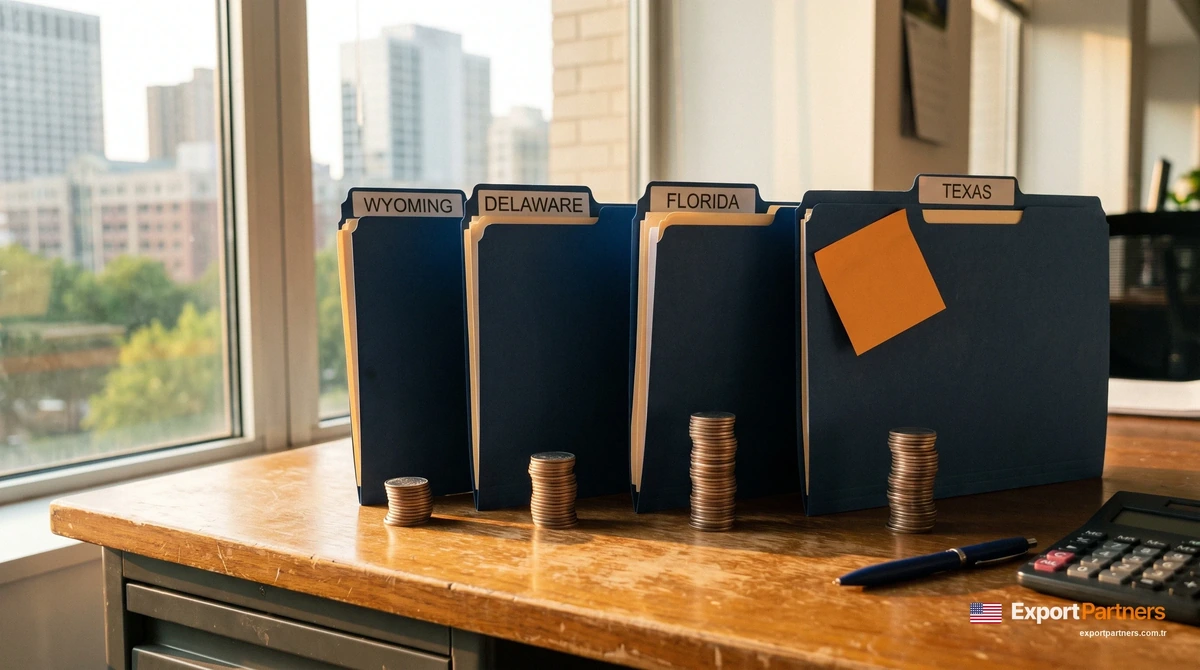
Which State Is Best for Forming a Company? (Wyoming vs Delaware vs Florida vs Texas)
| Item | Wyoming | Delaware | Florida | Texas |
|---|---|---|---|---|
| LLC filing fee (state) | 100 USD | 110 USD | 125 USD (100 + 25 registered agent fee) | 300 USD |
| Annual state obligation | Annual report, minimum 60 USD | Annual LLC tax 400 USD, June 1 | Annual report 138.75 USD, May 1 | Franchise tax report, May 15; no tax below the threshold |
| State income tax on the LLC itself | None | None (the LLC passes taxes through to its members) | None (the LLC passes taxes through to its members) | No income tax; franchise tax threshold applies |
| State sales tax | 4 percent + local | None | 6 percent + county | Required |
| Best for | Online-only sales, low annual cost | Investor-backed and multi-member structures | An office or warehouse in Florida | Inventory, an office or a team in Texas |
A registered agent and a U.S. address are required in every state; commercial pricing generally ranges from 50 to 150 USD per year depending on the provider. If you form the company through a service provider, the total is usually quoted as the state fee plus the service fee.
Why Do These Three States Stand Out?
Wyoming, Delaware and Florida are the states most discussed among foreign entrepreneurs; Texas has gained ground in recent years for those with physical operations and those who want to avoid an annual state fee. A common misconception: the statement "there is no tax in these states" is not accurate. The LLC itself does not pay state income tax in these states, and profits pass through to the members; however, Delaware has a personal income tax and a gross receipts tax, and federal obligations apply to every company regardless of the state of formation.
The most important federal item: a single-member LLC whose owner lives outside the U.S. files a pro forma Form 1120 and Form 5472 by April 15 each year; the penalty for not filing Form 5472 is 25,000 USD. Details are in our U.S. tax filing article.
Amazon vs Shopify: Sales Tax Responsibility
Amazon FBA: In states with marketplace facilitator laws, Amazon calculates, collects and remits sales tax itself. Sellers generally do not need to collect tax separately on Amazon sales; however, if a seller is registered in that state, it may be asked to report its total sales on its return.
Shopify: Shopify is not a marketplace. A seller selling through its own website registers in every state where a sales tax obligation arises (inventory, an office or exceeding the economic nexus threshold), collects the tax from the buyer and remits it to that state. The difference between registration and a resale certificate is covered in our Sales Tax ID and Resale Certificate article.
1. Wyoming: The Most Economical Option for Foreign Entrepreneurs Forming a U.S. Company
Formation fee is 100 USD. The annual report, filed every year, is 60 USD or two hundredths of one percent of the company's assets located in Wyoming, whichever is greater; for a small LLC selling online this is 60 USD in practice. The LLC itself pays no state income tax; the state sales tax is 4 percent, with local taxes added on top.
- Best fit: An entrepreneur with no physical presence in the U.S. who sells only through Amazon or their own website.
- Keep in mind: If inventory, an office or employees are located in another state, registration in that state (foreign qualification) may also be required, and annual fees are then paid to two states.
2. Delaware: Strong Corporate Law and an Investor-Friendly Framework for U.S. Company Formation
The LLC formation fee (Certificate of Formation) is 110 USD. According to the Delaware Division of Corporations, the annual LLC tax is 400 USD, due June 1 each year. The amount rose from 300 USD to 400 USD; in June 2026, 300 USD was paid for the 2025 tax year, and the first 400 USD payment is due June 1, 2027. Late payment carries a 200 USD penalty plus 1.5 percent monthly interest.
- Best fit: A company planning to raise investment, transfer shares or operate with multiple partners; Delaware's business court (Court of Chancery) and investors' familiarity with this structure are advantages.
- Keep in mind: For online sales alone, the annual cost is roughly seven times that of Wyoming. Delaware has no sales tax, but it does have a gross receipts tax and personal income tax. Closing the company also requires paying the annual tax and a dissolution fee.
3. Florida: Infrastructure for Those Planning Physical Operations
Formation fee is 100 USD plus a 25 USD registered agent fee, 125 USD in total. The annual report is 138.75 USD and due May 1; after May 1 a 400 USD late fee is added, and this fee is not waived. The state sales tax is 6 percent; many counties add a local surtax.
- Best fit: An entrepreneur who will open an office, warehouse or showroom in Florida and be present in the U.S.
- Keep in mind: File the annual report before May 1; the late fee is nearly three times the report fee.
4. Texas: When Inventory and Team Are in Texas
LLC formation (Certificate of Formation, Form 205) is 300 USD. Texas has no personal or corporate income tax; instead it has a franchise tax. For the 2026 report year, an LLC with annual revenue below 2,650,000 USD owes no tax, but it files an information report (Public Information Report or Ownership Information Report) by May 15 each year.
- Best fit: An entrepreneur with a warehouse, office or employees in Texas, or setting up logistics near Texas.
- Keep in mind: The formation fee is higher than in the other states; there is no annual state fee, but there is a reporting obligation.

Which State to Choose, and When?
- Online sales only, no physical presence in the U.S.: Wyoming, the lowest annual cost.
- Raising investment, partners or an exit plan: Delaware.
- Office or warehouse in Florida: Florida.
- Inventory, office or team in Texas: Texas.
The decision criteria are covered in detail in the article which U.S. state to form your company in. Our video conversation on state selection and annual costs with Tax Accountant Gökhan Çıkılı is part of the series on the U.S. company formation page.
Frequently Asked Questions
How much does it cost to form a company in the U.S.?
State filing fees range from 100 to 300 USD depending on the state (Wyoming 100, Delaware 110, Florida 125, Texas 300). Registered agent and address services and the formation service fee are added to this. In later years, an annual report or tax depending on the state (Wyoming at least 60, Florida 138.75, Delaware 400 USD) and the cost of federal filings recur.
Can a U.S. LLC be moved to another state?
Some states allow an LLC to move to another state (domestication or conversion); in states that do not, a new company is formed in the new state and the old one is dissolved, or the company is registered in the new state as a foreign entity. Which route fits depends on the rules of both states.
Is forming a company in Delaware advantageous?
For companies raising investment or with multiple partners, yes; the court system and investor familiarity are advantages. For a single-member company selling only through Amazon or its own website, the 400 USD annual tax is a high cost compared with Wyoming's 60 USD annual report.
What is paid every year after forming an LLC?
The state's annual report or tax, the registered agent fee and federal filings. A single-member LLC whose owner lives outside the U.S. files a pro forma Form 1120 and Form 5472 by April 15 each year; even if the company has no sales, this filing is required when there are reportable transactions.
Which state is cheapest for forming a company in the U.S.?
Wyoming (100 USD) and Delaware (110 USD) have the lowest formation fees, and Wyoming (at least 60 USD) has the lowest annual cost. Texas has no annual state tax below the threshold, but its formation fee is 300 USD. Choosing a low-cost state while holding inventory in another state can lead to paying fees in both states.
U.S. Company Formation with Export Partners
For founders based outside the U.S., we handle LLC formation, EIN, a bank account and annual filings under one plan. We work with you to identify which state fits your business model and then start the formation; timing varies by state. The process and steps are on the U.S. LLC formation page, and tax ID numbers are covered in our EIN vs. ITIN article. To learn more, feel free to contact us.
Filing fees and tax amounts were taken from the official state websites in October 2026; since states can change these amounts, the current fee schedule is checked before formation.
Sources: Wyoming Secretary of State, Delaware Division of Corporations, Florida Division of Corporations, Texas Comptroller, IRS Form 5472.
Last updated: October 17, 2026