
The UK VAT system directly shapes the pricing, cash flow and registration workload of any manufacturer selling into the United Kingdom from abroad. The standard rate is 20 percent, but the real question is not the rate: it is who needs to register, who pays VAT on Amazon sales, and how VAT paid at import is recovered. When these three are set up incorrectly, penalties and cash flow pressure can grow as sales grow.
In this article we walk through the UK VAT system step by step, from the perspective of a seller managing its business from outside the UK. Figures and rules come from HMRC and GOV.UK's own pages; for the steps from company formation to VAT registration, see our UK company formation page.
UK VAT rates
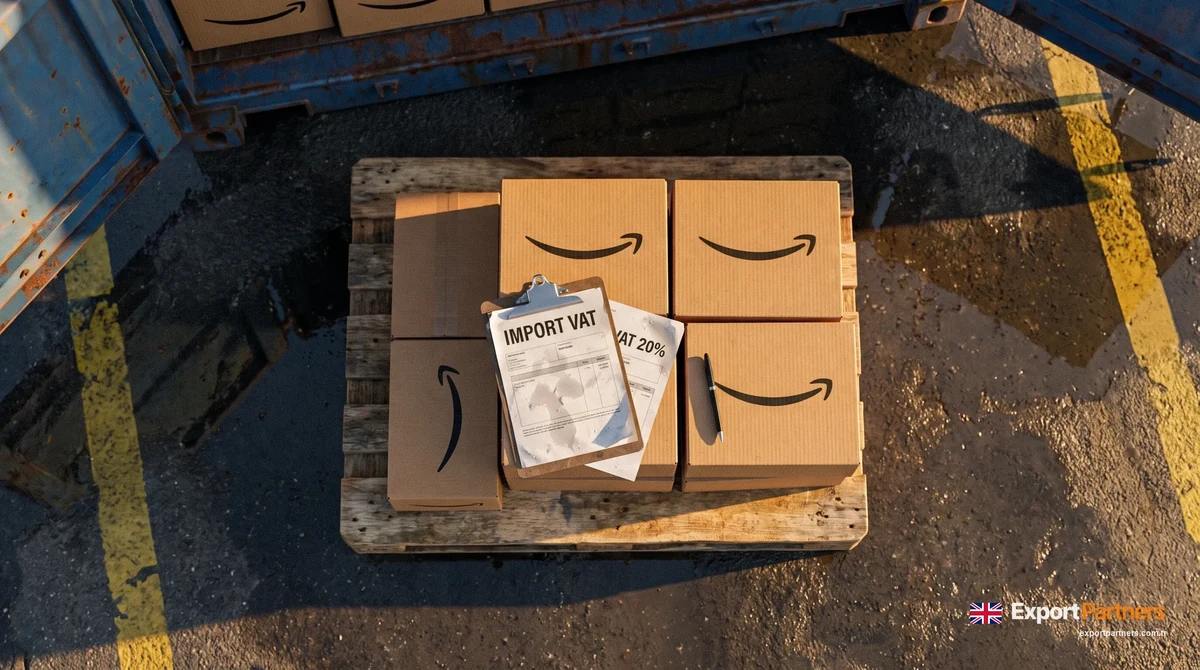
The UK applies three rates: a standard rate of 20 percent, a reduced rate of 5 percent and a zero rate. Most products fall under the standard rate. Some products, such as most food, children's clothing and books, are zero-rated; certain items such as domestic energy are charged at 5 percent. Which rate applies to your product should be checked product by product before pricing, since exceptions can exist even within the same category.
When is VAT registration required?
There are two separate rules here, and which one applies to you depends on whether the business is considered established in the UK.
- UK-established business: registration is required if VAT-taxable turnover exceeds 90,000 GBP over the last 12 months, or is expected to exceed it within the next 30 days alone. This threshold has applied since 1 April 2024; the deregistration threshold is 88,000 GBP.
- Non-established taxable person (NETP): there is no threshold. If you make a taxable supply in the UK, or expect to make one within the next 30 days, registration is required.
A common assumption is: "I set up a UK Ltd company, so now I can use the 90,000 GBP threshold." According to HMRC's own manual, a company being incorporated in the UK, or using a registered or virtual office there, does not by itself mean it is established in the UK. A UK company managed from another country is in many cases treated as an NETP, and the threshold does not apply to it. If the company is genuinely managed from within the UK, the situation may be different, so the decision should be made by looking at the company's structure.
Who pays VAT on Amazon UK?
Since 1 January 2021, the UK has applied an online marketplace rule. When goods belonging to an overseas seller are sold from UK stock through a marketplace such as Amazon, the marketplace calculates the VAT on the sale and pays it to HMRC. The same rule applies to imported consignments of up to 135 GBP. In practice, this means the 20 percent VAT on sales from FBA stock to UK consumers goes through Amazon's return, not yours.
This does not mean VAT registration is unnecessary. Import VAT and customs duty paid when bringing goods into the UK remain the seller's responsibility, and VAT registration is needed to recover import VAT. HMRC gives sellers who make such sales only through a marketplace a choice between registering and requesting exemption from registration; for most FBA sellers, registration tends to be the sensible option because it is the only way to recover import VAT.

Import VAT and customs duty
Import VAT of 20 percent is paid when goods enter the UK. The taxable amount is generally the customs value of the goods (including freight and insurance up to the UK border) plus customs duty. For example, if the customs value is 1,250 GBP and customs duty is 30 GBP, import VAT will be 256 GBP.
VAT-registered importers can use postponed VAT accounting to show import VAT on their VAT return as both a liability and a deduction at the same time, instead of paying it in cash at the border; this can make a meaningful difference to cash flow.
Customs duty depends on the product's tariff code. If your country has a free trade agreement with the UK, goods that meet the rules of origin and carry an origin declaration may qualify for preferential duty, which is zero for many industrial products. Without the origin declaration, goods may be taxed at the standard tariff rate. Confirm the origin statement on the invoice and the tariff code before shipment.
Direct sales under 135 GBP
Some sales go from your own website to UK consumers without a marketplace. If the consignment value is 135 GBP or less, VAT is collected at the point of sale rather than at the border. In that case the seller needs to register for VAT in the UK. Consignments over 135 GBP follow normal import rules. The threshold applies to each consignment, not to the order total.
VAT returns and digital records
VAT-registered businesses usually file a VAT return with HMRC every quarter. Returns are filed under Making Tax Digital through HMRC-compatible accounting software, and records have to be kept digitally. On the return, VAT charged on sales is offset against VAT paid on purchases and imports. The business then pays the difference or claims a refund.
Example: VAT and profit on one Amazon FBA product
A seller managed from outside the UK, registered for VAT as an NETP, sells one product from Amazon UK FBA stock:
| Item | Amount |
|---|---|
| Sale price (incl. VAT) | 120 GBP |
| VAT (20 percent), reported by Amazon | 20 GBP |
| Seller's revenue excl. VAT | 100 GBP |
| Product cost (at origin) | 30 GBP |
| Freight, insurance and customs | 10 GBP |
| Amazon referral and FBA fees | 25 GBP |
| Gross profit | 35 GBP |
Import VAT paid per unit (about 8 GBP in this example) can be reclaimed on the VAT return, so it is not added to cost. With postponed VAT accounting there is no cash outlay at all. These figures are an example. Referral and FBA fees vary by category and product size.
Frequently asked questions
What is the UK VAT threshold?
For UK-established businesses, the threshold is 90,000 GBP of taxable turnover over 12 months, and the deregistration threshold is 88,000 GBP. Non-established taxable persons have no threshold. They must register from their first taxable sale in the UK.
Can a UK company managed from abroad use the 90,000 GBP threshold?
In most cases, no. Being incorporated in the UK or using a UK address does not make a company established there on its own. If the company is managed from abroad, it may be treated as a non-established taxable person, and the threshold does not apply. What decides it is where the company is actually managed from.
Do I pay the VAT when selling on Amazon UK?
For sales made from UK stock, and for imported consignments up to 135 GBP, Amazon calculates and pays the VAT on behalf of an overseas seller. Import VAT and customs duty are still the seller's responsibility, and a VAT registration is needed to reclaim them.
Can import VAT be reclaimed?
A VAT-registered business can deduct the VAT it paid on imports on its VAT return. With postponed VAT accounting, no import VAT is paid in cash at the border. It appears on the same return as both a liability and a deduction.
Conclusion
In the UK VAT system, the first question is establishment, not the rate. For a seller managed from abroad there is often no threshold, and registration is required from the first sale. On Amazon sales the marketplace pays the VAT, but you still need a VAT registration to reclaim import VAT. Planning pricing, the tariff code and the origin declaration together before shipment helps avoid most unexpected costs.
At Export Partners, we handle UK company formation, VAT registration and the steps to selling on Amazon UK as one plan. For common questions on the company side, see UK company formation questions and answers. For market and logistics, see UK cross-border e-commerce guide for SMEs.
Last updated: October 17, 2026

