
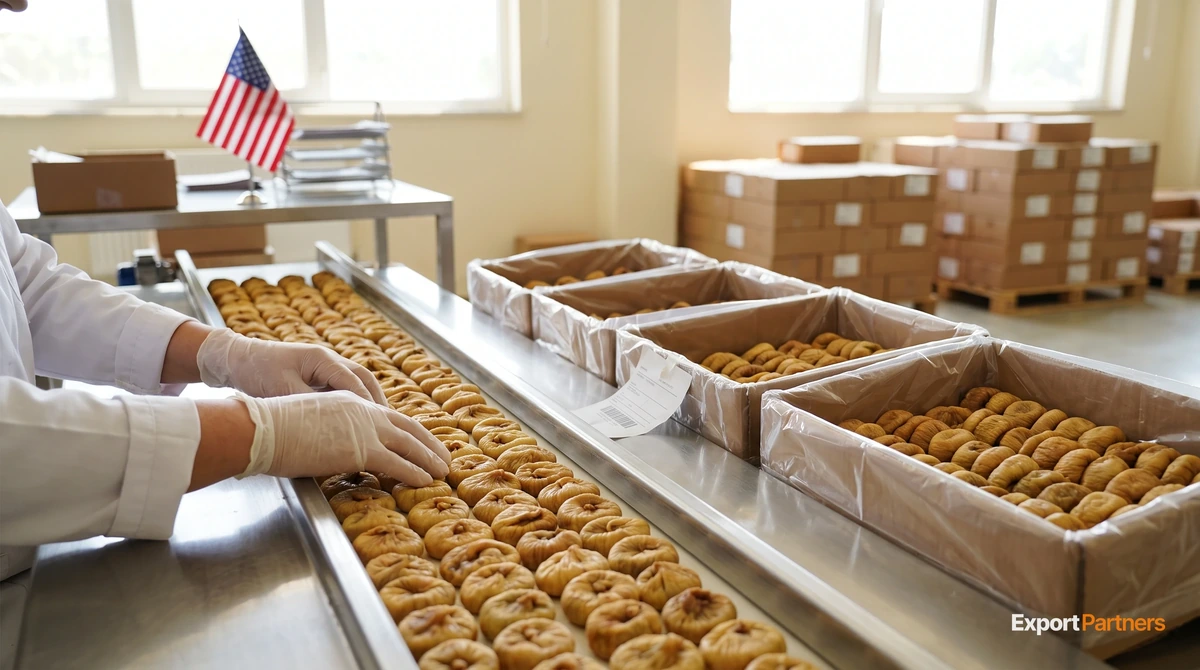
Dried figs are a product where established producing regions compete on quality more than on price. In the U.S., dried figs are sought both as a natural snack and as an ingredient for bakery and confectionery products. Competition happens less on price and more on quality and documentation: the buyer wants to see documented proof that the product is clean in terms of aflatoxin.
For dried figs, the most sensitive issue on the U.S. side is aflatoxin. The FDA applies an import alert under which dried fig shipments from certain firms can be detained without physical examination because of mycotoxins. This is why work on dried figs starts months before shipment, at the harvest and drying stage. In this article we outline the steps specific to dried figs in order; for the general framework for dried fruit, see our article on exporting dried fruit and nuts to the U.S.
The main risk in dried figs: aflatoxin
Aflatoxin is a toxin produced by certain mold species. Because figs ripen on the tree and are dried after they fall to the ground, humid weather and long waiting times can increase the risk of mold. Affected fruit often cannot be identified by eye, which is why sorting and analysis are carried out as separate steps.
The FDA's action level for total aflatoxin in human food is 20 ppb (20 parts per billion). This level is not a target but a threshold that should not be exceeded; some U.S. buyers may ask for lower values in their own specifications. Because the EU's limits for dried figs are stricter than those of the U.S., a facility producing to EU standards is generally in a comfortable position on the U.S. side.
Import Alert 23-14: the list works by firm name
The FDA's Import Alert 23-14 covers shipments of pistachios, figs, fig paste and peanuts because of mycotoxins (mainly aflatoxin). The list works by firm, not by country: when a listed firm's shipment arrives at a U.S. port, it can be detained without physical examination, and laboratory analysis is requested for its release.
If your firm is not on the list, your shipment is not caught by this mechanism; however, a single problematic lot can lead to a firm being added to the list. Removal from the list is possible, but it takes time because analysis results and a history of consecutive compliant shipments are required. It is worth checking the list on the FDA's own page before the first shipment.
Step 1: Harvest, drying and storage
Most aflatoxin forms in the field and during drying. This is why the first control point is in the orchard, not at the facility:
- Collecting fallen figs without long delays
- Drying on clean racks raised off the ground
- Checking the moisture of the dried product and keeping it in a cool, dry warehouse
- Keeping records of supplying orchards and lots (traceability)
Step 2: Sorting under UV light
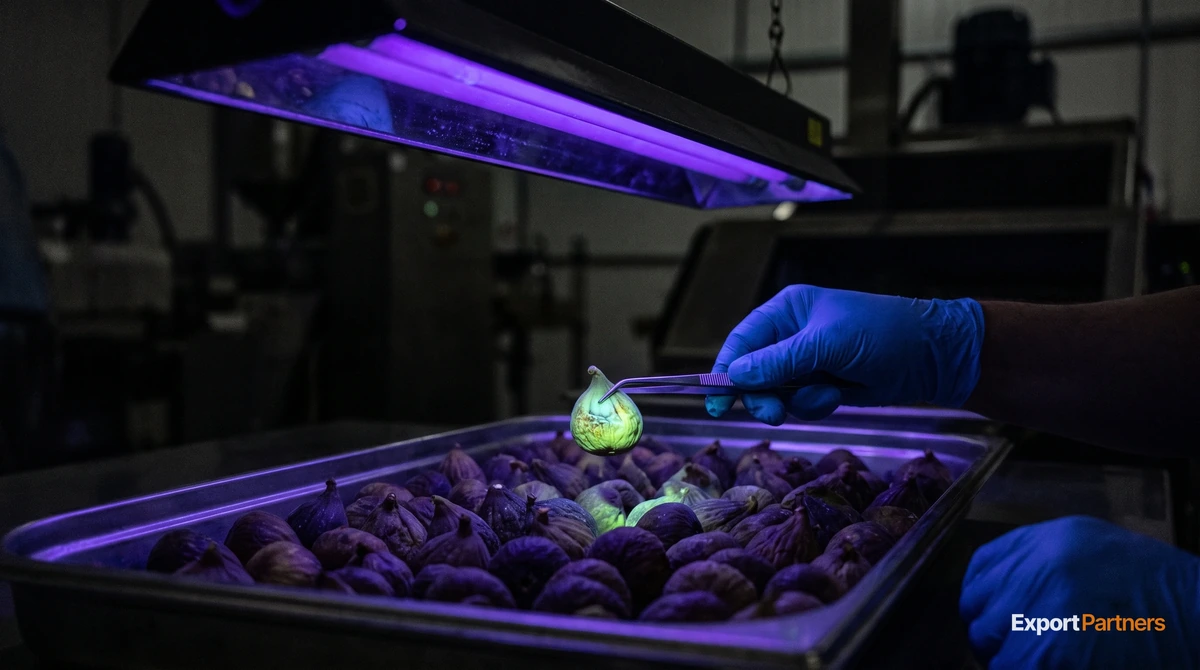
Facilities processing dried figs commonly use sorting under ultraviolet (UV) light to separate fruit that carries aflatoxin risk. Figs contaminated with certain molds give off a bright yellow-green fluorescence under UV light, and these fruits are removed from the line. The method alone does not provide a guarantee, but it can noticeably reduce the risk before analysis.
A short process description and photos of the line explaining how sorting is done strengthen the document file for the U.S. buyer.
Step 3: Lot-based laboratory analysis
It makes more sense to take a representative sample from each shipment lot and have total aflatoxin and aflatoxin B1 analyzed at an accredited laboratory. Because toxin distribution in dried figs is uneven, the sample size and the way it is taken directly affect the result; the sampling plan should be set up together with the laboratory.
The analysis report should match the lot number, and the lot code on the cartons should appear in the report. This match is needed both for the U.S. importer's document file and for a quick response in case of a detention.
Step 4: FDA facility registration and US Agent
A facility that processes, packs or stores dried figs needs to be registered with the FDA and to appoint a U.S. representative (US Agent). Registration is free and belongs to the facility; it is renewed between October and December in even-numbered years. Registration alone does not mean a shipment will clear without issues, but without it a shipment cannot start at all.
Step 5: Labeling
The retail package carries the product name (“Dried Figs”), net quantity (in both oz and g), the name and address of the manufacturer or distributor, an ingredient list and a U.S.-format Nutrition Facts panel. Even though dried figs are a single-ingredient product, the nutrition labeling exemption usually does not apply, because the product's calorie and sugar content is not insignificant.
If the product is sulfured or contains a preservative, this must be stated in the ingredient list; in the U.S., sulfites above a certain level must be declared. For bulk shipments, the carton label shows the product name, lot number, net weight and country of origin.
Step 6: Prior Notice and shipment
For every shipment, Prior Notice is submitted to the FDA before the goods arrive in the U.S. Under the Foreign Supplier Verification Program (FSVP), the U.S. importer may ask you for lab reports, a food safety plan and traceability records. When this file is ready at the first order, the process tends to move noticeably faster.
Shipment sequence
| Step | Step | When |
|---|---|---|
| 1 | Harvest, drying and storage controls | At the start of the season |
| 2 | UV sorting | During processing |
| 3 | Lot-by-lot aflatoxin testing | After packing, before shipment |
| 4 | FDA facility registration and US Agent | Before the first shipment |
| 5 | U.S.-format label | Before printing |
| 6 | Import Alert 23-14 check | Before every shipment |
| 7 | Prior Notice and FSVP document file | Every shipment |
Frequently asked questions
What is the aflatoxin limit for dried figs exported to the U.S.?
The FDA action level for total aflatoxins in human food is 20 ppb. Some U.S. buyers may require lower values in their own specifications.
Does Import Alert 23-14 cover all fig exporters?
No. The list works on a company basis; only shipments from firms named on the list can be detained without physical examination.
Is FDA registration enough for dried figs?
Registration is mandatory but not sufficient on its own. Lot-by-lot aflatoxin testing, a U.S.-format label and Prior Notice for every shipment are also required.
Does a dried fig package need a Nutrition Facts panel?
On retail packages it is usually required; the calorie and sugar content of dried figs is not at the insignificant level that qualifies for an exemption. The panel is prepared in U.S. format.
Conclusion
What matters most when exporting dried figs to the U.S. is how early aflatoxin control begins: proper picking and drying in the orchard, UV sorting at the facility and a lab report for every lot. On top of these come FDA facility registration, a U.S.-format label and Prior Notice for every shipment. Because the import alert works on a company basis and a single problem lot can affect later shipments, the testing and document file should be set up from day one.
For FDA registration, US Agent and label review, you can get information about our FDA registration and certification service.

