
Manufacturers who form a company in the U.S. and sell through Amazon or their own website often confuse two documents: the Sales Tax ID and the Resale Certificate. Both relate to sales tax and both work on a state-by-state basis, but one is a registration with the state tax agency, while the other is a declaration given to a supplier at the time of purchase.
This article explains the difference between the two documents, who issues each one, the rules in California, Texas, Florida and New York, and what is actually meant by a “resale certificate” on Amazon. Each rule was verified against the relevant state tax agency and Amazon’s own help pages.
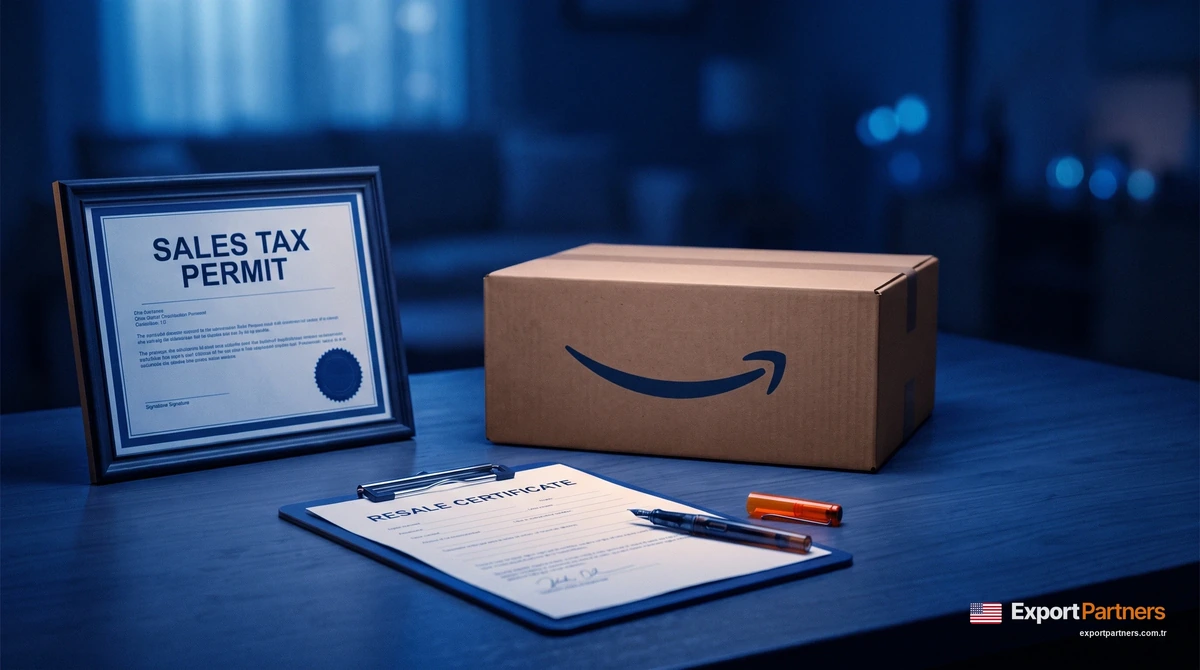
What is a Sales Tax ID?
A Sales Tax ID is the number showing that a business is registered with a state’s tax agency to collect and report sales tax in that state. The name varies by state: a seller’s permit in California, an 11-digit Sales and Use Tax Permit in Texas, a Certificate of Authority in New York, and a sales tax registration (dealer registration) in Florida.
The state issues this number. Registration is generally required in the state where taxable sales take place; whether it is required depends on physical presence (warehouse, office, inventory) and the economic nexus threshold.
What is a Resale Certificate?
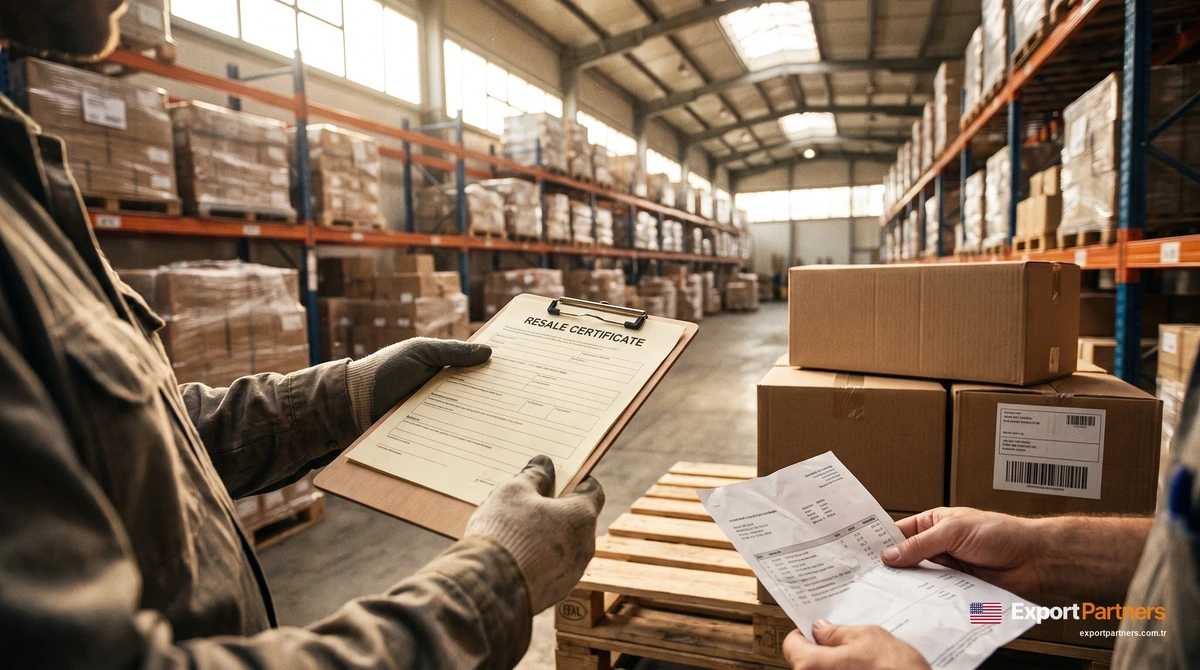
A Resale Certificate is a document in which the buyer declares to the supplier that the goods are being purchased for resale. Once the supplier receives this document, it does not collect sales tax on that sale; the tax is collected when the product is sold to the end consumer.
The key difference is this: in most states, the resale certificate is not issued by the tax agency but completed by the buyer and given to the supplier. California’s tax agency, the CDTFA, states this clearly: it does not issue resale certificates; the buyer completes form CDTFA-230 and gives it to the seller. Florida is the exception: there, the state itself issues the Annual Resale Certificate to registered dealers.
Sales Tax ID vs. Resale Certificate in one table
| Sales Tax ID | Resale Certificate | |
|---|---|---|
| Purpose | Registration to collect and report sales tax | Declaration to avoid paying sales tax on purchases for resale |
| Who issues it | State tax agency | The buyer in most states (the state in Florida) |
| Who receives it | Kept by the seller | Given to the supplier |
| How they connect | In most states, the buyer’s sales tax registration number is entered on the resale certificate | |
State-by-state rules: California, Texas, Florida, New York
California
Form CDTFA-230 asks for the buyer’s seller’s permit number. If the buyer is not required to hold a permit (for example, because it makes no sales in California), the reason is written on the certificate. The document has no expiration date; it remains valid until the buyer revokes it in writing. The certificate should include the phrase “for resale.”
Texas
The front of Form 01-339 is the resale certificate. The form has a field for the 11-digit Texas Sales and Use Tax Permit number, plus a separate field for an out-of-state registration number for buyers outside Texas. According to the Texas Comptroller’s FAQs, a photocopy of the permit number does not replace the certificate.
Florida
In Florida, the state issues a new Annual Resale Certificate each calendar year to sellers registered for sales tax, so the document is renewed every year. An out-of-state applicant with no permanent place of business in Florida and no retail sales in Florida is not granted registration solely for the purpose of tax-exempt purchases.
New York
A seller registered in New York obtains a Certificate of Authority and gives the supplier Form ST-120. Part 2 of Form ST-120 is for purchasers who are not registered in New York and are not required to register; these purchasers can enter a tax registration number from another state or country. Exemption certificates issued by other states are not valid in New York.
Is another state's certificate accepted? MTC and SST certificates
There are two common forms for businesses that buy from more than one state. The Multistate Tax Commission (MTC) Uniform Sales and Use Tax Resale Certificate is listed by more than 30 states; New York and Wyoming are not on the list. The MTC does not guarantee that every state will accept the form; responsibility for acceptance rests with the buyer and the seller.
The Streamlined Sales Tax (SST) Certificate of Exemption is accepted in all 24 SST member states (including Wyoming). If the buyer is not registered in that state, it can enter a sales tax number issued by another state.
Some states have their own requirements:
- Illinois: If the product is delivered to Illinois, an Illinois registration number is required. If the product will be resold and delivered to buyers outside Illinois, the state's Form CRT-61 provides a separate path for out-of-state purchasers.
- Pennsylvania: If the buyer does not have an 8-digit Pennsylvania license, the certificate must explain why it does not have one.
- Wyoming: Because Wyoming is an SST member, the SST certificate and another state's registration number can be used.
Because rules can vary by seller and by state, it is safer to ask the supplier which form it accepts before purchasing and to confirm with a tax professional.
Worked example: the tax difference on a wholesale purchase
A business registered in Texas buys 30,000 USD of products for resale from a distributor in California. California's statewide sales tax rate is 7.25%; with local taxes the rate can be higher.
- If no resale certificate is provided, the distributor adds sales tax: at least 2,175 USD, for a total payment of 32,175 USD.
- If a valid resale certificate is provided, the payment is 30,000 USD; sales tax is collected when the product is sold to the end consumer.
“Resale certificate” on Amazon: two separate situations
A search for “Amazon resale certificate” covers two different needs, and the two are often confused.
1. Sales tax when selling on Amazon: In states with marketplace facilitator laws, Amazon calculates, collects and remits sales tax on third-party sellers' sales. California, Texas, Florida, New York, Illinois, Pennsylvania, Arizona and Wyoming are among these states. In that case the seller does not need to collect tax separately on those sales; however, some states such as California require a registered seller to report total sales on its return and to keep records showing that Amazon paid the tax.
2. Tax-free purchases from Amazon (Amazon Tax Exemption Program, ATEP): A business that buys products from Amazon for resale enrolls in ATEP from its Amazon Business account settings and uploads its exemption document. The uploaded document must be a dated, signed exemption certificate whose business name and address match the account. Amazon does not accept sales tax permits, company formation documents or Form W-9 as exemption documents.
In other words, ATEP is not the seller accepting certificates on its own sales; it is the buyer making tax-free purchases from Amazon.
Economic nexus: at what sales volume is registration required?
Even without a physical presence, a remote seller that exceeds a certain sales volume may be required to register in that state:
- Texas: If revenue from Texas exceeds 500,000 USD in the past 12 months.
- California: If sales delivered into California exceed 500,000 USD in the previous or current calendar year.
- Florida: If taxable remote sales into Florida exceeded 100,000 USD in the previous calendar year.
- New York: If sales exceed both 500,000 USD and 100 deliveries in the last four quarters.
For a seller that sells only through Amazon, Amazon collects the tax on those sales, so the threshold calculation mostly matters for the seller's own website (such as Shopify) or its wholesale channel.
How does the sequence work with a U.S. company?
Sales tax registration comes after the company. First the company is formed and an EIN is obtained; then registration is completed in the state where sales tax arises and, if needed, resale certificates are provided to suppliers. The order and timelines of company formation are covered on the U.S. company formation page, the effect of state choice on sales tax in the which state to form a U.S. company in article, and tax ID numbers in the difference between EIN and ITIN article. Sales tax is separate from federal tax filing; the annual filing side is covered in the U.S. tax filing article.
Frequently asked questions
What is an Amazon resale certificate?
On Amazon, the term usually refers to the Amazon Tax Exemption Program (ATEP): a business that buys products from Amazon for resale uploads its exemption document and makes tax-free purchases. Sales tax on your sales as an Amazon seller is collected by Amazon in states where the law is in effect.
Does an Amazon FBA seller need to register for sales tax?
In states where Amazon collects sales tax, it is usually not required for Amazon sales alone. However, registration may be required for a seller that also sells through its own website or wholesale, or that keeps inventory or an office in a state; registering in a state creates a filing obligation there.
How do you get a resale certificate in Florida?
In Florida, you first register for sales tax; Florida then issues registered dealers a new Annual Resale Certificate for each calendar year. An out-of-state applicant with no place of business in Florida and no retail sales there is not registered solely to make tax-exempt purchases.
Does a resale certificate expire?
It depends on the state. In California, it stays valid until it is revoked in writing; in Florida, it is renewed every calendar year. In New York, a blanket certificate stays valid as long as exempt purchases from the same supplier continue.
Does a resale certificate remove sales tax entirely?
No. The certificate only defers the tax on purchases made for resale; sales tax is collected when the product is sold to the end consumer. If you buy a product for your own use, you cannot use a resale certificate.
Conclusion
A Sales Tax ID is a registration with the state tax agency and shows the obligation to collect and report sales tax; a resale certificate is a statement given to the supplier when buying for resale, and in most states it is filled out by the buyer. On Amazon, Amazon collects sales tax in most cases; for sellers who sell through their own website, sell wholesale or hold inventory in the U.S., registration and documentation become more important.
If you would like support with U.S. company formation, sales tax registration and resale certificates, you can contact us through our U.S. company formation page.
This article is for general information only; rules can vary by state and transaction, so please confirm your own situation with a tax professional.
Sources: CDTFA Publication 103, Texas Comptroller, New York DTF, Multistate Tax Commission, Streamlined Sales Tax.
Last updated: October 17, 2026

