A U.S. tax filing service helps an entrepreneur who owns a U.S. company and sells through Amazon or their own website prepare the annual IRS filings on the right forms, by the right dates and in line with their sales data. For a seller who lives outside the U.S. and has formed a U.S. LLC, the process is more than a single form: the company's own filing and the owner's personal return are handled separately.
This article explains which forms are filed for each company structure, the deadlines, why Form 5472 should not be skipped and how Amazon reports carry over into the return. Forms and dates were verified against the IRS's own instructions.
Which year's return is filed, and when?
For most U.S. companies, the tax year is the calendar year. Activity from January 1 to December 31, 2025 is reported in 2026, and the 2026 tax year is reported in 2027. So the "2026 filing season" refers to sales and expenses from 2025.
Forms filed by company structure
| Company structure | Company filing | Deadline (calendar year) |
|---|---|---|
| Single-member LLC, owner lives outside the U.S. | Pro forma Form 1120 with Form 5472 attached | April 15; extendable to October 15 with Form 7004 |
| Multi-member LLC (partnership) | Form 1065 and K-1s to partners; additional forms if there is a foreign partner | March 15 |
| Corporation (C-Corp) | Form 1120, federal corporate income tax on company profit (21 percent) | April 15 |
The owner's personal return is assessed separately: a nonresident individual files a personal return on Form 1040-NR. For a nonresident without wages subject to withholding, the 1040-NR deadline is June 15.
Form 5472 and pro forma 1120 for a single-member LLC
Most sellers based outside the U.S. operate through a single-member LLC. For tax purposes this structure is treated as a "disregarded entity": the company has no corporate income tax return of its own, and profit passes through to the owner. That does not mean no filing is made on the company's behalf.
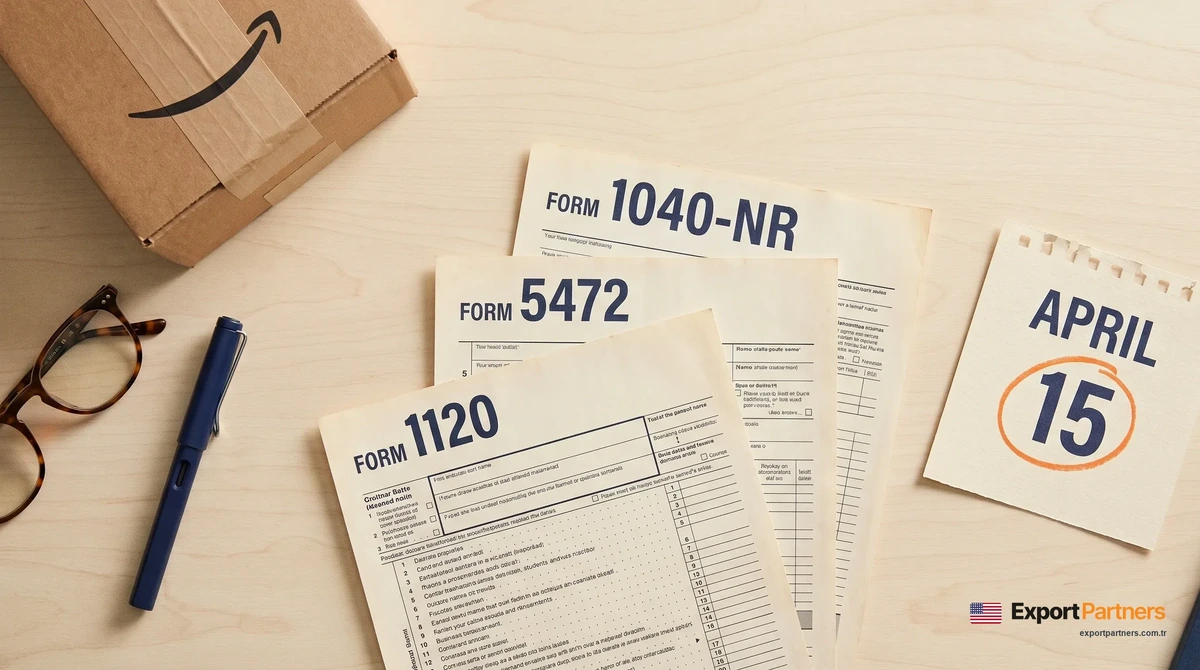
Under the IRS instructions for Form 5472, a foreign-owned U.S. disregarded entity files a pro forma Form 1120 with Form 5472 attached. Here the 1120 is not used to calculate tax but to carry Form 5472; only the name, address and a few information lines are completed. Form 5472 reports reportable transactions between the company and its owner, such as capital contributions, payments from the company to the owner or expenses the owner pays on the company's behalf. In practice, almost every active LLC has such transactions.
- Deadline: April 15. It can be extended by six months to October 15 with Form 7004; "Foreign-owned U.S. DE" is written at the top of the 7004.
- Submission: Form 5472 cannot be e-filed; it is sent to the fax number specified by the IRS or by mail to the Ogden, Utah address.
- Penalty: 25,000 USD for each Form 5472 that is not filed or is filed incomplete. If not corrected within 90 days of IRS notice, an additional 25,000 USD is added for each 30-day period.
Even if the company had no sales, this filing is made when there are reportable transactions. The "no income, no filing" rule may apply to U.S. residents; it does not apply to a foreign-owned LLC.
Personal return: Form 1040-NR and Schedule C
Because the LLC's profit passes through to the owner for tax purposes, the owner's personal situation is assessed separately. If a nonresident has U.S.-source income that is effectively connected with a U.S. trade or business, the return is filed on Form 1040-NR; business income and expenses are calculated on Schedule C and carried to the 1040-NR.
Whether income counts as effectively connected with a U.S. trade or business varies from person to person, depending on where inventory, employees and activity are located and on any income tax treaty between the seller's country of residence and the U.S. This assessment is made with a tax professional before filing; whether the same seller needs a 1040-NR depends on the outcome.
How do Amazon reports carry over into the return?
For an Amazon seller, the main source of income and expense data is Seller Central reports. Preparation starts with downloading the right reports for the right date range:
- Reports → Payments → Date Range Reports, Summary: With the date range set to 01/01/2025 to 12/31/2025, it summarizes annual gross sales, the fees Amazon deducted and the net payout. The total sales figure on the return comes from the gross sales in this report.
- Reports → Report Repository: Raw data by order and transaction; the strongest support if a review question comes up.
- Payments / Balance panel: Shows the payouts from Amazon to your bank account; used for reconciling against bank activity.
- Form 1099-K: Amazon issues it by the end of January at the latest; the gross amount on the form should be consistent with the income on the return.

Income and expense items
On the income side are sales made through Amazon and other channels. On the expense side, the usual items are Amazon referral fees and FBA fees, advertising (PPC) spend, product cost and logistics, and software and service expenses. Expenses need to be documented and business related; bookkeeping (connecting the bank account to a program such as QuickBooks or Xero) makes the return both easier and faster.
Situations that cause problems in practice
In practice, most situations that lead to review questions come from data that does not match:
- An unexplained difference between the gross sales on the Amazon summary report or the 1099-K and the income on the return.
- Reporting a zero or very low result in a year with regular payouts.
- Reporting most of the income as expenses, especially a disproportionately large "other expenses" or professional fees line.
- A form that does not fit the company structure: skipping Form 5472 for a single-member foreign-owned LLC, or filing Form 1065 for a single-member structure.
- Not keeping Amazon reports and bank statements.
Annual tax calendar
| Date | What happens |
|---|---|
| From January 1 | Prior-year expense records and bank statements are collected |
| End of January | Amazon Form 1099-K and annual reports are available |
| March 15 | Partnership (Form 1065) deadline |
| April 15 | Deadline for single-member foreign-owned LLCs (pro forma 1120 + 5472) and corporations (1120); Form 7004 for an extension |
| June 15 | Form 1040-NR deadline for nonresidents without wages subject to withholding |
| October 15 | Deadline for 1120 and 5472 extended with Form 7004 |
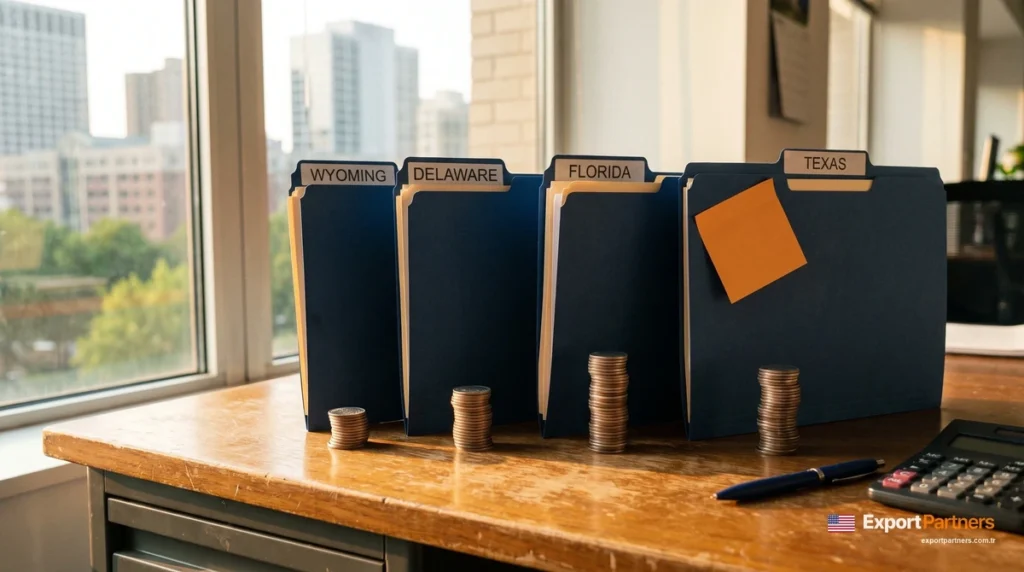
State-level annual reports and taxes (Wyoming annual report, Delaware annual LLC tax, Florida annual report) are separate from the federal return; amounts by state are in our article cost of forming an LLC in the U.S. The video series in which we discuss with Tax Accountant Gökhan Çıkılı how the company type changes the return is on the U.S. company formation page; tax ID numbers are covered in EIN vs. ITIN. Sales tax is a state obligation separate from the federal return; details are in Sales Tax ID and Resale Certificate.
Frequently asked questions
What does the U.S. tax filing service cover?
Identifying the company structure, collecting Amazon and bank data, classifying income and expenses, preparing the company's filing (pro forma 1120 and Form 5472 for a single-member foreign-owned LLC, 1065 for a partnership) and, if required, the owner's Form 1040-NR, and submitting them to the IRS.
My company had no sales. Do I still need to file?
For a single-member LLC whose owner lives outside the U.S., a pro forma 1120 and Form 5472 are filed if there is a reportable transaction between the company and its owner, such as a capital contribution or a payment. Failing to file may result in a penalty of 25,000 USD per form.
Is tax paid in the U.S. on Amazon sales?
In most states, Amazon collects sales tax. Income tax depends on the company structure and on whether the income is treated as effectively connected with a U.S. trade or business; this assessment is made before filing.
What happens if I miss the deadline?
If an extension is requested with Form 7004 before April 15, the deadline for 1120 and Form 5472 moves to October 15. For a Form 5472 filed late without an extension, or not filed at all, the penalty starts at 25,000 USD; filing as soon as the situation is noticed helps keep the penalty from growing.
When should I start preparing my tax return?
In January. Expense records can be collected as soon as the year ends; Amazon's Form 1099-K and annual reports are available at the end of January. Since the deadline is March 15 for partnerships and April 15 for single-member LLCs, February is a good time to start.
Conclusion
For a non-U.S. seller with a U.S. LLC, the annual filing has two parts: the company's own filing (pro forma 1120 and Form 5472 for a single-member foreign-owned LLC) and, if required, the owner's Form 1040-NR. Deadlines are March 15, April 15 and June 15 depending on the company structure; skipping Form 5472 is the most expensive mistake.
To prepare your annual return on time and consistent with your Amazon data, you can contact us; company formation and the tax side together are on the U.S. company formation page.
This article is for general information only; please confirm your own situation with a tax professional.
Sources: IRS Form 5472 instructions, IRS Form 1120 instructions, IRS Form 7004 instructions, IRS Form 1040-NR instructions, IRS Form 1065 instructions.
Last updated: October 17, 2026