
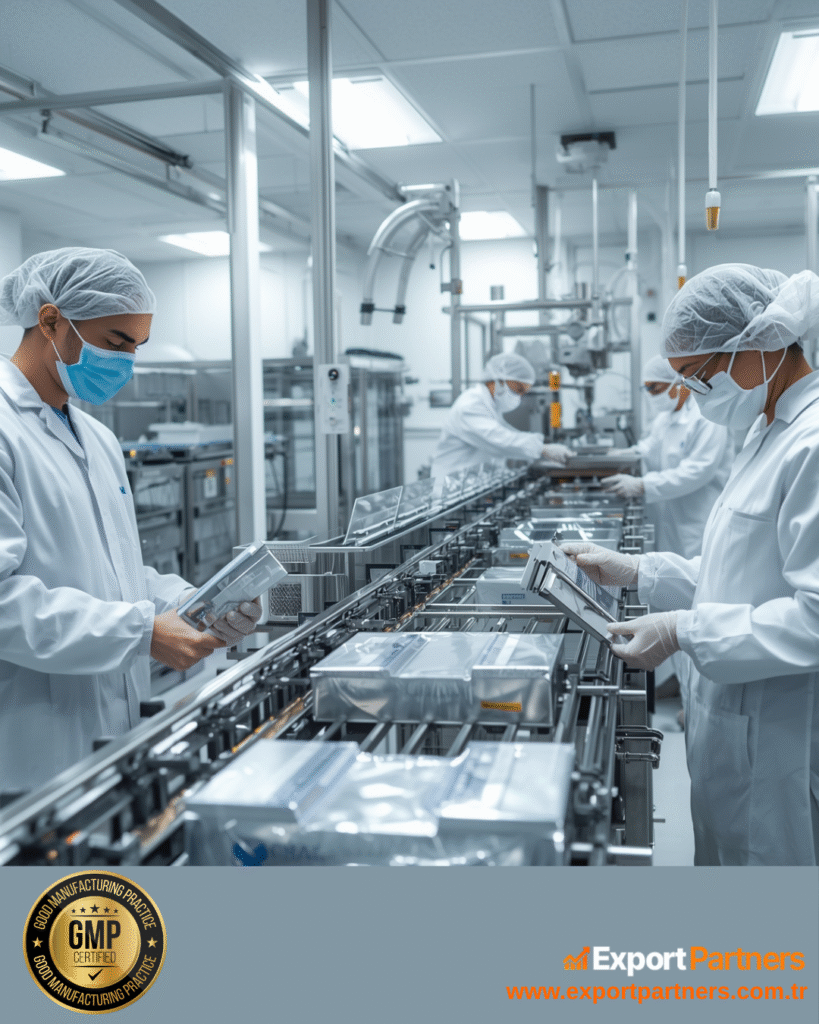
GMP (Good Manufacturing Practices) is an international quality system that helps ensure production takes place under safe, hygienic and traceable conditions in sectors that directly affect human health, led by food and pharmaceuticals and including cosmetics, medical devices and veterinary products, where manufacturers often ask how to obtain a GMP certificate.
For manufacturers that want to export to the European Union and the United States in particular, a GMP certificate is one of the core requirements for market entry. It is more than a certificate; it is a mark of trust showing that the company's production processes meet international standards.
1. What Does a GMP Certificate Do?
GMP is a system in which every stage of production is recorded, controlled and made traceable.
It covers every process from the receipt of raw materials until the product reaches the end consumer.
With a GMP certificate, a manufacturer formally documents not only that it makes quality products, but that it can deliver that quality consistently.
2. Which Products Require It?
In Europe, importers and distributors often require a GMP certificate for the following product groups:
- Dietary supplements (herbal capsules, vitamins, minerals)
- Sports nutrition products such as protein powder, collagen and amino acids
- Functional beverages (supplement drinks, energy shots)
- Baby food and products for medical purposes
- Plant-based specialty foods and liquid extracts
Importers look not only at product quality but also at how safely the production process is run. A GMP certificate is one of the most important tools for building that trust.
3. What Is the Difference Between GMP and HACCP?
HACCP is a system for analyzing and controlling food safety risks. GMP, on the other hand, ensures that the entire production process is run in an orderly and hygienic way.
HACCP is generally focused on food safety, while GMP covers both the production process and quality management.
That is why companies in Europe often ask for both certificates together.
4. How Do You Get a GMP Certificate, and How Does the Process Work?
The GMP process requires technical knowledge, document preparation and solid organization.
Companies that try to manage this process on their own often run into gaps during certification.
At Export Partners, we provide end-to-end support to manufacturers that want to obtain a GMP certificate.
- We carry out an initial pre-assessment of your facility.
We review your current production setup and report the gaps in terms of GMP compliance. - We prepare the technical documentation.
We create documents such as procedures, hygiene plans, production records and quality forms on your behalf. - We organize staff training.
We arrange GMP training for your production and quality control personnel. - We manage the process together with our partner accredited certification bodies.
The application, audit scheduling and follow-up are fully coordinated by our team. - We prepare your export files for Europe.
We prepare the documents needed for export, such as technical files, label translations and analysis reports.
Through this process, your company establishes an internal quality system and becomes ready to export to Europe.
Benefits of a GMP Certificate
- Opens the door to the European and U.S. markets
- Builds customer trust and strengthens brand value
- Gives your company a structured system for hygiene and quality
- Reduces the risk of problems during inspections
- Can be a prerequisite for certain incentive and support programs
Frequently Asked Questions (FAQ)
Is a GMP certificate required to sell supplements in Europe?
A GMP (Good Manufacturing Practices) certificate is not always a legal requirement, but many buyers in Europe set it as a condition. In dietary supplements, functional beverages and products for special purposes in particular, manufacturers without a GMP certificate may be eliminated when requesting quotes or negotiating distributor agreements. For this reason, GMP is no longer just a competitive advantage in exporting; it has become a prerequisite.
Do I need to change my production facility to get a GMP certificate?
No, in most cases you do not need to replace your production line entirely. However, some areas may need adjustments, record-keeping systems may need to be set up, hygiene plans implemented and procedures documented. At Export Partners, we build a roadmap specific to your current facility so that you make only the improvements that are needed.
Are other documents needed after obtaining a GMP certificate?
Yes, GMP alone may not be enough for exporting to Europe. Depending on the product, additional documents such as HACCP, ISO 22000, product analysis reports, label compliance and translated technical files may be requested. At Export Partners, we organize all of these processes under one roof and keep you informed about document combinations and European market expectations.
How many years is a GMP certificate valid?
It is generally valid for 3 years. However, it must be kept current through annual surveillance audits.
Will my operations stop during the certification process?
No. The process is planned without disrupting your production. Revisions are generally carried out in line with your production schedule.
5. Why Work With Us?
At Export Partners, we treat the GMP process not just as document preparation but as a building block of your brand's export strategy.
Our goal is to help the manufacturers we work with become respected and trusted brands both in their home markets and abroad.
Our support is not limited to certification; our expert team also provides service across many areas, including export strategy, label compliance, logistics and incentive applications.
Conclusion: A Safer Path to Europe With GMP Certification
GMP is no longer just a competitive advantage; it has become a system that export markets expect.
For companies that want to sell supplements, functional foods or special-purpose products in Europe, holding this certificate directly affects the acceptability and credibility of their products.
At Export Partners, we organize the entire process on your behalf and offer turnkey solutions from production to labeling.
Contact us to apply for GMP certification and have your production infrastructure assessed.

