
What Is Amazon PPC and Why Does It Matter?
What is Amazon PPC, how does the system work, and where does the budget go? We start with the basics.
Amazon PPC, or pay-per-click, is an advertising model that helps sellers become more visible. Advertisers pay only when someone clicks the ad, which makes it a budget-friendly, performance-based model. Our article Selling Food Supplements on Amazon UK in 2026 also covers this topic.
Sponsored Products:
Helps individual products appear higher in search results
Sponsored Brands:
Places your brand name and logo, and with them your brand awareness, at the top of the results
Sponsored Display:
Lets you show your ad to shoppers at different points along their shopping journey
2. Budget Planning by Campaign Type
Budget allocation that fits your strategy
When you create a campaign, the budget should follow the goal. The table below shows common campaign types and suggested daily budgets:
| Campaign Type | Goal | Suggested Budget (Daily) |
| Sponsored Products | Individual product sales | 10-30 USD |
| Sponsored Brands | Brand awareness and product range | 20-50 USD |
| Sponsored Display | Remarketing, cross-selling | 15-40 USD |
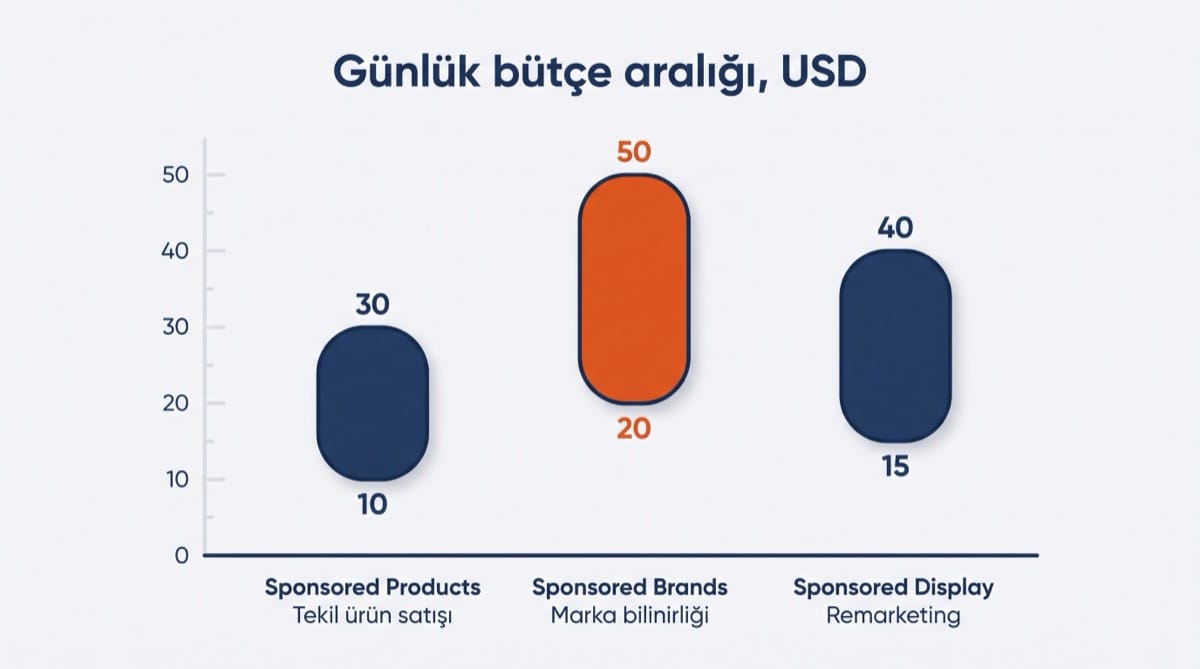
The right campaign type, the right conversion
Not every campaign type delivers the same conversion. For a new product launch, starting with Sponsored Products tends to work better. If you are in the brand-growth stage, Sponsored Brands may be more efficient.
Why Is Amazon PPC So Effective?
Shoppers already come to Amazon with the intent to buy, so compared with platforms such as Google and Facebook, engagement may be lower but conversion is often much higher. That is why Amazon PPC offers more than visibility: it offers sales potential at the right conversion rate. Our Amazon Private Label Starter Guide takes this topic one step further.
Its impact shows most clearly on product listings
An unoptimized page can waste your ad budget
Many sellers focus only on getting the ad to run and overlook the product page itself. When a shopper clicks your ad but does not buy on that page, the cost of that click is lost.
To learn more about these methods and to work with an experienced team on Amazon and cross-border e-commerce service, we would be glad to hear from you.
Listing integration
Amazon PPC success depends on the shopper finding on the product page what your ad promised; otherwise you may end up in the "high clicks, low conversion" trap. You can also read our article What Is Amazon SPN? What Are Its Benefits?, which covers this in more detail.
Use Automatic and Manual Campaigns Wisely with Amazon PPC
Discover with automatic campaigns
For beginners, an automatic campaign is a practical way to see which searches drive revenue. Amazon matches the ads to relevant target keywords on its own.
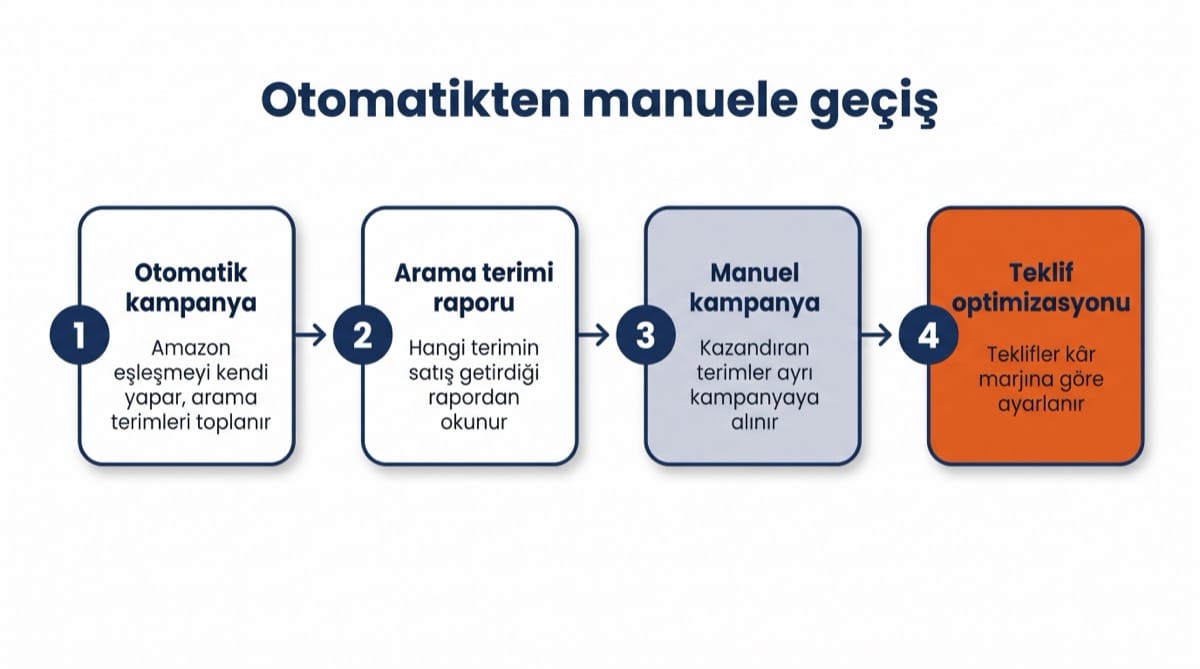
Benefits of Automatic Campaigns
Discovery of new core [keywords]
Visibility in places competitors may overlook
Time savings
When to switch to a manual campaign
Once data has been collected, high-performing terms are moved into a manual campaign. With a higher cost-per-click bid on those terms, return on investment can improve and Amazon PPC is optimized step by step.
Read the market through competitor analysis.
Analyze your competitors and shape your strategy accordingly. This can become one of your biggest opportunities going forward. One of the core principles of a successful Amazon PPC strategy is to look closely at the competitors who are already doing well in your category. It helps you develop original ideas for your own ads and refine them further.
5. Measuring and Interpreting Ad Performance
Growth requires tracking your KPIs
Treating your ads as "launched and done" is a costly mistake. The table below shows the core metrics you should track:
| Metric | Explanation |
| ACoS | Ad spend as a share of sales |
| CTR | Click-through rate per impression |
| CVR | Purchase rate after a click |
| ROAS | Revenue per ad dollar spent |
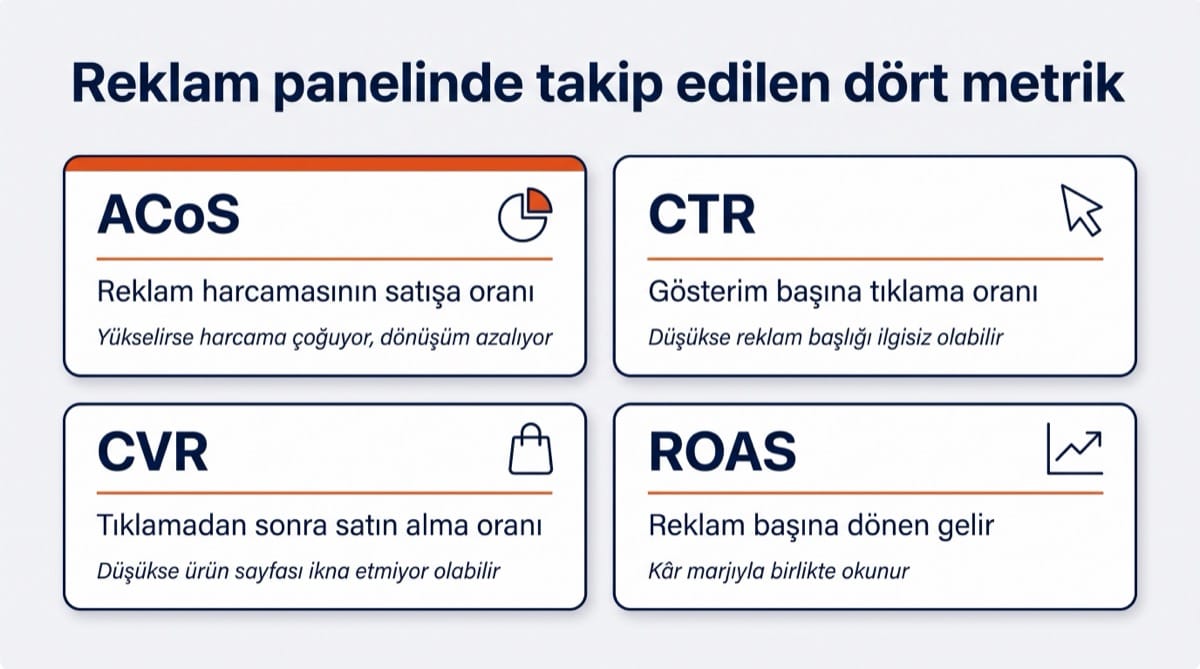
Interpreting the numbers is critical
For example, a low CTR may mean your ad headline is not relevant enough. A low CVR can indicate that your product page is not persuasive. A rising ACoS suggests the ad is spending more while converting less. Acting on this data can help your Amazon PPC performance improve faster.
Amazon PPC tools you can use:
Amazon Advertising Console: Amazon can show some of the keywords your competitors are using and can help you decide which keywords deserve more focus.
Third-party tools: Many Amazon PPC tools have been developed. Some of them can show which products competitors are advertising successfully or which keywords they are focusing on.
Build your strategy around the areas where competitors are strong.
After analyzing competitors, you can build your strategy using what you have learned from them. For example, if some competitors have weak images or descriptions, you can offer better content and turn that gap into an opportunity. Likewise, by identifying the keywords where competitors perform well, you may be able to increase your own clicks and sales.
Advanced bidding strategies for Amazon PPC
Start using manual bids instead of automatic bids. Automatic bids are often used to launch a campaign, but over time you will need manual bids to optimize it. Manual bids work based on the maximum cost per click you are willing to pay.
More control, higher conversion.
By assigning a bid and budget to each keyword, you can make better use of the conversion performance of every keyword and achieve a higher ROI. This is one of the key features that lets you tailor Amazon PPC to your business.
Expert view: how can you strengthen your Amazon PPC?
Over the years I have built Amazon PPC advertising strategies for businesses across many different industries. The foundation of good advertising is accurate targeting and the capacity for continuous analysis. The main principles I use in client projects are described below, and we would be glad to see you on our website, where we present these export models globally.
Know the right target audience.
Every product appeals to specific audiences. Reaching the right people at the right time not only helps you meet your campaign goals but also improves your efficiency.
Continuous improvement: By monitoring and optimizing your ads on an ongoing basis, you can sustain strong performance.
Make data-driven decisions. Even a well-designed ad needs a strategy behind it. By analyzing data from past campaigns, you can take the right steps where the margin between success and failure is thin.
Final Assessment and Practical Guidance:
Make your current advertising strategy better. To run effective Amazon PPC campaigns, review and optimize your existing strategies regularly. Analyze your campaigns, make sure you are using the right keywords for your audience, and manage your budget carefully. Amazon PPC is a pay-per-click advertising model: if no one clicks your ad, you do not pay.
Frequently Asked Questions
- What is Amazon PPC?
Amazon PPC is a pay-per-click advertising model. Sellers pay only when a customer clicks on the ad. - How long do Amazon PPC campaigns take to show results?
It depends on the campaign type and your goals, but performance can usually be observed within 1-2 weeks. - How should I set my advertising budget?
You can start with a low budget and increase it as you analyze the data. - Which campaign type should I choose?
Choose campaign types based on your goal. Sponsored Products works well for new products, while Sponsored Brands is better suited to brand awareness. - Why might ad campaigns be inefficient?
Weak product listings, inaccurate targeting or low bids can lead to inefficient results. - How does bidding work in Amazon PPC?
You can set your bids manually or automatically. Manual bids let you set the maximum cost per click for each keyword. - How important is competitor analysis?
Reviewing competitors' advertising strategies helps you discover your strengths and new opportunities. - How long should campaigns stay active?
It is important to monitor and optimize your ads on an ongoing basis. You can keep seasonal campaigns short, while always-on campaigns may need to run longer. - How can Amazon PPC increase sales?
Accurate targeting, well-optimized product pages and competitive bids can help you grow your sales. - What are common reasons Amazon PPC campaigns underperform?
Weak budget management, poor keyword selection and underdeveloped product page design are common reasons campaigns underperform.

